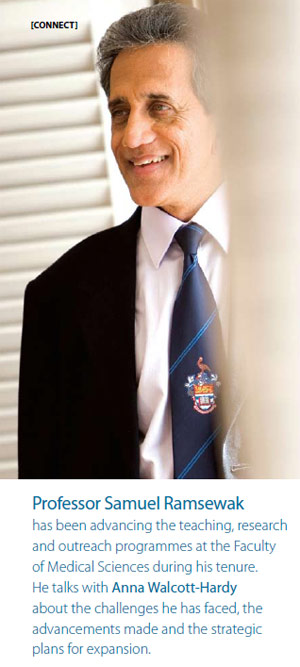
 The UWI Medical Faculty is highly respected, no doubt, and over the years there have been many advancements, but there have also been some fundamental challenges. Can you tell us about them? The UWI Medical Faculty is highly respected, no doubt, and over the years there have been many advancements, but there have also been some fundamental challenges. Can you tell us about them?
When I took over the Deanship of the Faculty, much advancement had already been made, but significant challenges remained, which I addressed to the Faculty Board at the first meeting. These included the need to be student focused, the issues of infrastructure demands for students’ support, as well as our relationship with stakeholders, in particular the Regional Health Authorities, the Ministry of Tertiary Education and Skills Training, our line Ministry, and the Ministry of Health. Additionally, there was a need for a concerted response to the demands for additional post-graduate training. Finally, we would be the subject of accreditation visits by the Accreditation Authority of Trinidad and Tobago, as well as the Caribbean Accreditation Authority for Medicine and Other Health Professions. So you can appreciate, there was a lot to be done!
Yes, definitely. What grade would you give the Faculty ?
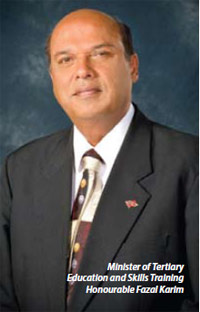
Happily, I can say that our report card shows a positive grade, since these areas have been well addressed. For example, having expanded clinical teaching to San Fernando, we were able to provide, with the great support of the South West Regional Health Authority and the Ministry of Health, a three-storey building on the compound of the San Fernando General Hospital which was refurbished as students’ accommodation and teaching facility. This was a huge success, since on-call students can feel very comfortable and safe to access the hospital at nights. A students’ recreation and study building is in the final month of construction and will provide much-needed mental and physical relaxation on site in Mt Hope. Students have been provided with a dedicated 24-hour study-area in the medical library, so that they do not have to leave the library at late hours of the night and undertake risks to their security and safety. The nursing school is being expanded with the near completion of the refurbishment of a three-storey building in El Dorado as part of the Nursing Academy, which has been the brainchild of the Minister of Tertiary Education andSkills Training, Honourable Fazal Karim, with the mission of responding to the shortage of trained nurses in Trinidad and Tobago. The Dental School has had approval for expansion and the Campus Projects Office has developed the plans and tenders have been invited. The Caribbean Accreditation Authority for Medicine and other Health Professions (CAAM-HP) has granted an extension of accreditation to the School of Medicine for five years, the first time this duration has been awarded to a Medical School in the Region, and extensions of accreditation to the Schools of Veterinary Medicine and Dentistry, and these have been granted without the need for site visits for two years and one year respectively. Furthermore, the Faculty has been pleased to note that collaboration with the Regional Health Authorities has progressed to the point where Memoranda of Understanding were signed with all RHAs in Trinidad, in 2012. This is a critical association as it augurs well for further strengthening of ties and cooperation, which I hold as the cornerstone of successful training of our students and of UWI faculty, providing much needed service to the patients of the RHAs.
Why is it so difficult to gain admission to the Medical School?
As you know, The UWI was launched in 1948 as a medical school in Mona, Jamaica, and the progress of medical training and research over the past 63 years have been nothing short of remarkable. There are now three full faculties in Jamaica, T&T and Barbados, as well as a clinical training programme in the Bahamas. The quality of our graduates is beyond question, which is also supported by our ongoing accreditation. Furthermore, our graduates move ahead to fill major positions in health facilities all over the globe and there have been many areas of research in which The UWI has been an innovator, either independently or in collaboration with research institutions elsewhere.
 Students in the Caribbean, and particularly in Trinidad and Tobago are well known to excel in CAPE examinations and they have also been focused in co-curricular activities in order to demonstrate social awareness and excellence in other skills, so that they easily fulfill the criteria for selection. Students in the Caribbean, and particularly in Trinidad and Tobago are well known to excel in CAPE examinations and they have also been focused in co-curricular activities in order to demonstrate social awareness and excellence in other skills, so that they easily fulfill the criteria for selection.
Our facilities are limited so that the limit for numbers to be admitted gets saturated rapidly and some students have to be given guaranteed placement for the subsequent year. We have to resist the temptation of admitting excessive numbers because we are mindful of not compromising quality of education.
However, the Faculty of Medical Sciences has been successful in receiving a substantial grant from the Inter-American Development Bank for a consultancy on expansion of the Faculty in the short term, as well as to develop a five-year business plan. The process of awarding the consultancy has been completed and the Central Tenders Board is currently finalizing the award on behalf of the Ministry of Public Administration.
Tell us about the new programmes being introduced in 2013?
I am so pleased to see that members of my faculty have responded with vigour to the call for new programmes. Some of these which have been developed during my tenure are:
- Doctor of Medicine (Postgraduate DM) in Surgery, Otorhinolaryngology (Ear, Nose and Throat), Ophthalmology, Cardiology
- Master of Public Health (in conjunction with University of Alabama, Birmingham)
- MPhil or PhD in Pathology (Anatomical Pathology, Chemical Pathology, Haematology, Immunology and Microbiology)
- Master of Science in Health Service Management
Furthermore, we have developed the BSc Nursing as a first degree, BSc Dental Hygiene and Dental Therapy, the Diploma in HIV Management. In 2013, we will launch the Masters Programme in Forensic Sciences, in conjunction with the University of Central Lancashire, (UK), so that we can meet the need for professional training in Criminal Scene Investigation, which is a need all over the region.
It seems well-targeted, but what of the dire need for more nurses and doctors in our hospitals and health care institutions?
As you can imagine, this is a need which we have really tried to address and I believe the success of our efforts will soon be evident.
Can you tell me about your outreach activities?
One of the social responsibilities of the faculty is dissemination of relevant research and we work hard at that by holding our faculty out to the public in the form of inaugural professorial lectures and a number of articles which we contribute to the UWI STAN magazine and UWI Today newspaper.
 You spoke of The UWI having Campuses across the Caribbean. What do you think are the benefits of being a regional institution? You spoke of The UWI having Campuses across the Caribbean. What do you think are the benefits of being a regional institution?
We benefit from the strengths of each other in terms of quality controls and size. For example, we are able to have common admissions criteria, common courses and common examinations, in which colleagues from each Campus will work together in curriculum planning and examinations, we do have an all-encompassing University Medical Curriculum Committee, as well as a vibrant Committee of Medical Deans. As a regional university we have been able to launch a cross-Caribbean response to the HIV/AIDS epidemic and to come together for grant-seeking because, as a group, our resources can match many of the largest and well known universities in the world.
We are proud of our progress, both as individual faculties, and well, as a family of professionals, and we look forward to serving the peoples of the Caribbean in the most diligent way particularly as we have a new University Strategic Plan which addresses many of the challenges which the region faces.
Thank you. |