


When Professor Rose-Marie Belle Antoine became St Augustine Campus Principal in 2022, her strategic objective was to build an entrepreneurship culture, in particular, implementing the commercialisation of the innovations on the campus, with concrete support from the Office of the Principal. Financial sustainability was an urgent issue.
“For me, it was about our research, our uniqueness, our brilliant scholars, who could create things that the community and the society needs. So it was about using our research, leveraging it, and making money out of it,”she said.
As it caught on, she realised that partnerships with public and private sector organisations had to be formed. It was not practical for the university to get involved in the actual production process on long-term bases.
“We can’t run all these factories by ourselves”forever, she said.“So I was looking for these investor-type arrangements.”
She traversed the private sector, meeting with several of the top business-persons in the country. She also joined the Chamber of Commerce to have a presence and raise awareness of UWI’s business initiative.
Similarly, she met with the then President of the Trinidad and Tobago Manufacturers’ Association to forge linkages. When she heard about the TTMA’s annual Trade and Investment Convention (TIC), she decided that this was something the UWI should participate in as a serious innovator and entrepreneur.

The UWI Made booth at TIC 2026. Photo: Aneel Karim
Three years ago, UWI set up its first booth for UWI Made products at the TIC (the campus had previously had a presence at the convention for recruitment and other purposes). They were pleasantly surprised by the amount of attention it garnered. Their presence has broadened, and the UWI’s booth now features a range of products created on the campus.
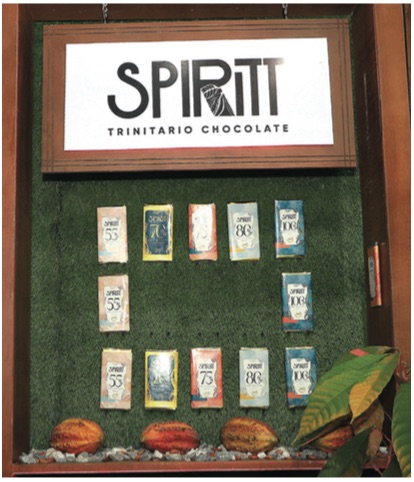
We call them our UWI MADE merchandise, she said proudly, listing off some of the brands that were featured from companies that have been formed: UWI Seal-It Ltd. and UWI Fine Cocoa Ltd, which showed off its“Spirit” dark chocolates, now being made at its Chocolate Factory at TIC.
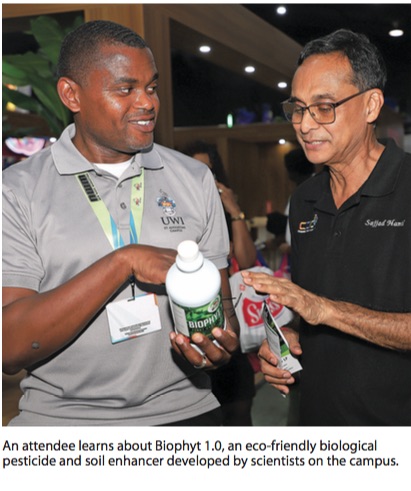
UWI also displayed Biophyt 1.0 (a completely organic, non-toxic bio- control solution developed by researchers at the Faculty of Agricultural Sciences and Sustainability (formerly the Faculty of Food and Agriculture), UWI Optical, and Humankind Studios (a video production enterprise created by the Faculty of Humanities and Education).
Rusell Thomas (right), a member of the UWI Seal-It team, explains the capabilities of one of their products to an attendee. Photo: Aneel Karim

Ms Koscina Sookram-Quintal, Business Manager for UWI Optical, shares a flyer with a visitor to the UWI Made booth. Photo: Aneel Karim
This year, the TIC was its biggest yet, reflecting the steady growth since it first started 27 years ago as a gathering place for business networking.
Shanna-Marie Israel, its lead co-ordinator, said there were 422 booths and tables, and five pavilions, up from 318 booths last year. Total traffic over its three days was 26,500, and there were 381 B2B (business to business) meetings. The TIC also arranged 21 webinars and seminars as part of its Business Education series.
From all reports, it was a productive event all round.
Ms Koscina Sookram-Quintal, Business Manager for UWI Optical, said the experience allowed them to showcase their products and raise public awareness about the importance of eye health.

“There was a high degree of interest in our services and people were particularly fascinated by the fact that the university was providing professional services to the general public. It is my view that it will have a positive impact as we have already received requests from contact information collected over the three days for appointments for eye exams.”
UWI Optical is the eye care and vision services of the Optometry Unit at the Faculty of Medical Sciences (Editor’s note: see interview with Optometry Unit Head Dr Kingsley Ekemiri in this issue).
“It supports the teaching and learning component of the Bachelors of Optometry in the area of dispensing. So, in addition to the Optometry Clinic services we now have an optical lab for the students to gain skills in lens cutting and fitting, and the optical store for skills training in frame fitting, lens selection, and customer service,” she explained.
The Principal relates how staff have become so invested in the entrepreneurship culture, that a marketing person, Events and Projects Officer Wendy Maynard, came up with the idea that a lens cleaner should be part of the range of products and collaborated with the Optometry Unit (without her knowledge) to make one. It is one of her treasured collection of products that are UWI MADE.
Dr Lebert Grierson, a Chemistry Lecturer, and Nizamudeen Mohammed, a Development Engineer, worked together to produce the UWI Seal-It brand of products, for which they received the Principal’s Innovation Award.
Dr Grierson represented them at TIC and reported that for this, their third appearance, the reception was very favourable and they were able to demonstrate some of the superior qualities of their products.
“UWI Seal-It products are asphalt-based primer coatings and sealants. We have developed a range of products that include UWI Seal-It Primer Type 1 penetrative coating, UWI Seal-It primer Type 2 protective coating, and UWI Seal-It Roofing Compound Sealant. They are effective for water- proofing concrete roofs, walls, wood, and metal surfaces. They work by sealing cracks and pores in any surface, especially concrete. We also manufacture marine coating, a rust prevention coating.”He and Mohammed were focused on providing water- proofing for tropical and desert-like climates for periods of greater than 10 years, where the similar imported products only provide water-proofing for little over two years, he explained.
“Imported asphalt sealants products from temperate climates are not very sustainable in tropical climates. Our UWI Seal-It products can be used in temperate and tropical climates,” he said.
Mohammed said he is responsible for the lab; analysing raw material, and preparing and supervising the products during production and packaging. He also modifies products, customising them to suit the needs of clients
With his interest in inventing, he is always working on developing new products, and designs equipment to manufacture them. Naturally, he teaches his considerable skills as well.
Seal-It is working to expand manufacturing facilities at a site at Mount Hope because as it stands, demand is far greater than their capacity. The will soon be available at regional hardware stores.
Professor Antoine spoke about the savings The UWI has gained since implementing Seal-It.
“We were spending millions on roof repairs, and I said, ‘We will use our own products to fix our roofs.’”
There was resistance at first.
“And then little by little, next thing you know, everybody wants to use the products. So, it was established.”
Dr Grierson confirms that all waterproofing jobs over the last two years at the campus have been done by UWI Seal-It. It has been a journey of transformation, changing the culture of the campus from its mindset as a research-first institution into one that embraces the idea that its research- led innovations could be transformed into income-generating products without compromising its academic status. Professor Antoine has identified four key areas where that progress could be clearly discerned: translating research into entrepreneurship, fostering employee engagement, advancing a green agenda, and strengthening stakeholder relationships.
She also identified other initiative such as a Shark Tank to evaluate new entrepreneurship proposals. This includes a series of services ranging from consultancies to an analytical and diagnostic services centre, and an optometry centre which would offer health care services.
Many of these projects have come to fruition because of the determination of the Principal and many other members of the campus community to see the university steer itself into a position where it could be a viable institution, serving its community sensibly and sustainably.
