


At a time when it seems like institutions are dwindling and fading, it is noteworthy that ACHEA, the Association of Caribbean Higher Education Administrators, marked its 25th anniversary on July 5. It was by no means smooth sailing, and the tale of its growth is marked by the fettle of the people who brought it to life in 2001.
It really began with the newly appointed University Registrar in 1992 (the first female to serve in that post at The UWI), Gloria Barrett-Sobers, who was President from 2001 to 2004. Though retired for some time now as she is approaching 85, Mrs Barrett-Sobers is known as ACHEA’s mother. She recalled the rationale behind its formation.
“I encountered many competent and knowledgeable administrators who were operating as if they were second- class citizens (to the academics) at the university. The academics are, of course, the producers of The UWI’s core products: graduates and research,” she acknowledged.
But, “The UWI could not achieve its superb reputation without its excellent, professional administrative staff. I wanted these staff to become, to know, and relish this perspective. We needed to be a professional group, proud of our calling.”
It wasn’t a question of money, or even the working conditions, she said; their union was strong. It was about how they saw themselves professionally within the university community “in terms of competencies, qualifications, code of ethics, ability to discuss their role in the university with as much pride and self-awareness as the academics”.
Mrs Marvette Facey-Thompson, Immediate past President of ACHEA, delivering remarks at the Opening Ceremony of the 23rd Annual Conference held in The Bahamas, 2026. Looking on are President of the University of The Bahamas, Dr Robert J Blaine III and Ms Antona Curry, Conference Chair. PHOTOS: COURTESY ASSOCIATION OF CARIBBEAN HIGHER EDUCATION ADMINISTRATORS.
It was an act to demand respect and one that recalibrated the Caribbean’s relationship with its administrators in higher education. The membership was around 50 at first, but that figure has significantly increased, said the Membership Officer, Allison Johnson. Countries like Antigua and Barbuda, Barbados, St Kitts and Nevis, St Lucia, Turks and Caicos, British Virgin Islands, Cayman Islands, Grenada, Guyana, Jamaica, The Bahamas, Trinidad and Tobago, and even Ghana and the USA are included.
This year’s conference, ironically the 23rd one, marked the milestone of 25 years, so it had a special celebratory feel. Dr Helen Williams-Cumberbatch, 1st Vice President, who chaired the anniversary celebrations sub-committee, was very excited about the plans for the event, which took place from July 2 to 5 at Breezes Resort in The Bahamas.
Among them were the 25@25 Initiative, a tribute to the contribution of members. The following four categories were defined and 25 institutions were invited to nominate an excellent administrator in each.
There was also an artwork competition open to students at higher education institutions. The winning design, created by Carina Chin of COSTAATT, was the signature artwork for the conference.
There was also a gala themed Glitz and Glamour, a red-carpet affair meant to pay tribute to honourees of the ACHEA charity programme.
On the anniversary Sunday, a commemorative church service was held at the hotel. The service was officiated by Dr Kofi Nkrumah-Young, an ordained minister and ACHEA’s International Liaison Officer, who defined his role as seeking and maintaining connections with similar organisations.
FROM LEFT: Members of the ACHEA Executive Committee 2024-2026. Back row: Dr Kofi Nkrumah-Young, Ms Michelle Bruce, Mrs Kasiane Reid-Martin, Ms Alison Johnson, Dr Justin Zephyrine, Dr Courtney Garrick. Front Row: Ms Michelle Hollness, Mrs Marvette Facey-Thompson, Dr Linda Steele, Dr Helen Williams-Cumberbatch, Dr Candice Williams, Mrs Antonia Charlemagne-Marshall. Dr Williams-Cumberbatch and Dr Williams were elected as the new President and Vice President of the 2026-2028 Executive Committee.
The impact and consequences of COVID during the period from 2020 to 2022 has not yet been fully measured. Dr Linda Steele, who served as president from 2016 to 2018, recalled some of the upheaval. She had already decided that she would not seek another term because she was due to retire in July 2019 from her position as Senior Assistant Registrar (Human Resources) at St Augustine. So Claire Craig (now an Internet Exchange Point researcher and consultant) succeeded her, and Dr Steele remained on the executive as the Immediate Past President.
“Things were moving along smoothly until COVID arrived in March 2020. The conference scheduled for Barbados in July 2020 had to be cancelled, and hope for a conference in July 2021—also in Barbados—slowly faded because of closed borders and more and more COVID,” she said. It meant that elections were also cancelled. The annual executive retreat was conducted online in September 2020.
“ACHEA went through its most turbulent time after that. At the end of the retreat, we got a message from the president advising that she was resigning with immediate effect! Following an emergency meeting the next day during which we consulted and re-read our constitution, the 1st Vice President, Marvette Facey-Thompson, was appointed to act as president until elections could be constitutionally held.”
That period and its unprecedented circumstances yielded some positive adaptations. Bound by determination not to let the organisation fail, the membership grew closer.
Great challenges often squeeze out extraordinary resourcefulness, and by 2021, when it was obvious that the conference could not take place again for another year, they tried a one-day webinar type of conference. The presenters came primarily from the aborted conference in 2020 and it was a success, said Dr Steele. “We continued with monthly webinars after that session.”
Topics that the Executive felt would benefit members were presented and interest grew. ACHEA had become “extremely proficient” at hosting Webinars— an unexpected bonus. “I need to mention here that professionals in the Caribbean are very generous. All of them presented at no cost to ACHEA!”
By July 2022, the annual conference was back. ACHEA once again was able to host it in Trinidad, and the acting president, Marvette Facey-Thompson, was voted in as President. Given that the previous past president had resigned, the spot for Immediate Past President on the Executive was empty. Dr Steele was asked to continue.
(On July 2, 2026, the elections were held, and a new executive was approved. At the time of writing, this had not yet happened.)
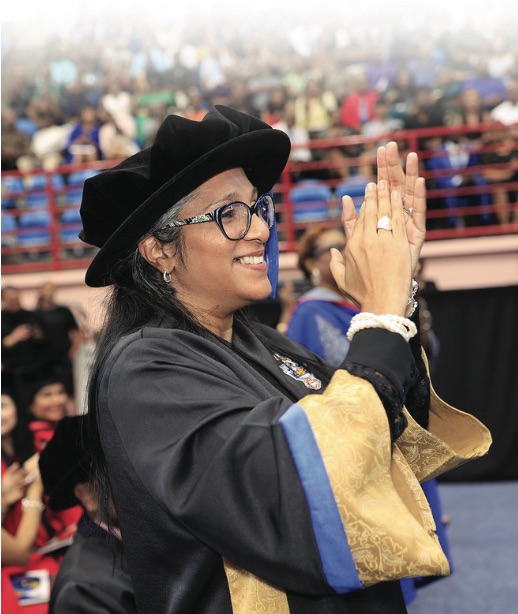
For Facey-Thompson, it has been a fascinating journey since she attended her first conference 15 years ago. She’s never missed one since, she said, and she’s moved steadily through the ranks. Her commitment is evident.
“ACHEA is more than an association. It is a community of higher education administrators dedicated to sharing knowledge and best practices in the furtherance of higher education administration,” she said, adding that her tenure as President was rewarding.
“It has been a privilege to serve the region in the many fora that ACHEA has led that focused on promoting higher education at the highest level. Our annual conferences have been the flagship event on the calendar and despite the many challenges, we continue to thrive.” She proudly acclaims the executive as “world class leaders” in their own rights.

“We sought to improve on the foundation that was laid by the early leaders by strengthening and building upon the structures already in place and creating new ones to support the mission and vision of ACHEA. At the forefront is our customer—the many members of the association—and the value they bring when our minds come together to share knowledge and best practices.”
As she looked toward the elections and the changing executive, she is realistic... and optimistic. “Financial challenges are ever present, but we remain resilient.”
As the association moves past its first quarter of a century, it is fitting that it celebrates the past and remains hopeful for the future.
Mrs Barrett-Sobers sums it up with all the pride of a mother seeing her baby come to adulthood.
“I am delighted and proud of how the association has grown and developed. I am particularly pleased at the number of academics who have chosen to attend our annual conferences and present research papers. The conferences tend to provide insights into universities and how they operate as institutions and what is trending globally within the sector. If one is a physicist or historian, one tends to research and be informed in those areas in order to progress career-wise. Some become interested in how the institution that employs them is structured and operates. These are core topics at ACHEA’s annual conferences. I am proud that the association is keeping track and contributing to these insights and thus keeping our university on its toes in terms of global trends,” she said joyfully.
For more information on ACHEA, visit them at https://www.acheacaribbean.org/wp/
