
Context and Background
This course addresses a critical shortage of qualified food safety personnel across the Caribbean, from entry-level food handlers to food safety officers and quality assurance technicians, equipping participants with the capability to close the infrastructure and sanitary design gaps that currently leave less than 10% of small businesses meeting local and export compliance requirements. Through impact-driven, tertiary-level training tailored to specific value chain business profiles, practical applications, hemispheric webinars, and regional field trips co-facilitated by IICA, the programme bridges real-world Caribbean scenarios with international CODEX standards and replaces ineffective generic workshops with contextually relevant instruction. The programme empowers participants to build a robust food safety culture, meet expanding global regulations, and improve trade readiness, while earning an official certificate with credits recognized by UWI.
Learning Outcomes for the Workshop
By the end of this course, participants will be able to:
- To describe the concept and importance of food safety, food hygiene and sanitation as the basis of preventing food borne illnesses.
- To explain the linkages between food safety and human health along the entire production to consumption chain.
- To describe the basic principles of food safety and the specific aspects of interest based on the various food value chains.
- To identify food safety risks and the related Food Safety Management Systems for compliance with food safety standards
- To describe the various industry standards for safety and quality assurance and their application across the agri-food value chain, including those deemed mandatory for trade (exports) and voluntary for domestic food marketing and distribution.
- To design, implement and monitor food safety plans and audits for record keeping and traceability.
Key Takeaways
This short course addresses critical regional gaps by providing practical, Caribbean-focused training aligned with international food safety standards, boosting local capacity and export readiness. It offers career advancement opportunities with an UWI-recognized certificate, equipping participants with essential skills in hazard assessment, SOPs, and compliance. Co-facilitated by IICA and UWI, the programme fosters regional collaboration, networking, and market access, making it a valuable investment for those seeking to enhance their expertise and contribute to food security and trade growth.
Key Topics
- Introduction and General principles of Food Safety, creating a food safety culture, Food Hazards and Risk Assessment
- Introduction to Industry Food Safety Standards] i.e. Good Agriculture Practices (GAPs); Good Manufacturing Practices (GMPs); Regional and International Standards.
- Awareness of Synthetic Agro-Chemical Use and Impacts on Food Safety Including their specific SOPs (Standard Operating Procedures) and SSOPs (Sanitation SOPs) and Flow charts for identified hazards and preventive measures
- Standards: Good Agricultural Practices, Good Manufacturing Practices (GMP) and Introduction to Hazard Analysis Critical Control Points – HACCP
- Food Safety Record Keeping and Templates [how to write the SOPs and SSOPs and Food Safety Plans]
- Packaging, Labelling – requirements and choosing your packaging; acquiring Public Health & Free Sale Certificates
- Climate Change and impacts on food safety along the value chain
The Facilitator

Dr. Harrynanan holds a BSc General in Agriculture, an MPhil, and a PhD in Agricultural Engineering with a focus on postharvest technology, and a Postgraduate Certificate from UC Davis. As project leader for IICA’s AHFSQ Programme in Trinidad and Tobago she supports both public and private sector stakeholders to improve their food safety competencies and compliance. She conduct training on Food Safety Management Systems and serve as a lead trainer for FDA FSMA rules, preparing farmers and processors for exports markets to US and other region.
Certificate Awarded
Participants will receive a Certificate of Achievement with Continuing Education Units (CEUs).
Pricing Information
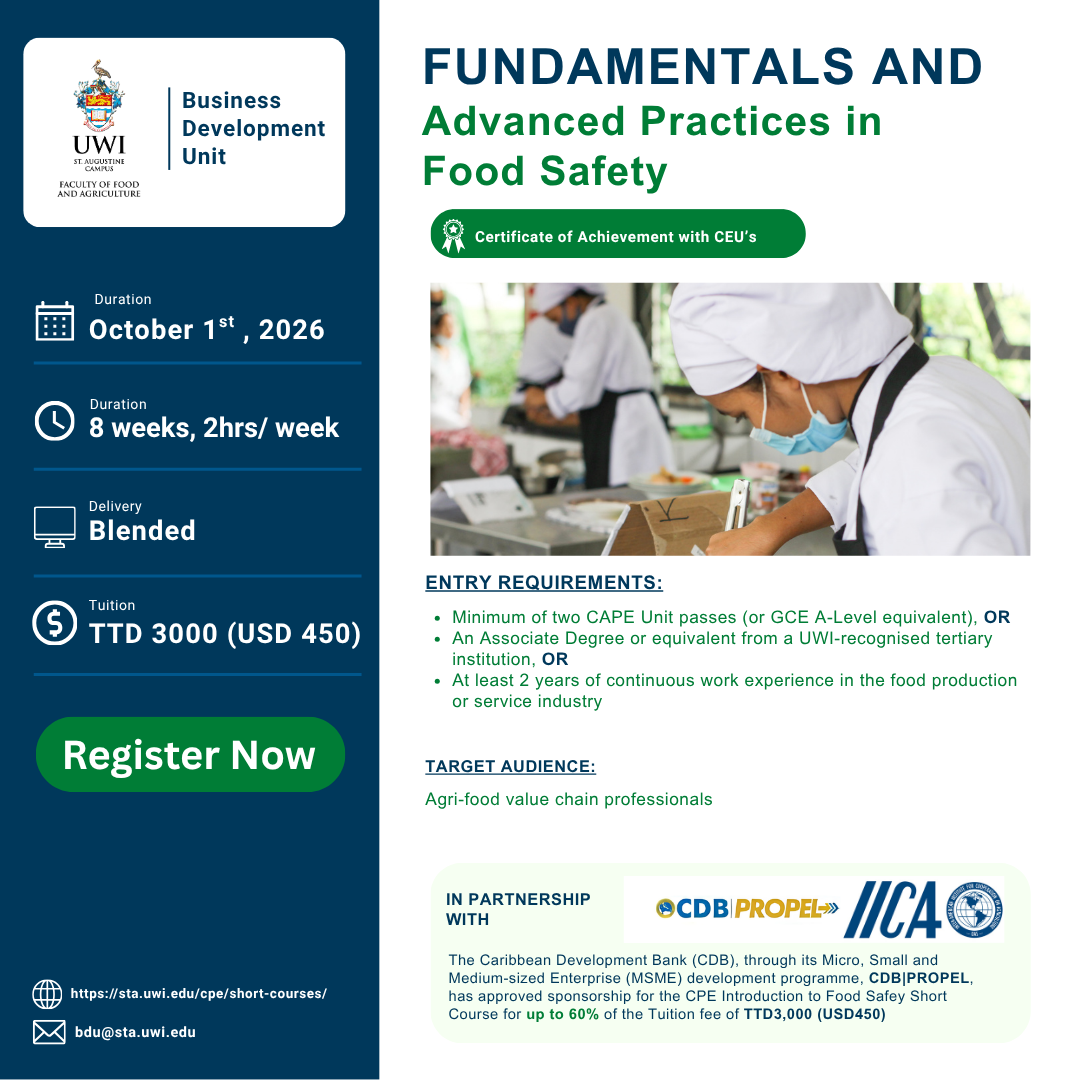
Course Fee: TT$3,000 | US$450
Online payment option (bank charges of 2.5% applies).
Partial Scholarships are avalible for this course please see details IICA-CDB UWI Food Safety CPE Course Partial Scholarship Offer and complete the Partial Scholarship Application Form.
When and Where:
The course begins this September utilizing a blended format that combines online Zoom sessions with in-person activities. While theoretical content is delivered virtually, regional participants will engage in local field trips arranged and facilitated by IICA and its regional partner organizations.
The course will follow the schedule below:
- Dates: October 1st 2026 for 8 weeks
- Times: 2 hours of synchronous lectures per week
- Online and In-Person sessions
Don’t hesitate to contact the CPE Team at sta-cpe@uwi.edu, or visit sta.uwi.edu/cpe for registration details or complete the registration form using the following link: https://uwi.jotform.com/261305603848861