

Posted Friday, March 13, 2026
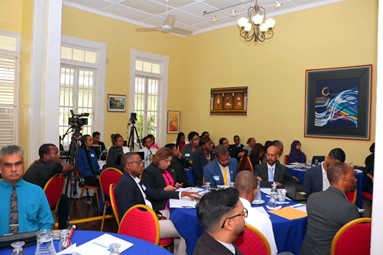
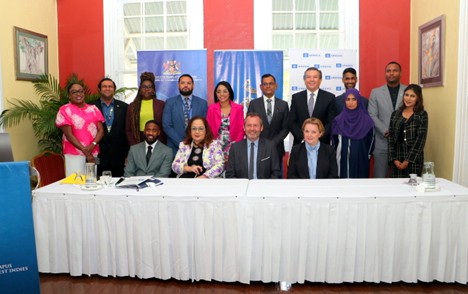
On Friday 27 February 2026, The University of the West Indies (UWI), St. Augustine Campus, hosted the UNESCO Readiness Assessment Methodology (RAM) Validation Workshop, a key milestone in Trinidad and Tobago’s National Artificial Intelligence (AI) Assessment. The workshop, hosted by the Office of the Campus Principal in collaboration with UNESCO and the Ministry of Public Administration and Artificial Intelligence (MPAAI), brought together over 50 invited stakeholders from across government, academia, private sector, civil society, and international development agencies. Held in the Principal’s Main Salon, the closed, high-level engagement marked an important transition from national consultation to structured alignment.
From Assessment to Alignment
The UNESCO RAM forms part of a broader national AI assessment initiative supported by UNESCO and UNDP, aimed at generating evidence-based insights to strengthen Trinidad and Tobago’s AI policy and governance framework. Throughout the day, stakeholders engaged in focused discussions across five dimensions of AI readiness including, Legal and Regulatory, Technological and Infrastructural, Scientific and Educational, Societal and Cultural and Economic.
Stakeholders validated findings emerging from national consultations, identified priority gaps and opportunities, and outlined practical next steps toward responsible and coordinated AI governance. A central theme that emerged from the discussions was clear: Trinidad and Tobago does not lack technical capability or intellectual capital. Rather, the more binding constraints relate to governance coordination, legal clarity, sequencing of reforms, institutional alignment, and public trust. The workshop reflected a shift from consultation toward convergence, reinforcing the importance of structured, human-centred AI development.
Showcasing UWI’s Research Leadership
The morning session featured an AI Research Spotlight, highlighting multidisciplinary AI-related research and innovation underway at UWI, St. Augustine. Presentations spanned areas including AI and copyright law, speech-enabled literacy tools, eco-cultural storytelling, institutional readiness, sustainable SME innovation, and early warning systems. The session demonstrated the breadth and depth of AI scholarship across faculties and reinforced UWI’s growing leadership in AI research within the Caribbean.
Leadership and Collaboration
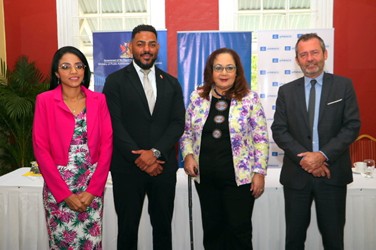
The Opening Ceremony featured remarks from Professor Rose-Marie Belle Antoine, Pro Vice-Chancellor and Campus Principal; Mr. Eric Falt, Regional Director and Representative of the UNESCO Regional Office for the Caribbean; and Senator the Honourable Dominic Alexander Smith, Minister of Public Administration and Artificial Intelligence. Principal Antoine noted that AI is a transformative force shaping the way we learn, educate, innovate and provide service. This workshop is important step in our development and creative utilization of AI.
UNESCO Caribbean’s Regional Director, Mr. Eric Falt indicated that the UNESCO Readiness Assessment Methodology is the first global AI standard setting framework designed to ensure that AI technologies are developed to uphold human rights, fairness and transparency. Minister Smith added that ethical adoption of AI is high on the agenda for the Ministry and that it is important that we inculcate our cultural values and nuances of the Caribbean and of Trinidad and Tobago. As Lead Expert for the UNESCO RAM in Trinidad and Tobago, Dr. Letetia Addison added that AI readiness is not simply a technological question, but a governance question, one that requires intentional coordination, inclusive dialogue, and institutional clarity.
Looking Ahead
Insights from the Validation Workshop will inform the final UNESCO RAM Country Report, scheduled for completion in April 2026. The report will support the development of a nationally owned pathway toward responsible AI adoption and governance.
The University of the West Indies, St. Augustine remains committed to advancing multidisciplinary research, regional collaboration, and evidence-based policy engagement in artificial intelligence and emerging technologies.
The University of the West Indies
St Augustine, Trinidad and Tobago
Tel: (868) 663-1334/662-4394
Fax: (868) 663-9684
© 2004 -
https://sta.uwi.edu. All Rights Reserved.
Disclaimer | Privacy Statement
