

News Releases
UWI Hosts UNESCO’s AI Readiness Assessment Methodology Validation Workshop
For Release Upon Receipt - March 13, 2026
St. Augustine
St. Augustine, Trinidad and Tobago – March 13, 2026 – A national roadmap for responsible AI in Trinidad and Tobago is taking shape. The roadmap is aimed at using artificial intelligence (AI) to accelerate development while reducing risk, with one shared direction for government, academia, industry and society. This was the basis of a National Validation Workshop, hosted by The University of the West Indies (The UWI), St. Augustine at the Campus Principal’s Salon - a collaborative event with The Ministry of Public Administration and Artificial Intelligence and the United Nations Educational, Scientific and Cultural Organization (UNESCO) Caribbean, on Friday 27th February, 2026. The workshop was facilitated by Dr. Letetia Addison, UNESCO RAM Lead Expert for Trinidad and Tobago, who has been leading the national AI readiness assessment process and coordinating the multi-stakeholder consultations that informed the validation exercise.

(Centre-left) Pro Vice-Chancellor and Campus Principal, Professor Rose-Marie Belle Antoine, and (centre-right) Regional Director and Representative of the UNESCO Office for the Caribbean, Mr. Eric Falt, join representatives from The UWI and UNESCO for a group photograph at the UNESCO RAM Validation Workshop 2026, hosted at The UWI, St. Augustine, Office of the Campus Principal on Friday, 27 February 2026.
The workshop brought together over fifty invited stakeholders from across government, academia, private sector, civil society, and international development agencies, marking an important transition from national consultation to structured alignment. The UNESCO RAM forms part of a broader national AI assessment initiative supported by UNESCO and The United Nations Development Programme (UNDP), aimed at generating evidence-based insights to strengthen Trinidad and Tobago’s AI policy and governance framework. Throughout the day, stakeholders engaged in focused discussions across five dimensions of AI readiness including, Legal and Regulatory, Technological and Infrastructural, Scientific and Educational, Societal and Cultural and Economic.
.jpg "undefined")
Stakeholders and committee members gather for a group photo at the UNESCO RAM Validation Workshop 2026 with Dr. Letetia Addison, Lead Expert (centre), held at The UWI, St. Augustine, Office of the Campus Principal on Friday, 27 February 2026.
This process served as the final consultative review to verify and refine findings, emerging from a series of multi-stakeholder consultations convened in January 2026 under UNESCO’s Readiness Assessment Methodology (RAM). The validation exercise ensures that the resulting national AI roadmap accurately reflects the unique priorities, institutional landscape and development aspirations of Trinidad and Tobago.
The UNESCO RAM Validation Workshop featured a series of high-level addresses, including remarks by Minister of Public Administration and Artificial Intelligence, Senator the Honourable Dominic Smith. In his address, the Minister reaffirmed the Government’s commitment to building a responsible, inclusive and forward-looking digital society.
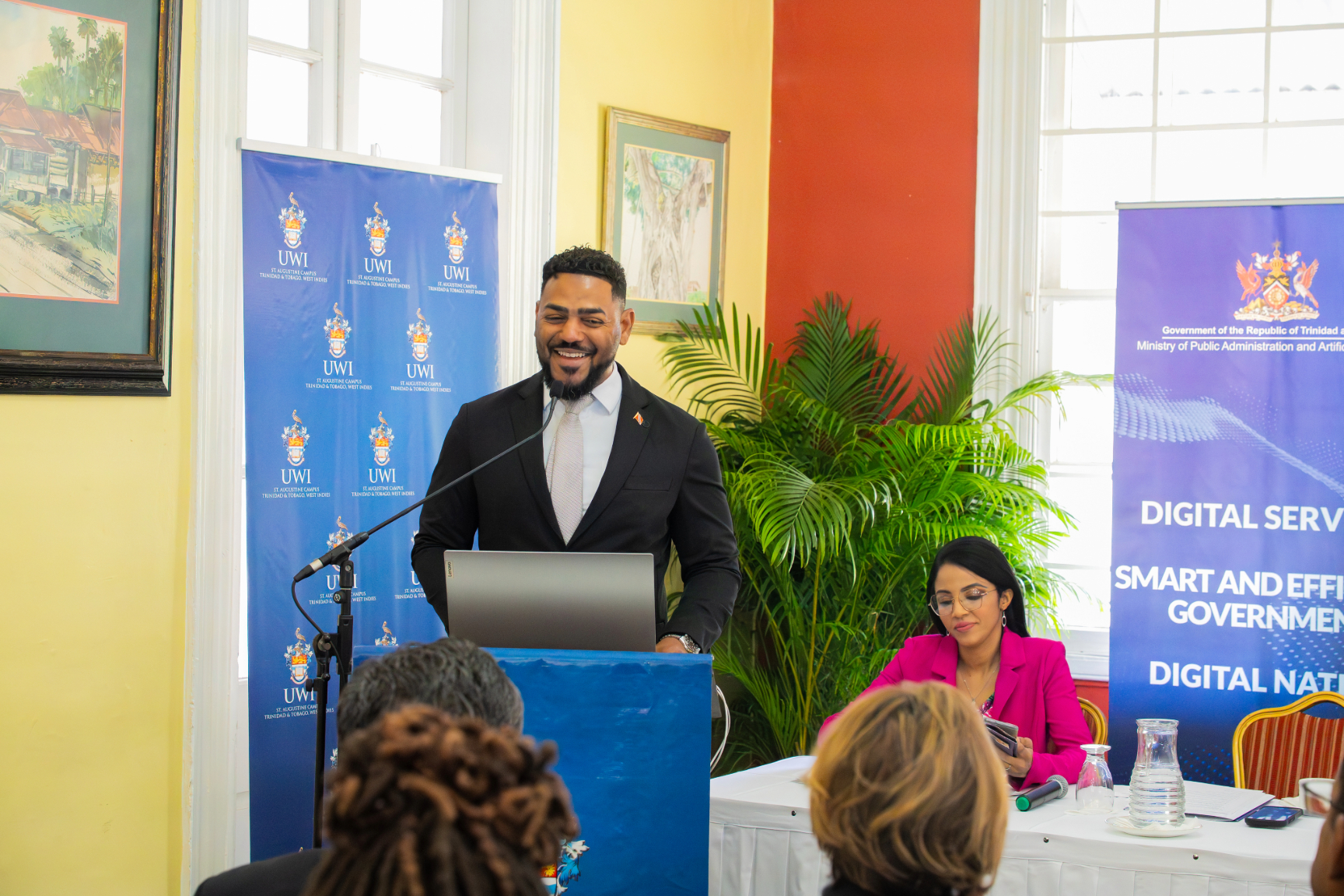
Minister of Public Administration and Artificial Intelligence, Senator the Honourable Dominic Smith, addresses attendees during the UNESCO RAM Validation Workshop 2026 at The UWI, St. Augustine, Office of the Campus Principal on Friday, 27 February 2026.
“We seek a future in which technology serves people, not the other way around. A future in which innovation flourishes without compromising rights, equity, or public trust. A future in which small states like ours are active architects of technological progress,” Minister Smith stated.
Professor Rose-Marie Belle Antoine, Pro Vice-Chancellor and Campus Principal of The UWI St. Augustine, discussed the relevance of the exercise. “This workshop is a very important step in our development, embrace, and creative utilization of AI, and I can think of no better place to hold it than the St Augustine Campus”. Professor Antoine reminded that the St Augustine Campus has had a long history of AI thought leadership, development and creation, through the AI unit in the Faculty of Engineering, “We have been, and continue to be, pioneers in this discipline.” Professor Antoine stated that the launch of the AI Innovation Centre (AIIC) in 2025, further institutionalized The UWI’s commitment in a multidisciplinary way, to support policy, dialogue, innovation and capacity building in AI. The AIIC is currently the Caribbean’s largest AI centre dedicated to advancing AI research, capacity building, commercialization, policy and governance.
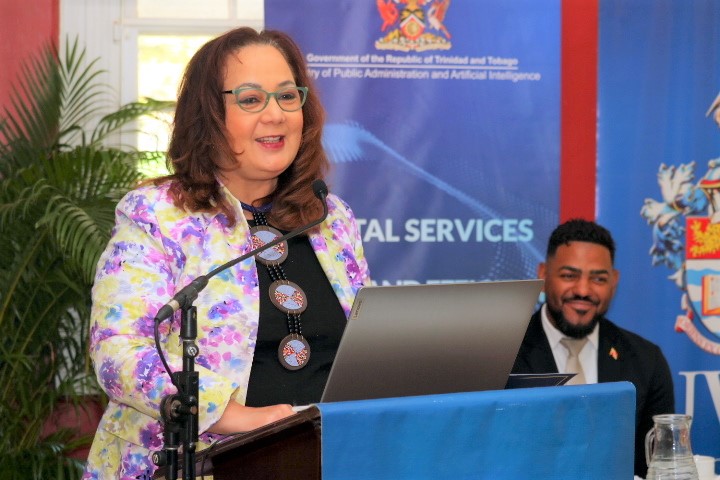
Pro Vice-Chancellor and Campus Principal, Professor Rose-Marie Belle Antoine, delivers the opening remarks at the UNESCO RAM Validation Workshop 2026, held at The UWI, St. Augustine, Office of the Campus Principal on Friday, 27 February 2026.
Professor Antoine noted that, “This collaboration not only strengthens national readiness but also positions Trinidad and Tobago as an early adopter and potential regional leader. “ Professor Antoine stated that UNESCO’s RAM is an internationally recognized methodology, and this engagement signals alignment with international standards and best practices. “As we engage in this process, we reaffirm our commitment to ethical and transparent AI strategies that will not only foster innovation but also ensure that our societal values are upheld.”
Other distinguished speakers included Mr. Eric Falt, Regional Director and Representative, UNESCO Regional Office for the Caribbean and Dr. Letetia Addison, Lead Expert UNESCO RAM Trinidad and Tobago process and facilitator of the workshop, who noted that “AI readiness is a governance question, one that requires intentional coordination, inclusive dialogue, and institutional clarity.”
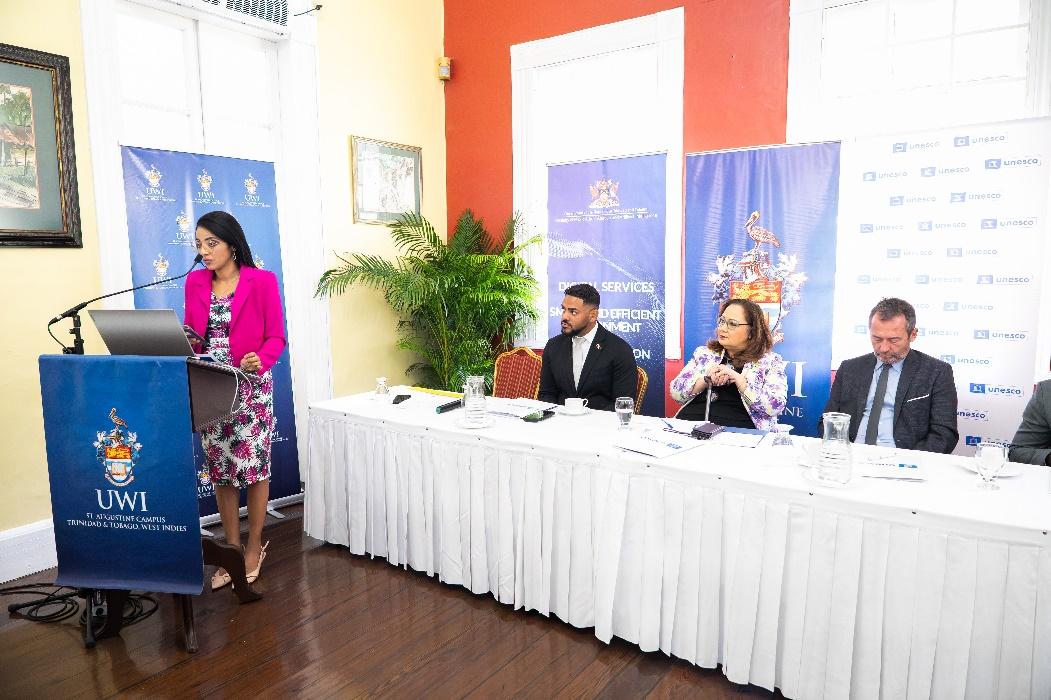
Dr. Letetia Addison, Lead Expert, UNESCO RAM Trinidad and Tobago provides a summary of the consultation process at the UNESCO RAM Validation Workshop 2026, held at The UWI, St. Augustine, Office of the Campus Principal on Friday, 27 February 2026.
The Workshop represents the culmination of an intensive diagnostic phase conducted across five (5) core dimensions: Legal and Regulatory, Technological and Infrastructural, Societal and Cultural, Scientific and Educational and Economic. Several UWI academics also presented related research during a spotlight session and engaged with stakeholders in roundtable discussions and plenary exchanges aimed at strengthening national AI readiness.
The finalized National AI Readiness Report is tentatively scheduled for official public launch in May 2026.
END
About The University of the West Indies
The University of the West Indies (The UWI) has played a crucial role in Caribbean development for over 75 years, consistently contributing to the improvement of the well-being of people across the region.
Established in 1948 as a university college of London in Jamaica, with just 33 medical students, UWI has grown into an internationally respected, global university with nearly 50,000 students. Today, it boasts five campuses: Mona in Jamaica, St. Augustine in Trinidad and Tobago, Cave Hill in Barbados, Five Islands in Antigua and Barbuda, and its Global Campus, along with international centres in partnership with universities across North America, Latin America, Asia, Africa, and Europe.
The UWI offers over 1000 certificate, diploma, undergraduate and postgraduate degree options in Culture, Creative and Performing Arts, Food and Agriculture, Engineering, Humanities and Education, Law, Medical Sciences, Science and Technology, Social Sciences, and Sport. As the leading university in the Caribbean, it is home to the largest pool of intellect and expertise in the region, dedicated to addressing the critical issues facing both the Caribbean and the wider world.
Validated by its inclusion in the Times Higher Education (THE) annual rankings since 2018, The UWI has affirmed its position as one of the top universities globally. It stands out as the only English-speaking institution in the Caribbean featured in four of THE's prestigious ranking lists. The World University Rankings evaluate over 2,000 research-focused universities worldwide, while the Golden Age University Rankings highlight institutions established between 50 and 80 years ago. The Latin America Rankings focus specifically on universities within Latin America and the Caribbean. Additionally, the Impact Rankings assess universities based on their contributions to the United Nations’ Sustainable Development Goals (SDGs).
This recognition has also springboarded the establishment of The UWI’s International School for Development Justice (ISDJ), a global online graduate business school aimed at preparing future leaders for sustainable development.
The UWI is an SDG-engaged university consistently recognised among the best in the world. Discover more at www.uwi.edu.
Contact
Marketing and Communications Department
- Tel.: (868)-662-2002 ext.2013/2014
- Email: marketing.communications@sta.uwi.edu

The University of the West Indies
St Augustine, Trinidad and Tobago
Tel: (868) 662-2002 | Fax: (868) 663-9684
© 2004 -
http://www.sta.uwi.edu. All Rights Reserved.
Disclaimer | Privacy Statement
