
News Releases
The UWI’s IGDS statement on Child Abuse Prevention and Sexual Assault Awareness month
For Release Upon Receipt - April 21, 2026
St. Augustine
Recognising Child Sexual Abuse (CSA) as a National Security Issue: Strengthening Response and Prevention in the Education System in Trinidad and Tobago
The UWI’s Institute for Gender and Development Studies (IGDS) statement on Child Abuse Prevention and Sexual Assault Awareness month
St. Augustine, Trinidad and Tobago – April 21, 2026 – The Institute for Gender and Development Studies (IGDS) at The University of the West Indies (The UWI) St Augustine Campus, calls upon the government and the arms of the state entrusted with the security of the population to prioritize Child Sexual Abuse (CSA) as a central threat to human security and national development. Framing CSA as a national security concern is a necessary step to come to more relevant, comprehensive crime policy responses, improve resource allocation and protect our children, who are among our most vulnerable citizens. Critical to our capacity to protect our children, is to enhance the availability of safe, confidential spaces to report incidents of abuse.
Since 2008, the IGDS St Augustine Unit’s (IGDS SAU), Break the Silence (BTS) Action-Research project has been committed to bringing visibility to the issue of CSA, its multi-level threat to society and its numerous repercussions. The project’s activities over the years have consistently underscored the need for policy intervention, to influence systemic change that treats CSA, not only as an issue of child rights, but as a national security crisis.
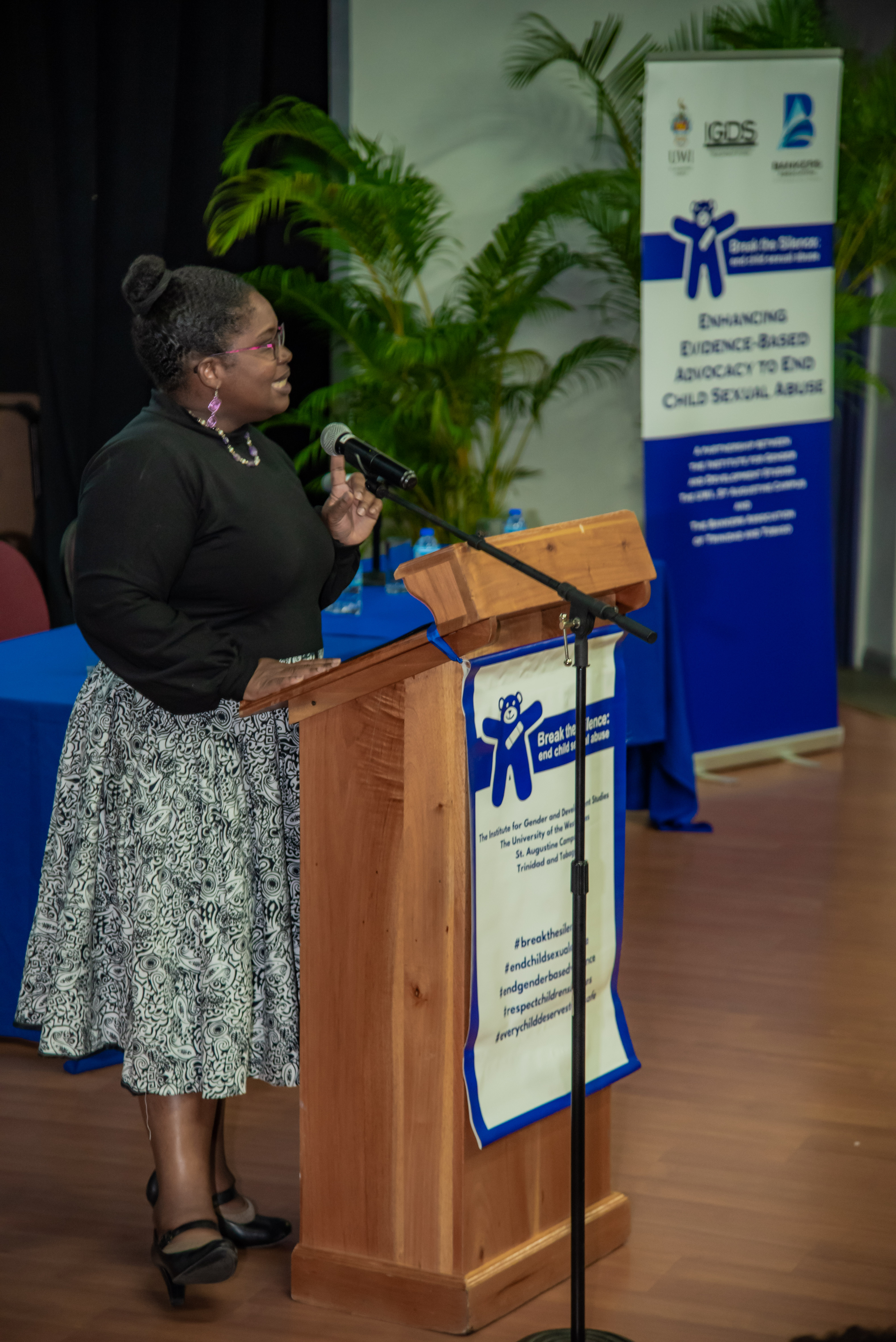
Dr. Sue Ann Barratt, Lecturer and Head of the Institute for Gender and Development Studies at The University of the West Indies, delivers remarks at a 2023 seminar focused on strengthening evidence-based advocacy to end child sexual abuse.
In our most recent iteration of the BTS project, “Filling the Gaps: Enhancing Evidence-Based Advocacy to End Child Sexual Abuse,” funded by the Bankers Association of Trinidad & Tobago (BATT), young men and adult males in particular reinforced the significance of School Social Workers and School Guidance Officers in their decisions to report incidents of abuse. The young men also cited the difficulty of speaking within the family and with peers, identifying the busyness of home and the fear of being ostracised if abuse is spoken about. The belief that socio-psychological professionals are better equipped to manage such sensitive information was a recurring theme.
Over the past decade, reported cases of child sexual abuse have remained consistently high in Trinidad & Tobago. The Children’s Authority of Trinidad and Tobago (CATT) estimates incidents of reported cases to be more than 10,800 between 2015 and 2023, averaging approximately 1,300 cases per year, or four children affected every day. In January 2024 alone, the CATT reported that over 500 cases of child abuse were lodged, underscoring the persistence of the crisis. Recently, Childline launched its Technical Report of five years of research findings on this issue titled, “A Snapshot of Problems faced by Children in Trinidad and Tobago: Insights from Childline Data (2020-2025)”. Among problems reported as part of the experience of some 11 thousand children studied, child sexual abuse affected 43.2% of the children (36.1% girls, 7.1% boys), signaling a steady continuation of its occurrence in T&T.
BTS research findings, consistent with regional and international reports of CSA, indicate that in most instances the perpetrators are known to the child, often family members, close family friends, caregivers or individuals in positions of trust. While homicide rates, firearm-related crimes, and gang activity continue to monopolize the focus of national security in Trinidad and Tobago, other indicators of insecurity get pushed to the back burner of policy intervention. Successful, holistic crime fighting must find urgent ways to make our children safe.
As we commemorate this month of April as Child Abuse Prevention Month and Sexual Assault Awareness Month, the IGDS calls on the government to commit to the following:
- Ensure that our children have a wide cross section of safe spaces to which they can report incidents of abuse.
- Reinforce the importance of Guidance Officers and School Social Workers as necessary for ensuring these safe spaces for our children.
- Invest our education ecosystem to manage such reporting by ensuring such professionals form a sufficient and consistent part of the system.
- Ensure that such professionals form a consistent part of the education system.
We at the Institute for Gender and Development Studies (IGDS), consistent with our mission to advance social justice, promote gender-responsive human relations and development in the wider society remain committed to the elimination of all forms of Gender-Based Violence, stronger protection systems, and a safer future for all children in Trinidad and Tobago.
END
About The University of the West Indies
The University of the West Indies (The UWI) has played a crucial role in Caribbean development for over 75 years, consistently contributing to the improvement of the well-being of people across the region.
Established in 1948 as a university college of London in Jamaica, with just 33 medical students, UWI has grown into an internationally respected, global university with nearly 50,000 students. Today, it boasts five campuses: Mona in Jamaica, St. Augustine in Trinidad and Tobago, Cave Hill in Barbados, Five Islands in Antigua and Barbuda, and its Global Campus, along with international centres in partnership with universities across North America, Latin America, Asia, Africa, and Europe.
The UWI offers over 1000 certificate, diploma, undergraduate and postgraduate degree options in Culture, Creative and Performing Arts, Food and Agriculture, Engineering, Humanities and Education, Law, Medical Sciences, Science and Technology, Social Sciences, and Sport. As the leading university in the Caribbean, it is home to the largest pool of intellect and expertise in the region, dedicated to addressing the critical issues facing both the Caribbean and the wider world.
Validated by its inclusion in the Times Higher Education (THE) annual rankings since 2018, The UWI has affirmed its position as one of the top universities globally. It stands out as the only English-speaking institution in the Caribbean featured in four of THE's prestigious ranking lists. The World University Rankings evaluate over 2,000 research-focused universities worldwide, while the Golden Age University Rankings highlight institutions established between 50 and 80 years ago. The Latin America Rankings focus specifically on universities within Latin America and the Caribbean. Additionally, the Impact Rankings assess universities based on their contributions to the United Nations’ Sustainable Development Goals (SDGs).
This recognition has also spring boarded the establishment of The UWI’s International School for Development Justice (ISDJ), a global online graduate business school aimed at preparing future leaders for sustainable development.
The UWI is an SDG-engaged university consistently recognised among the best in the world. Discover more at www.uwi.edu.
Contact
Marketing and Communications Department
- Tel.: (868)-662-2002 ext.2013/2014
- Email: marketing.communications@sta.uwi.edu

The University of the West Indies
St Augustine, Trinidad and Tobago
Tel: (868) 662-2002 | Fax: (868) 663-9684
© 2004 -
http://www.sta.uwi.edu. All Rights Reserved.
Disclaimer | Privacy Statement
