

News Releases
Back‑to‑Back Wins for T&T at UWI Reparations Debate Competition
For Release Upon Receipt - April 28, 2026
UWI
The UWI Regional Headquarters, Jamaica, W.I., Tuesday, April 28, 2026—After months of rigorous intellectual exchange, bold argumentation, and regional competition, the Centre for Reparation Research at The University of the West Indies proudly announces Fatima College from Trinidad and Tobago as the champion of the International Reparation Debate Competition (IRDC) 2026.
The Grand Final, held on April 22, at The UWI Regional Headquarters in Jamaica and hosted by renowned journalist Dionne Jackson Miller, delivered a fitting climax to a competition that has grown into one of the region’s most dynamic intellectual platforms for youth.
Emerging from a field of 36 secondary schools across the Caribbean and the United Kingdom, Fatima College delivered a commanding performance against Clarendon College from Jamaica. The JADE-judged debate reflected exceptional analytical depth, strategic precision, and a commanding grasp of the evolving discourse on reparatory justice.
Fatima’s dominance was evident not only in clinching the IRDC 2026 Championship title but also in the team’s recognition for Best Team Collaboration. Leading from the front, captain Kennedy Valley delivered a remarkable performance throughout the competition, earning a sweep of individual honours including Overall Best Debater, Grand Final Best Debater, Most Outstanding Male Debater, and the prestigious Director’s Award.
This victory has cemented Trinidad and Tobago’s strength in regional debating and youth advocacy. The Clarendon College students also delivered a formidable performance, finishing in second place after a highly competitive final. Team Captain Aliya McKenzie was recognised as Most Outstanding Female Debater, capping an exceptional run through the competition.
Montego Bay High School for Girls from Jamaica secured third place, with Khadijah Jennings earning the Best Reply Speaker Award.
Rawlins Academy from the UK, celebrated as one of the competition’s most improved teams, earned both the Most Improved School Award and the Repair Campaign Outstanding Sportsmanship Award, highlighting their remarkable progress and exemplary conduct throughout the tournament. Additional honours went to Convent of Mercy Academy “Alpha” for Excellence in Argumentation and Content, C.V. Bethel Senior High School in the Bahamas for the University of Hull Digital Advocacy Award, Shanika Crossdale of Edwin Allen High School for the Spirit Award, and Solange Campbell of York Castle High School for the Most Passionate Debater Award. Winners across these categories were recognised with a mix of cash prizes, trophies, sponsored awards, and regional acclaim, underscoring the competition’s dedication to celebrating both excellence and meaningful impact.
The final event drew a distinguished audience, including Her Excellency Deborah Thomas-Felix, High Commissioner of the Republic of Trinidad and Tobago to Jamaica; Mrs Alicia Herbert OBE, British High Commissioner (Designate) to Jamaica; Mr Stephen Golding, President of the UNIA-ACL Jamaica; and Dr Marcus Goffe, Lecturer and Attorney-at-Law.
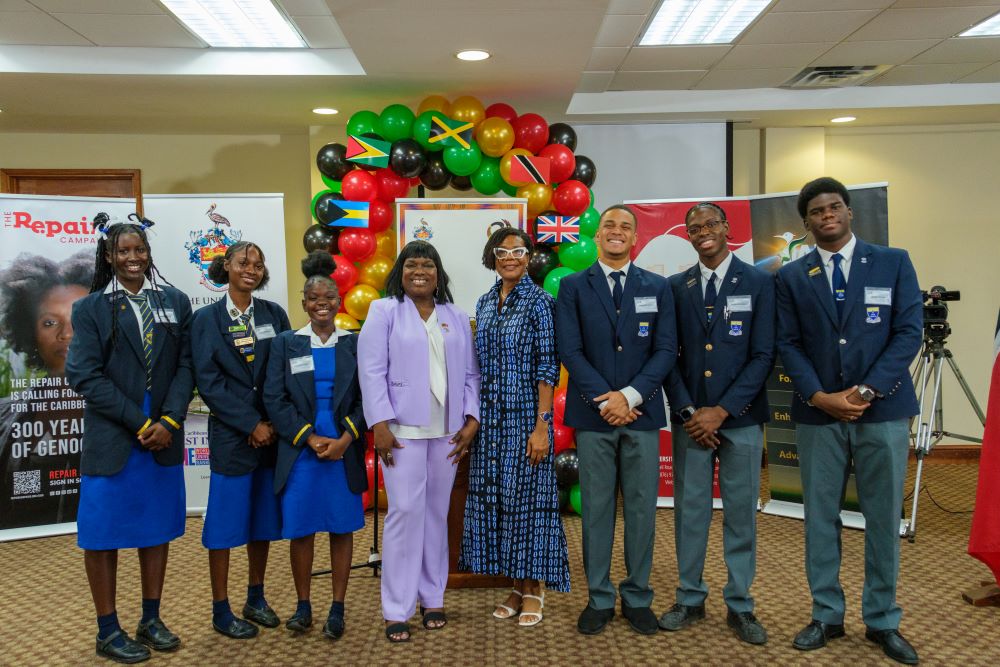
“From left: students of Clarendon College, Jamaica; Her Excellency Deborah Thomas-Felix, High Commissioner of the Republic of Trinidad and Tobago to Jamaica; Professor Stanley Niaah, Director of the Centre for Reparation Research at The UWI; and students of Fatima College, Trinidad and Tobago, winners of the 2026 International Reparation Debate Competition Grand Final held on April 22.”
In her opening remarks, Professor Stanley Niaah, Director of the Centre for Reparation Research, noted, "This competition is one of the most significant pillars of the reparation movement, as it focuses on the next generation of advocates, thought leaders, and reparationists. It helps to prepare young people not merely to inherit a conversation but to lead it and demand justice for themselves and their ancestors."
Sheba Thomas-Gifford, Engagement Lead at The Repair Campaign, added, "Reparatory justice is not always an easy topic, even for adults, so it is encouraging to see young people engaging with these issues at such a high level. The Repair Campaign is proud to support this competition for a second year, as reparative justice advocacy and public education are at the heart of our work. Young people must be meaningfully involved if the Caribbean reparations movement is to grow and endure. We commend the CRR for the important work it is doing to bring the conversation about repair to youth across the region. Congratulations to Our Lady of Fatima College on their well-earned victory and to Clarendon College and all the schools from across the region and the UK that took part."
The 2026 staging of the IRDC unfolded at a pivotal moment in global discourse, following recent developments at the United Nations General Assembly recognising the trafficking of enslaved Africans and racialised chattel enslavement as the gravest crime against humanity. Against this backdrop, the competition continues to serve as a critical platform for youth engagement, research, and advocacy.
Notably, the continued growth and regional impact of the competition have been driven through institutional collaboration and committed partners, underscoring both the strength of regional support and the opportunity for broader national engagement in advancing youth-centred academic initiatives of this scale.
END
About the What is the Centre for Reparation Research
The Centre for Reparation Research (CRR), officially began operations in March 2017 but was, however, launched to the public in October 2017. The CRR was created to promote research and engage in advocacy around the legacies of the transatlantic trafficking in enslaved Africans, African chattel enslavement, post-slavery indentureship (for example Indian indentureship), colonialism and its legacies in the Caribbean; and assist to bring justice and positive transformation to societies affected by these legacies.
Learn more at https://www.uwi.edu/crr
About The University of the West Indies
The University of the West Indies (The UWI) has played a crucial role in Caribbean development for over 75 years, consistently contributing to the improvement of the well-being of people across the region.
Established in 1948 as a university college of London in Jamaica, with just 33 medical students, UWI has grown into an internationally respected, global university with nearly 50,000 students. Today, it boasts five campuses: Mona in Jamaica, St. Augustine in Trinidad and Tobago, Cave Hill in Barbados, Five Islands in Antigua and Barbuda, and its Global Campus, along with international centres in partnership with universities across North America, Latin America, Asia, Africa, and Europe.
The UWI offers over 1000 certificate, diploma, undergraduate and postgraduate degree options in Culture, Creative and Performing Arts, Food and Agriculture, Engineering, Humanities and Education, Law, Medical Sciences, Science and Technology, Social Sciences, and Sport. As the leading university in the Caribbean, it is home to the largest pool of intellect and expertise in the region, dedicated to addressing the critical issues facing both the Caribbean and the wider world.
Validated by its inclusion in the Times Higher Education (THE) annual rankings since 2018, The UWI has affirmed its position as one of the top universities globally. It stands out as the only English-speaking institution in the Caribbean featured in four of THE's prestigious ranking lists. The World University Rankings evaluate over 2,000 research-focused universities worldwide, while the Golden Age University Rankings highlight institutions established between 50 and 80 years ago. The Latin America Rankings focus specifically on universities within Latin America and the Caribbean. Additionally, the Impact Rankings assess universities based on their contributions to the United Nations’ Sustainable Development Goals (SDGs).
This recognition has also springboarded the establishment of The UWI’s International School for Development Justice (ISDJ), a global online graduate business school aimed at preparing future leaders for sustainable development.
The UWI is an SDG-engaged university consistently recognised among the best in the world. Discover more at www.uwi.edu.
Contact
Marketing and Communications Department
- Tel.: (868)-662-2002 ext.2013/2014
- Email: marketing.communications@sta.uwi.edu

The University of the West Indies
St Augustine, Trinidad and Tobago
Tel: (868) 662-2002 | Fax: (868) 663-9684
© 2004 -
http://www.sta.uwi.edu. All Rights Reserved.
Disclaimer | Privacy Statement
