

News Releases
Over 300 Species Recorded at UWI St Augustine Campus’s Night Walk During Campus Biodiversity Week
For Release Upon Receipt - June 8, 2026
St. Augustine
St. Augustine, Trinidad and Tobago – June 8th, 2026 – Over 300 species of animals and plants were recorded at The University of the West Indies (The UWI) St Augustine Campus during the first-ever Campus Biodiversity Week held from April 12 to 19, 2026. This initiative, a collaboration among the Department of Life Sciences, Faculty of Science and Technology and The UWI Biological Society, brought together more than 150 students, staff and members of the wider public for the Night Walk which supported the series of guided biodiversity activities that took place across the campus throughout Biodiversity Week.
Species were documented through guided tree walks, a guided bird walk, a pollinator walk and the first Campus Biodiversity Night Walk with participants taking photos of the species and documenting them using the free iNaturalist app.
A major highlight of the week was the Campus Biodiversity Night Walk, held on April 16th which gave participants an opportunity to explore the campus after dark and identify the species that become active at night. The campus walk was led by Senior Zoology Lecturer Dr Amy Deacon, with the assistance of Life Sciences students Saifudeen Muhammad and Bryan Ramdeen.
The walk began at the CARDI car park, which was designated the “Bat Station” by Ecology Lecturer Dr Luke Rostant and his team. In ecosystems, bats play an important role, including serving as pollinators, insect controllers and seed dispersers. The bat station used mist nets and a harp trap to safely capture bats within the cocoa plot to the north-west of campus for brief observation, documentation and safe release. The activity was conducted by the ecology team to ensure that the animals were handled with care and returned unharmed to their natural environment. Other species observed and documented during the night walk included jumping “guabine” in drains, a manicou, anole lizards and iguanas.
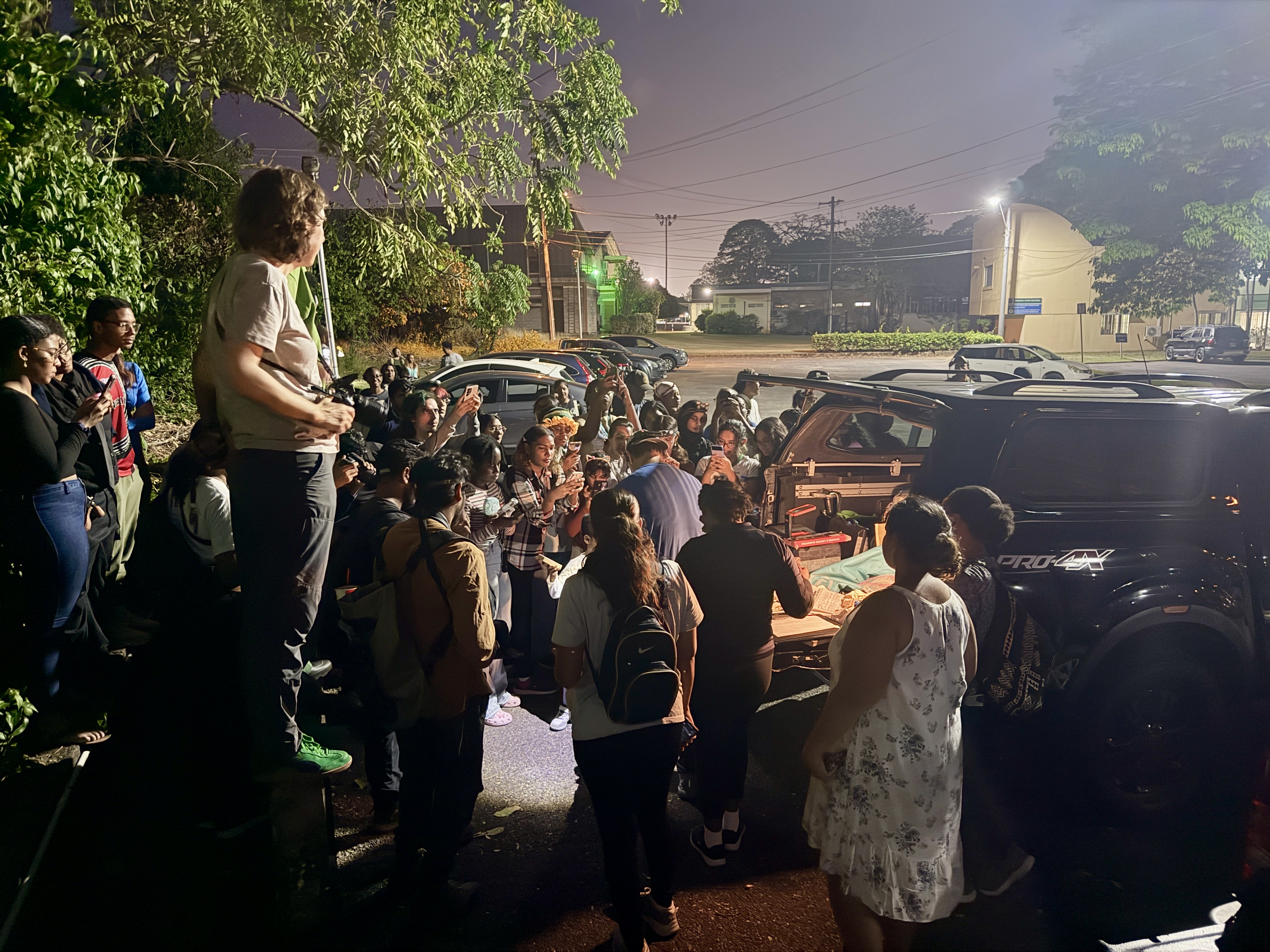
Dr. Luke Rostant showcases a variety of specimens discovered during the Campus Biodiversity Night Walk, held on April 16, at The UWI, St. Augustine Campus.
The walk ended near the campus’s pollinator garden, which had been set up to attract insects that are naturally drawn to light, such as moths, beetles, wasps, grasshoppers and ants. Other events during the Biodiversity Week included a Biodiversity Fair and scheduled tours of The UWI Zoological Museum and the National Herbarium. The Campus Biodiversity Night Walk and the wider Campus Biodiversity Week will return in 2027 for their second edition.
END
About The University of the West Indies
The University of the West Indies (The UWI) has played a crucial role in Caribbean development for over 75 years, consistently contributing to the improvement of the well-being of people across the region.
Established in 1948 as a university college of London in Jamaica, with just 33 medical students, UWI has grown into an internationally respected, global university with nearly 50,000 students. Today, it boasts five campuses: Mona in Jamaica, St. Augustine in Trinidad and Tobago, Cave Hill in Barbados, Five Islands in Antigua and Barbuda, and its Global Campus, along with international centres in partnership with universities across North America, Latin America, Asia, Africa, and Europe.
The UWI offers over 1000 certificate, diploma, undergraduate and postgraduate degree options in Culture, Creative and Performing Arts, Food and Agriculture, Engineering, Humanities and Education, Law, Medical Sciences, Science and Technology, Social Sciences, and Sport. As the leading university in the Caribbean, it is home to the largest pool of intellect and expertise in the region, dedicated to addressing the critical issues facing both the Caribbean and the wider world.
Validated by its inclusion in the Times Higher Education (THE) annual rankings since 2018, The UWI has affirmed its position as one of the top universities globally. It stands out as the only English-speaking institution in the Caribbean featured in four of THE's prestigious ranking lists. The World University Rankings evaluate over 2,000 research-focused universities worldwide, while the Golden Age University Rankings highlight institutions established between 50 and 80 years ago. The Latin America Rankings focus specifically on universities within Latin America and the Caribbean. Additionally, the Impact Rankings assess universities based on their contributions to the United Nations’ Sustainable Development Goals (SDGs).
This recognition has also springboarded the establishment of The UWI’s International School for Development Justice (ISDJ), a global online graduate business school aimed at preparing future leaders for sustainable development.
The UWI is an SDG-engaged university consistently recognised among the best in the world. Discover more at www.uwi.edu.
Contact
Marketing and Communications Department
- Tel.: (868)-662-2002 ext.2013/2014
- Email: marketing.communications@sta.uwi.edu

The University of the West Indies
St Augustine, Trinidad and Tobago
Tel: (868) 662-2002 | Fax: (868) 663-9684
© 2004 -
http://www.sta.uwi.edu. All Rights Reserved.
Disclaimer | Privacy Statement
