

News Releases
UWI and CAHFSA Join Forces to Advance Caribbean Food Safety and Agricultural Resilience
For Release Upon Receipt - July 2, 2026
St. Augustine
With Support from the Ministry of Agriculture and Fisheries, The UWI and CAHFSA Launch Partnership to Strengthen Caribbean Food Safety
ST. AUGUSTINE, Trinidad and Tobago — July 2, 2026 — As climate change, emerging pests and diseases and growing food safety risks place increasing pressure on Caribbean agriculture, The University of the West Indies (UWI), St. Augustine Campus, and the Caribbean Agricultural Health and Food Safety Agency (CAHFSA) have signed a Memorandum of Understanding (MOU) to deepen collaboration in research, education and technical cooperation aimed at strengthening agricultural health and food safety across the region.
The agreement, signed on Friday June 26, 2026, establishes a framework for joint initiatives in research, professional development, student training, public education and technical exchange, drawing on the complementary expertise of The UWI and CAHFSA. Representing the Campus Principal and acknowledging the timeliness of and the significance of the partnership, Dr. Acolla Lewis-Cameron, Chair of the Committee of Deans and Dean of the Faculty of Social Sciences, pointed out its emphasis on scientific risk assessment and research collaboration.
Dr. Lewis-Cameron underscored that “we cannot ignore the interconnected relationship among humans, animals and environmental health…and collaborations in identifying, assessing and mitigating emerging threats, including food safety hazards, will therefore strengthen our region’s ability to protect agricultural productivity and public health.”
The partnership responds to a changing agricultural landscape in which biosecurity threats, foodborne risks, climate variability and disruptions to global supply chains increasingly demand coordinated, science-based solutions. By linking academic research with regional technical expertise, the agreement seeks to accelerate knowledge generation, strengthen institutional capacity and support evidence-based decision-making in agricultural health and food safety.
Highlighting a concern that the core tenets of this MOU is meant to address, Dr. Garvin Peters, CEO of CAHFSA elaborated that “for food safety, we are working with the university to establish a Regional Centre for Laboratory Training and Food Authenticity Testing to address regional deficiencies in food fraud detection and testing that ensures that food is safe for consumption.”
Speaking at the official signing ceremony, on behalf of the Minister of Agriculture and Fisheries, Mr. Ravi Pooran Maharaj, Advisor to the Minister, stated that the collaboration reflects a shared commitment to addressing challenges that no single institution can solve on its own. He continued,
"Agricultural health and food safety are no longer peripheral concerns. They are fundamental to food security, public health, trade competitiveness and economic resilience."
The Minister’s Advisor noted that stronger partnerships among governments, universities and technical agencies are essential to developing practical solutions that protect agricultural production while preparing the next generation of professionals to lead the sector.
Under the Memorandum of Understanding, The UWI and CAHFSA will pursue collaborative activities that may include joint research and training, academic exchanges, supervision of students, staff development, public education initiatives and the planning and implementation of projects of mutual interest. The agreement also provides a framework for future collaborative arrangements governing research, publications, intellectual property and project implementation.
In driving home, the importance of this partnership, Professor Mark Wuddivira, Dean of the Faculty of Food and Agriculture emphasized the importance of a shared commitment to safer food systems and stronger agricultural health because “if it is not safe, it cannot be nutritious, it cannot be healthy and it cannot be food.”
For The UWI, the collaboration builds on the expertise of the Faculty of Food and Agriculture, the School of Veterinary Medicine and other faculties whose research contributes to agricultural sustainability, food quality and public health. CAHFSA, established under the Revised Treaty of Chaguaramas, coordinates regional efforts to strengthen sanitary and phytosanitary systems, surveillance, risk analysis and capacity building among CARICOM Member States.
Moreover, the stakeholders have embraced the potential of this partnership as a means to generate benefits that extend beyond the institutions themselves by supporting safer food systems, healthier crops and livestock, stronger agricultural resilience and more informed policymaking throughout the Caribbean.
The Memorandum of Understanding will remain in effect for an initial period of three years, with the option for renewal by mutual agreement
END
Photo Captions:
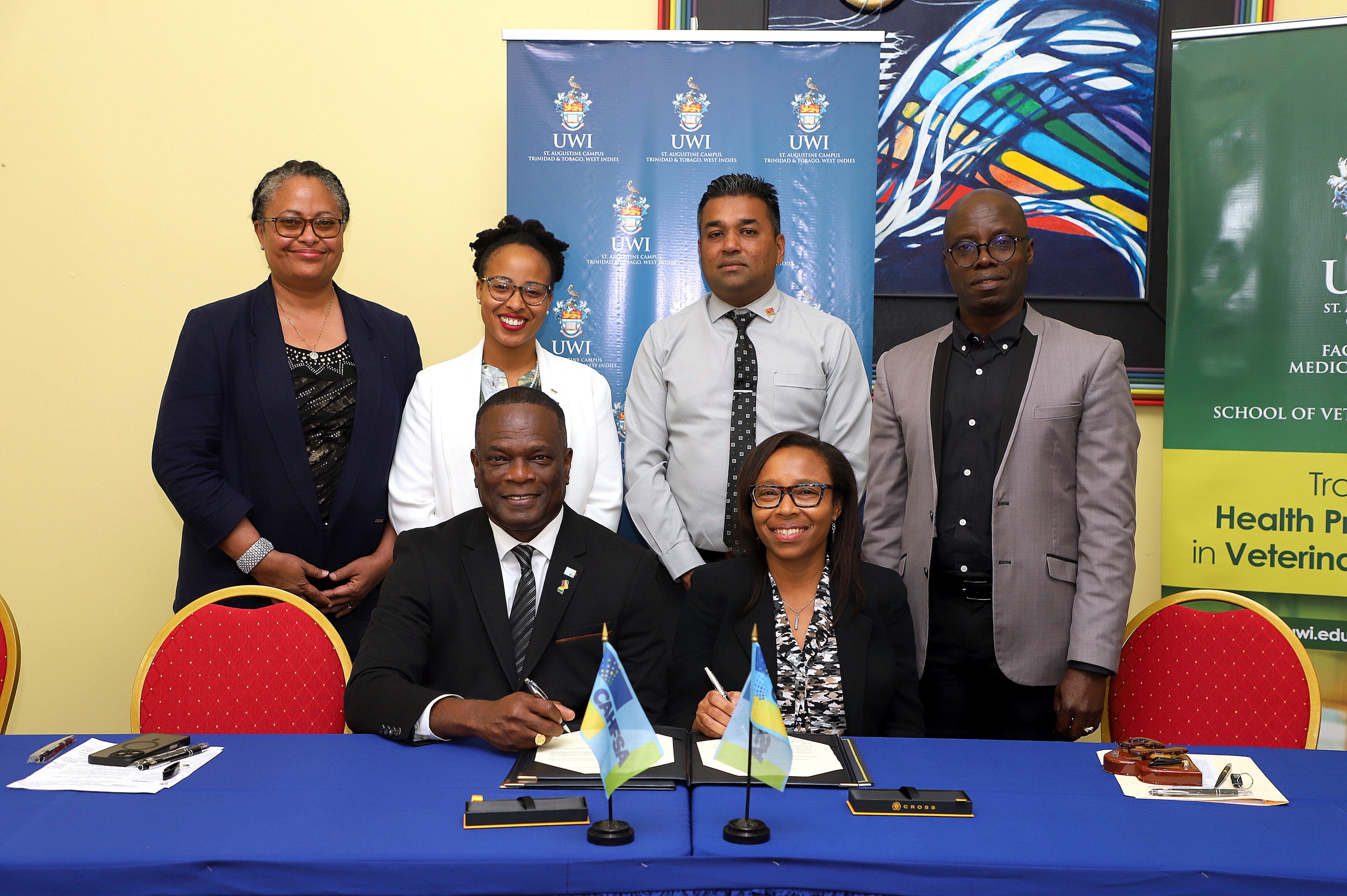
Photo #1
L-R: (seated) Dr. Garvin Peters, CEO of CAHFSA and Dr. Acolla Lewis-Cameron, Chair of the Committee of Deans at The UWI St. Augustine Campus, sign the Memorandum of Understanding, while L-R (standing) Professor Karla Georges - School of Veterinary Medicine, Dr. Dr. Nneka Hull-James, Animal Health Specialist, CAHFSA, Mr. Ravi Pooran Maharaj, Advisor to the Minister of Agriculture and Fisheries, and Professor Mark Wuddivira, Dean of the Faculty of Food and Agriculture look on.
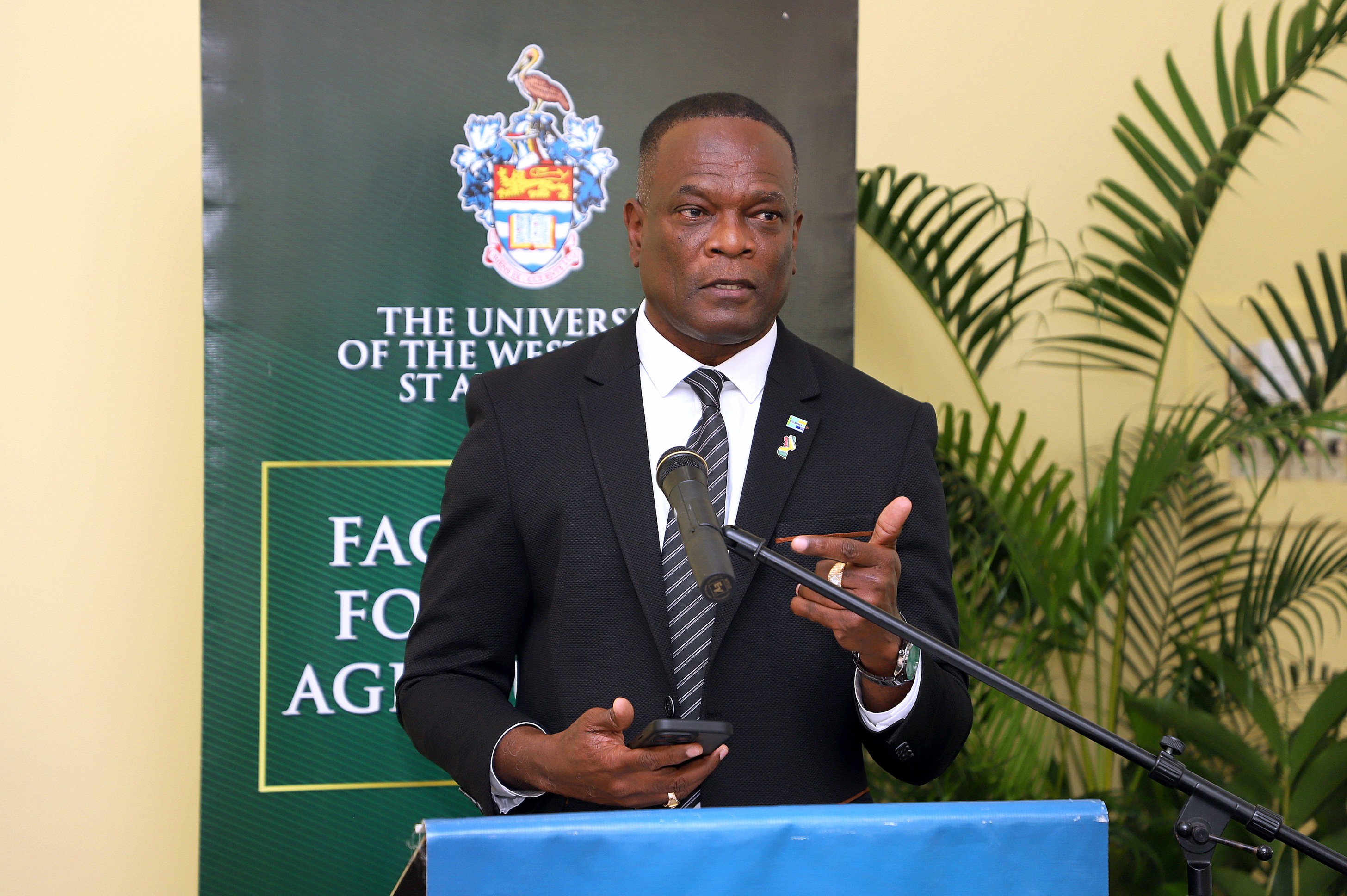
Photo #2
Dr. Garvin Peters, CEO of CAHFSA delivers remarks during the MOU signing at the Office of the Campus Principal at The UWI St. Augustine Campus.
About The University of the West Indies
The University of the West Indies (The UWI) has played a crucial role in Caribbean development for over 75 years, consistently contributing to the improvement of the well-being of people across the region.
Established in 1948 as a university college of London in Jamaica, with just 33 medical students, UWI has grown into an internationally respected, global university with nearly 50,000 students. Today, it boasts five campuses: Mona in Jamaica, St. Augustine in Trinidad and Tobago, Cave Hill in Barbados, Five Islands in Antigua and Barbuda, and its Global Campus, along with international centres in partnership with universities across North America, Latin America, Asia, Africa, and Europe.
The UWI offers over 1000 certificate, diploma, undergraduate and postgraduate degree options in Culture, Creative and Performing Arts, Food and Agriculture, Engineering, Humanities and Education, Law, Medical Sciences, Science and Technology, Social Sciences, and Sport. As the leading university in the Caribbean, it is home to the largest pool of intellect and expertise in the region, dedicated to addressing the critical issues facing both the Caribbean and the wider world.
Validated by its inclusion in the Times Higher Education (THE) annual rankings since 2018, The UWI has affirmed its position as one of the top universities globally. It stands out as the only English-speaking institution in the Caribbean featured in four of THE's prestigious ranking lists. The World University Rankings evaluate over 2,000 research-focused universities worldwide, while the Golden Age University Rankings highlight institutions established between 50 and 80 years ago. The Latin America Rankings focus specifically on universities within Latin America and the Caribbean. Additionally, the Impact Rankings assess universities based on their contributions to the United Nations’ Sustainable Development Goals (SDGs).
This recognition has also spring boarded the establishment of The UWI’s International School for Development Justice (ISDJ), a global online graduate business school aimed at preparing future leaders for sustainable development.
The UWI is an SDG-engaged university consistently recognised among the best in the world. Discover more at www.uwi.edu.
Contact
Marketing and Communications Department
- Tel.: (868)-662-2002 ext.2013/2014
- Email: marketing.communications@sta.uwi.edu

The University of the West Indies
St Augustine, Trinidad and Tobago
Tel: (868) 662-2002 | Fax: (868) 663-9684
© 2004 -
http://www.sta.uwi.edu. All Rights Reserved.
Disclaimer | Privacy Statement
