

News Releases
UWI and Partners Launch Bio Resilience Project to Restore T&T’s Landscapes
For Release Upon Receipt - July 2, 2026
St. Augustine
St. Augustine, Trinidad and Tobago – July, 02 2026 – As the country continues to navigate pressing environmental challenges like land degradation, biodiversity loss and climate vulnerability, the Faculty of Food and Agriculture (FFA) at The University of the West Indies (The UWI) St Augustine Campus successfully launched the Bio Resilience Project: Nature-Based Solutions for Resilient Landscapes in Trinidad and Tobago, marking a major step forward in national efforts to combat land degradation, biodiversity loss and climate vulnerability.
Funded by the Global Environment Facility (GEF) with US$3.5 million over five years, the project is implemented by the Food and Agriculture Organization of the United Nations (FAO) and executed by The UWI, with the Ministry of Planning, Economic Affairs and Development serving as the national coordinating entity. The project seeks to promote nature-positive development and strengthen food security through sustainable land management and ecosystem restoration.
Mrs Rayanna Boodram-Pulchan, from the Faculty's Project Management Unit, will serve as the National Technical Project Coordinator. Describing the project, Mrs. Boodram-Pulchan said, "Through research, stakeholder collaboration and practical field interventions, the project will generate critical knowledge, tools and strategies to enhance soil health, improve climate resilience and strengthen national food security.”
Two inception workshops, held in Trinidad at the University Inn and Conference Centre and in Tobago at Division of Food Security brought together government agencies, academia, international partners, civil society and the private sector to align strategies for project implementation under the global Blue and Green Islands Integrated Programme.
As the executing agency, The UWI will coordinate project implementation, provide technical oversight, lead stakeholder engagement and manage knowledge-sharing activities. Through its Faculty of Food and Agriculture, the University will support evidence-based decision-making, innovation and capacity development across sectors.
The project is intended to deliver integrated responses to environmental challenges through the establishment of a National Natural Capital Accounting system, the restoration of degraded agricultural lands using nature-based solutions, and measures to improve soil health and productivity. It will also support nature-positive private sector initiatives and strengthen capacity development and monitoring systems.
Key interventions include the implementation of the Recarbonization of Agricultural Soils (RECSOIL) initiative, demonstration of sustainable farming techniques, and development of policies and financial instruments that encourage environmentally responsible investment.
The project forms part of the GEF’s Blue & Green Islands Integrated Programme, which supports island nations in pursuing nature-positive development pathways.
Stakeholders agreed that sustained cooperation among sectors, improved data systems and strong community involvement will be key to the project’s success.
As such, The UWI and its partners are laying the foundation for a healthier, more sustainable landscape that can serve generations to come.
END
Photo Captions:
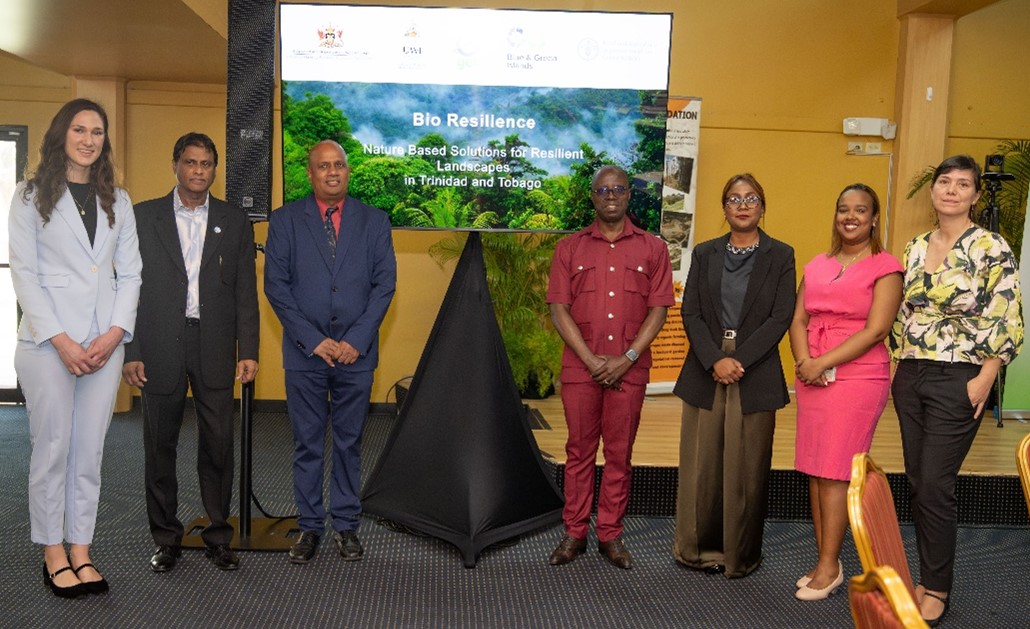
Photo 1:
L-R: Ms. Michela Brown, Project Multi-Programme Coordinator, FAO, representing T&T and Suriname; Mr. Suresh Sookbir, Technical Director, Ministry of Planning, Economic Affairs and Development; Dr. David Persaud, Project Technical Director; Professor Mark Wuddivira, Dean, The UWI Faculty of Food and Agriculture; Mrs. Rayanna Boodram-Pulchan, National Technical Project Coordinator, Bio Resilience Project; Ms. Christiana Chamaroo, Bio Resilience Project; and Dr. Maria Cruz Ferro Vazquez, Soil Health and Climate Change Specialist, Global Soil Partnership, FAO.
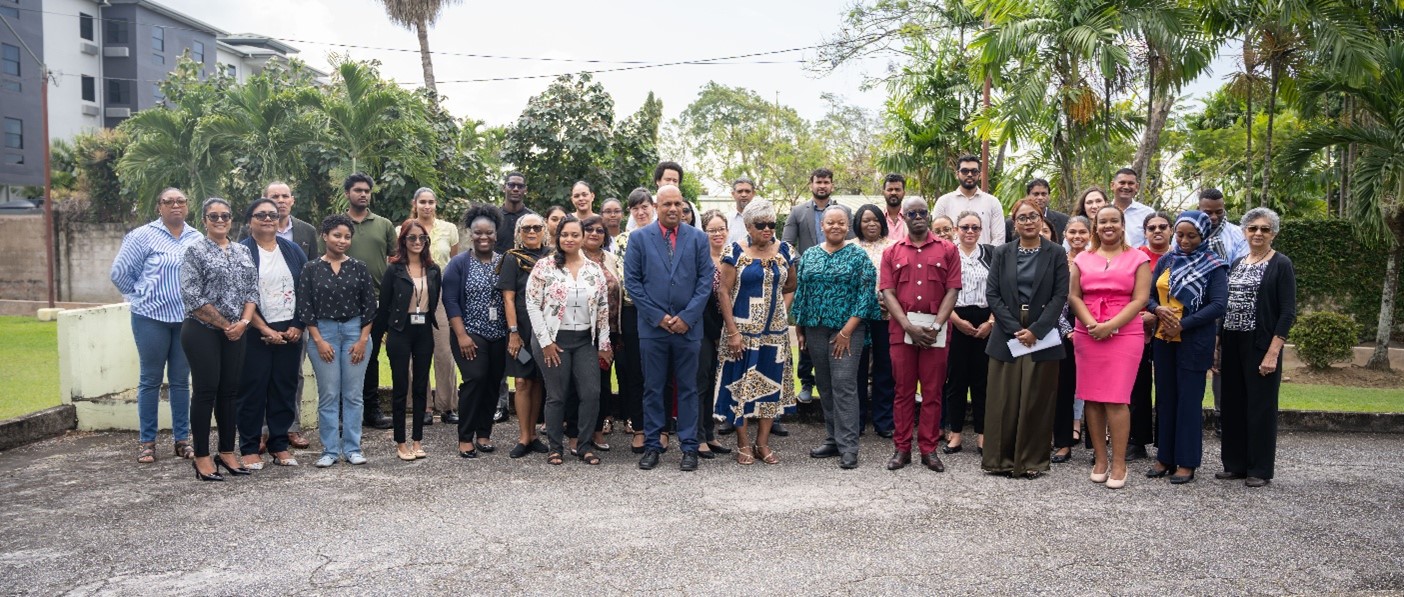
Photo 2:
Group shot of participants at the inception workshop.
About The University of the West Indies
The University of the West Indies (The UWI) has played a crucial role in Caribbean development for over 75 years, consistently contributing to the improvement of the well-being of people across the region.
Established in 1948 as a university college of London in Jamaica, with just 33 medical students, UWI has grown into an internationally respected, global university with nearly 50,000 students. Today, it boasts five campuses: Mona in Jamaica, St. Augustine in Trinidad and Tobago, Cave Hill in Barbados, Five Islands in Antigua and Barbuda, and its Global Campus, along with international centres in partnership with universities across North America, Latin America, Asia, Africa, and Europe.
The UWI offers over 1000 certificate, diploma, undergraduate and postgraduate degree options in Culture, Creative and Performing Arts, Food and Agriculture, Engineering, Humanities and Education, Law, Medical Sciences, Science and Technology, Social Sciences, and Sport. As the leading university in the Caribbean, it is home to the largest pool of intellect and expertise in the region, dedicated to addressing the critical issues facing both the Caribbean and the wider world.
Validated by its inclusion in the Times Higher Education (THE) annual rankings since 2018, The UWI has affirmed its position as one of the top universities globally. It stands out as the only English-speaking institution in the Caribbean featured in four of THE's prestigious ranking lists. The World University Rankings evaluate over 2,000 research-focused universities worldwide, while the Golden Age University Rankings highlight institutions established between 50 and 80 years ago. The Latin America Rankings focus specifically on universities within Latin America and the Caribbean. Additionally, the Impact Rankings assess universities based on their contributions to the United Nations’ Sustainable Development Goals (SDGs).
This recognition has also springboarded the establishment of The UWI’s International School for Development Justice (ISDJ), a global online graduate business school aimed at preparing future leaders for sustainable development.
The UWI is an SDG-engaged university consistently recognised among the best in the world. Discover more at www.uwi.edu.
Contact
Marketing and Communications Department
- Tel.: (868)-662-2002 ext.2013/2014
- Email: marketing.communications@sta.uwi.edu

The University of the West Indies
St Augustine, Trinidad and Tobago
Tel: (868) 662-2002 | Fax: (868) 663-9684
© 2004 -
http://www.sta.uwi.edu. All Rights Reserved.
Disclaimer | Privacy Statement
