

News Releases
BioResilience Project Highlighted at GEF National Forum in Trinidad and Tobago
For Release Upon Receipt - July 3, 2026
St. Augustine
St. Augustine, Trinidad and Tobago – July 03, 2026 – The BioResilience Project, Nature-Based Solutions for Resilient Landscapes in Trinidad and Tobago, was proudly featured at the recently concluded Global Environment Facility (GEF) National Forum hosted by the Environmental Management Authority (EMA) in Trinidad and Tobago.
The project’s vision, objectives and ongoing efforts to strengthen ecosystem resilience, sustainable land management and biodiversity conservation in Trinidad and Tobago. It also noted [NHB1.1]the growing environmental and economic challenges facing Trinidad and Tobago and outlined how the project is responding through integrated approaches such as Natural Capital Accounting, sustainable soil management, ecosystem restoration, regenerative agriculture and climate-resilient land-use planning.
The Forum was held on 20 May 2026 at the Hilton Trinidad and Conference Centre and on 26 May 2026 in Tobago at the Comfort Inn and Suites Conference Centre under the theme: “Transforming Environmental Ambition into Action: Trinidad and Tobago’s Pathway to Resilience through the GEF.” Mrs. Rayanna Boodram-Pulchan, National Technical Project Coordinator of the Bio Resilience FAO-GEF Funded Project at the Project Management Unit of the Faculty of Food and Agriculture delivered presentations on behalf of the project team during the session focused on Nature-Based Solutions, Biodiversity and Land Restoration.
Describing the significance of the project, Mrs. Boodram-Pulchan said, “through research, stakeholder collaboration and practical field interventions, the project will generate critical knowledge, tools and strategies to enhance soil health, improve climate resilience and strengthen national food security.”
Discussions were held on the RECSOIL initiative and the Soil Doctors Programme, both of which aim to strengthen soil organic carbon, improve agricultural sustainability and build resilience among farming communities.
The GEF National Forum brought together representatives from government agencies, academia, international organizations, civil society and development partners to showcase ongoing GEF-supported initiatives and foster dialogue on environmental sustainability, climate resilience and ecosystem protection. The event also featured presentations and discussions on climate transparency, energy efficiency, biodiversity conservation, hazardous chemical management and sustainable livelihoods.
The BioResilience Project Team extends sincere appreciation to the EMA and all participating organizations for facilitating a valuable platform for collaboration, knowledge exchange and national environmental dialogue. As implementation continues, the BioResilience Project remains committed to supporting Trinidad and Tobago’s transition toward more resilient, sustainable and nature-positive landscapes through innovation, partnerships and community engagement.
END
Photo Captions
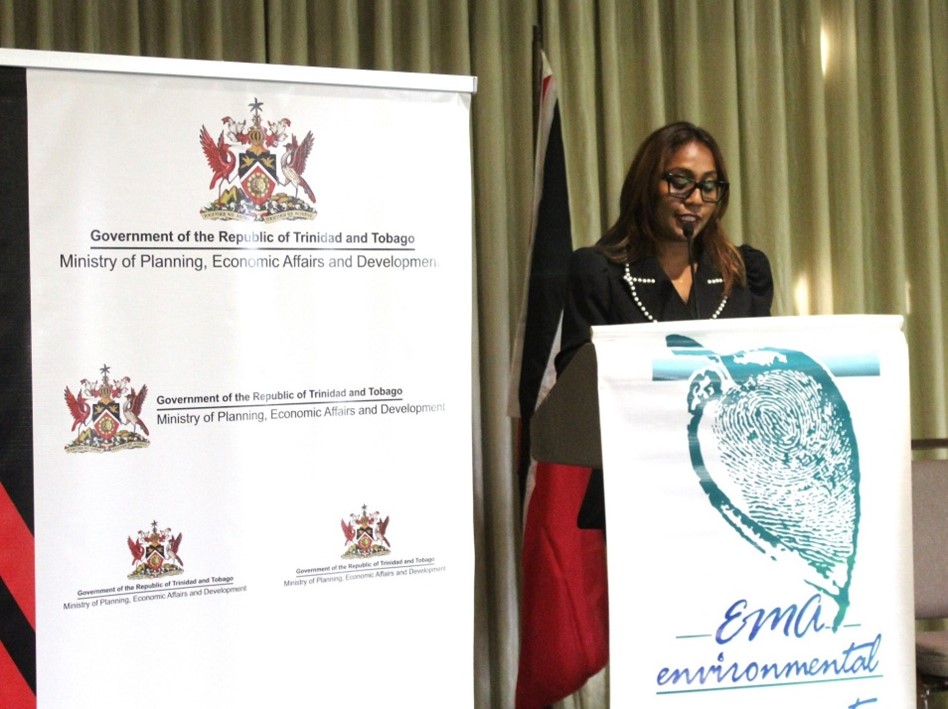
Photo #1: Rayanna Boodram-Pulchan, National Technical Project Coordinator for the BioResilience Project, makes a presentation at the event.
About The University of the West Indies
The University of the West Indies (The UWI) has played a crucial role in Caribbean development for over 75 years, consistently contributing to the improvement of the well-being of people across the region.
Established in 1948 as a university college of London in Jamaica, with just 33 medical students, UWI has grown into an internationally respected, global university with nearly 50,000 students. Today, it boasts five campuses: Mona in Jamaica, St. Augustine in Trinidad and Tobago, Cave Hill in Barbados, Five Islands in Antigua and Barbuda, and its Global Campus, along with international centres in partnership with universities across North America, Latin America, Asia, Africa, and Europe.
The UWI offers over 1000 certificate, diploma, undergraduate and postgraduate degree options in Culture, Creative and Performing Arts, Food and Agriculture, Engineering, Humanities and Education, Law, Medical Sciences, Science and Technology, Social Sciences, and Sport. As the leading university in the Caribbean, it is home to the largest pool of intellect and expertise in the region, dedicated to addressing the critical issues facing both the Caribbean and the wider world.
Validated by its inclusion in the Times Higher Education (THE) annual rankings since 2018, The UWI has affirmed its position as one of the top universities globally. It stands out as the only English-speaking institution in the Caribbean featured in four of THE's prestigious ranking lists. The World University Rankings evaluate over 2,000 research-focused universities worldwide, while the Golden Age University Rankings highlight institutions established between 50 and 80 years ago. The Latin America Rankings focus specifically on universities within Latin America and the Caribbean. Additionally, the Impact Rankings assess universities based on their contributions to the United Nations’ Sustainable Development Goals (SDGs).
This recognition has also springboarded the establishment of The UWI’s International School for Development Justice (ISDJ), a global online graduate business school aimed at preparing future leaders for sustainable development.
The UWI is an SDG-engaged university consistently recognised among the best in the world. Discover more at www.uwi.edu.
Contact
Marketing and Communications Department
- Tel.: (868)-662-2002 ext.2013/2014
- Email: marketing.communications@sta.uwi.edu

The University of the West Indies
St Augustine, Trinidad and Tobago
Tel: (868) 662-2002 | Fax: (868) 663-9684
© 2004 -
http://www.sta.uwi.edu. All Rights Reserved.
Disclaimer | Privacy Statement
