

News Releases
The UWI St. Augustine Expands AI Education with New Master's and Doctoral Programmes for the Region
For Release Upon Receipt - July 10, 2026
St. Augustine
As demand for AI expertise accelerates worldwide, The UWI launches new postgraduate programmes to help ensure the region develops the talent to create, not simply consume, the next generation of intelligent technologies.
ST. AUGUSTINE, Trinidad and Tobago - 10 July 2026 - Artificial intelligence is reshaping industries faster than almost any technology in modern history. From diagnosing disease and predicting equipment failures to improving disaster preparedness and modernising public services, AI is rapidly becoming part of everyday life. Yet as countries race to develop the skills needed to compete, one question is becoming increasingly urgent for the Caribbean: Who will build the region's AI future?
The challenge is not simply adopting artificial intelligence, it is developing the people capable of designing it, governing it and applying it to solve problems unique to Caribbean societies. Global demand for AI talent continues to outpace supply, while international institutions warn that countries lacking the skills, infrastructure and research capacity risk falling further behind as AI transforms economies and labour markets.
Responding to that challenge, The University of the West Indies (The UWI), St. Augustine Campus will introduce three (3) new postgraduate programmes in Artificial Intelligence from September 2026, creating one of the Caribbean's most comprehensive academic pathways for advanced AI research and innovation.
The new Master of Applied Science (MASc), Master of Philosophy (MPhil) and Doctor of Philosophy (PhD) programmes are designed not simply to teach professionals how to use artificial intelligence, but to develop the engineers, researchers and innovators who will build AI systems for the region's healthcare, energy, manufacturing, financial services, public sector and environmental resilience.
Dr Craig Ramlal, Executive Director of the Artificial Intelligence Innovation Centre at the UWI St. Augustine Campus, believes the Caribbean has reached a defining moment in its relationship with artificial intelligence, one that demands investment not only in technology, but in the people who will create and govern it. He explained,
"The Caribbean cannot afford to be merely a consumer of artificial intelligence developed elsewhere. We need researchers and innovators who understand our healthcare systems, our energy sector, our climate vulnerabilities and our economies, and who can build AI solutions that reflect those realities. These programmes are about developing that capability here, in the Caribbean."
Moving Beyond AI Users
For many people, artificial intelligence begins and ends with tools such as ChatGPT, Claude or image generators. Behind every one of those technologies, however, are engineers, data scientists and researchers responsible for developing algorithms, training models, managing data, strengthening cybersecurity and addressing increasingly complex questions surrounding ethics, privacy and governance.
Those are precisely the professionals these new programmes aim to develop.
Students will study machine learning engineering, intelligent systems, data engineering, AI governance and responsible innovation while undertaking research projects focused on solving real-world challenges facing Caribbean governments, businesses and communities.
Rather than treating AI as an imported technology, the programmes encourage students to develop solutions grounded in regional realities.
Built for Caribbean Priorities
Artificial intelligence is often discussed through the lens of Silicon Valley or global technology companies. The Caribbean, however, faces its own priorities. Across the region, AI is already creating opportunities to:
· Improve disease detection and healthcare delivery;
· Strengthen electricity generation and grid resilience;
· Modernise public services and government decision-making;
· Optimise manufacturing and industrial operations;
· Improve agricultural productivity and food security;
· Strengthen disaster preparedness and climate resilience;
· Combat financial fraud and strengthen cybersecurity;
· Improve logistics, transportation and supply chains;
· Support tourism through predictive analytics and customer intelligence; and
· Protect fragile ecosystems through environmental monitoring.
Meeting these opportunities will require more than technology. It will require professionals who understand Caribbean institutions, regulatory environments, cultural contexts and development priorities.
That regional perspective is embedded throughout the programmes, where technical training is combined with the ethical, legal and policy dimensions that increasingly define responsible AI.
Designed Around Working Professionals
Recognising that many prospective students are already employed as engineers, software developers, analysts and technical managers, the programmes will be delivered in a blended format that allows professionals to continue working while pursuing postgraduate study.
The programmes also establish a progressive research pathway, enabling students to advance from the MASc to the MPhil and ultimately doctoral research.
The long-term objective extends beyond producing graduates. It is to develop a critical mass of AI researchers capable of generating new knowledge, supporting innovation and strengthening the Caribbean's capacity to compete in an increasingly AI-driven global economy.
Five Reasons to Study AI at The UWI
Students enrolling in the programmes will benefit from:
1. One of the Caribbean's few integrated postgraduate AI pathways from master's through doctoral research.
2. Research designed around Caribbean challenges and opportunities.
3. Flexible blended delivery that accommodates working professionals.
4. Opportunities to undertake applied research with relevance to industry and government.
5. Training that combines advanced technical skills with AI ethics, governance and public policy.
Applications for the September 2026 intake are now open and close on July 17, 2026.
Prospective students can obtain additional information from the Department of Electrical and Computer Engineering by emailing secpgm.DECE@sta.uwi.edu or calling (868) 662-2002 ext. 83184 / 82462.
END
Notes to the Editor:
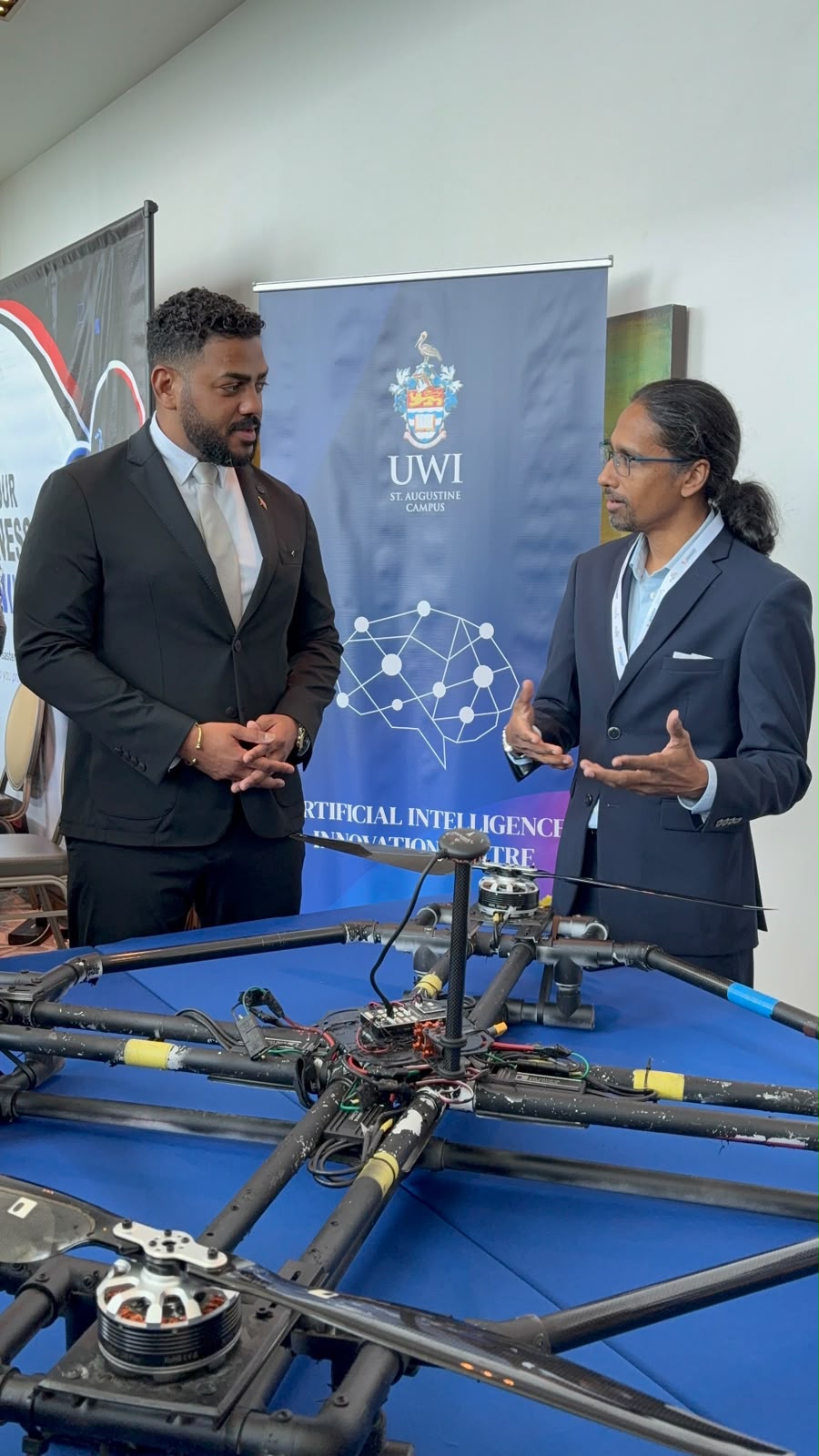
Photo 1: Mr Arthur Ravi Deonarine (right), Engineer at The UWI Artificial Intelligence Innovation Centre (AIIC), demonstrates to Senator the Honourable Dominic Smith (left), Minister of Public Administration and Artificial Intelligence, an AI-enabled drone developed by AMoS, a research cluster dedicated to advancing intelligent drone technologies that leverage artificial intelligence in both the design and autonomous piloting of drones for diverse applications, including drone light shows.
About The University of the West Indies
The University of the West Indies (The UWI) has played a crucial role in Caribbean development for over 75 years, consistently contributing to the improvement of the well-being of people across the region.
Established in 1948 as a university college of London in Jamaica, with just 33 medical students, UWI has grown into an internationally respected, global university with nearly 50,000 students. Today, it boasts five campuses: Mona in Jamaica, St. Augustine in Trinidad and Tobago, Cave Hill in Barbados, Five Islands in Antigua and Barbuda, and its Global Campus, along with international centres in partnership with universities across North America, Latin America, Asia, Africa, and Europe.
The UWI offers over 1000 certificate, diploma, undergraduate and postgraduate degree options in Culture, Creative and Performing Arts, Food and Agriculture, Engineering, Humanities and Education, Law, Medical Sciences, Science and Technology, Social Sciences, and Sport. As the leading university in the Caribbean, it is home to the largest pool of intellect and expertise in the region, dedicated to addressing the critical issues facing both the Caribbean and the wider world.
Validated by its inclusion in the Times Higher Education (THE) annual rankings since 2018, The UWI has affirmed its position as one of the top universities globally. It stands out as the only English-speaking institution in the Caribbean featured in four of THE's prestigious ranking lists. The World University Rankings evaluate over 2,000 research-focused universities worldwide, while the Golden Age University Rankings highlight institutions established between 50 and 80 years ago. The Latin America Rankings focus specifically on universities within Latin America and the Caribbean. Additionally, the Impact Rankings assess universities based on their contributions to the United Nations’ Sustainable Development Goals (SDGs).
This recognition has also spring boarded the establishment of The UWI’s International School for Development Justice (ISDJ), a global online graduate business school aimed at preparing future leaders for sustainable development.
The UWI is an SDG-engaged university consistently recognised among the best in the world. Discover more at www.uwi.edu.
Contact
Marketing and Communications Department
- Tel.: (868)-662-2002 ext.2013/2014
- Email: marketing.communications@sta.uwi.edu

The University of the West Indies
St Augustine, Trinidad and Tobago
Tel: (868) 662-2002 | Fax: (868) 663-9684
© 2004 -
http://www.sta.uwi.edu. All Rights Reserved.
Disclaimer | Privacy Statement
