

News Releases
The UWI Honours Slinger Francisco, The Mighty Sparrow
For Release Upon Receipt - September 28, 2026
St. Augustine
St. Augustine, Trinidad and Tobago – 28th September 2026 – The University of the West Indies (The UWI) St. Augustine Campus joins Trinidad and Tobago, the Caribbean and the international community in mourning the passing of Slinger Francisco, The Mighty Sparrow, whose extraordinary body of work helped shape Caribbean cultural identity and carried calypso to audiences around the world.
The UWI conferred on The Mighty Sparrow an Honorary Doctor of Letters degree in 1987, recognising a cultural icon whose influence extended far beyond the calypso stage. Performer, social commentator, storyteller and entrepreneur, The Mighty Sparrow chronicled Caribbean life and politics for generations, using calypso to entertain, challenge, celebrate and give voice to the societies from which his music emerged. His legacy as a cultural icon will forever be a testament to his indomitable will, resilience and a reminder of how enormous has been the space that he has carved in Caribbean memory.
The late Emeritus Professor Gordon Rohlehr of The UWI St. Augustine Campus, in his tribute prepared for Sparrow’s conferment of the Order of the Caribbean Community (OCC) in 2001, traced the beginnings of the remarkable career that would follow. Born in Grand Roi Village, Grenada on the 9th July 1935, Francisco came to Trinidad with his parents in 1937. His earliest public performances were with the St. Patrick’s Roman Catholic Church Choir and at school concerts at Newtown Boys’ Roman Catholic School. By 1954, he was making the rounds of nightclubs and restaurants as an itinerant performer, and in 1955 made his first appearance in a calypso tent at the Old Brigade Tent in Port of Spain.
A year later, “Jean and Dinah” propelled the young Sparrow to both the Calypso King and Road March titles. It began an extraordinary competitive record. From 1956, he would win the Calypso Monarch title seven more times and the Road March on a further seven occasions, as well as the Calypso King of Kings Competition in 1985 and 1988.
His contribution, however, was measured by far more than titles. In Professor Gordon Rohlehr’s tribute prepared for the OCC, The Mighty Sparrow’s career was examined against the demanding criteria for the regional honour. The first recognised contribution to the “political, cultural and social development of the Community” and its impact on Caribbean people. Sparrow’s work was described as encompassing the roles of celebrant, warner, prophet, satirist, purveyor of joy, delight and elation and raconteur, maintaining and expanding the Caribbean’s rich oral tradition through an extraordinary output of song.
A second criterion considered a recipient’s contribution to raising the self-esteem of the region. The Mighty Sparrow’s achievements as a performer, social critic, self-made intellectual and entrepreneur provided an example of Caribbean possibility. He advocated for local music, stronger copyright protection, professionalism and education, while building and accessing local, regional and international markets for Caribbean cultural products. His career was also characterised by a capacity to challenge social barriers and continually reinvent himself.
His contribution to forging a stronger Caribbean identity at home and in the diaspora was equally significant. Through songs about Caribbean politics, West Indian Federation, cricket, migration and the recognisable characters and experiences of everyday Caribbean life, Sparrow helped Caribbean people see and hear themselves in popular culture. His distinctive performance style also influenced generations of calypsonians throughout the region.
The final OCC criterion concerned “the projecting of the excellence of the Caribbean people on the world scene.” For decades, Sparrow carried calypso internationally, performing across the United States, Canada, the United Kingdom, Europe, Japan, Africa and the Caribbean. His music travelled with him, helping to establish both Sparrow and calypso as recognisable expressions of Caribbean culture.
His contribution was recognised across the Caribbean and internationally. Among his many honours were a Chieftaincy of the City of Lagos, Nigeria in 1977; recognition from governments and cities across the Caribbean and North America; Trinidad and Tobago’s Chaconia Medal Gold in 1993 for long and meritorious service; The UWI’s Honorary Doctor of Letters degree in 1987; and the Order of the Caribbean Community in 2001.
Pro Vice-Chancellor and Campus Principal Professor Rose-Marie Belle Antoine said Sparrow’s passing represents the loss of one of the Caribbean’s most consequential cultural voices.
“The Mighty Sparrow was a phenomenal cultural giant with an extraordinary catalogue of music. Through his wit, social commentary, storytelling and fearless engagement with the issues of the time, he helped generations of Caribbean people understand ourselves and gave the wider world a window into who we are. His voice travelled far beyond Trinidad and Tobago, but it remained unmistakably Caribbean. The UWI was proud to recognise his contribution with the conferral of an Honorary Doctor of Letters degree in 1987. Today, we mourn an extraordinary Caribbean son whose cultural influence will continue to be felt across our region and around the world.”
The UWI’s recognition of Sparrow extended beyond the conferral of his Honorary Doctor of Letters degree. Professor Antoine elaborated that, the Campus also contributed to the scholarship surrounding his life and work through Professor Gordon Rohlehr’s book, “My Whole Life Is Calypso”, a tribute to The Mighty Sparrow as one of the region’s premier and most celebrated artists, documenting and examining his expansive contribution to Caribbean culture. Furthermore, the campus also led efforts to highlight his work through conferences and a series of lecture-performances that explored his extensive repertoire.
These initiatives reflected a relationship with Sparrow that extended beyond honouring his achievements. Through scholarship, public engagement and support during a period of need, The UWI helped to celebrate, examine and document the body of work of an artist whose contribution had become part of the Caribbean’s cultural record.
From the young Grenadian-born performer who emerged as Calypso King and Road March champion in 1956 to the artist whose music travelled the world, Slinger Francisco leaves a body of work woven into the cultural memory of the Caribbean. The UWI extends its deepest condolences to his family, loved ones, colleagues, the calypso fraternity and the countless people across Trinidad and Tobago, the Caribbean and the wider world whose lives were touched by his music.
Read the entire tribute and citation originally published in UWI Today here:
END
Notes to Editors:
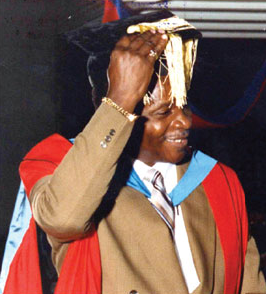
Photo #1: The Mighty Sparrow receives his honorary Doctor of Letters (D.Litt.) degree from The University of the West Indies, St. Augustine Campus in 1987.
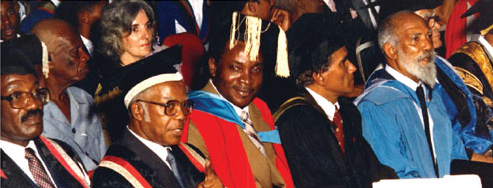
Photo #2: The Mighty Sparrow, pictured among members of the University community at The UWI St. Augustine graduation ceremony in 1987, where he was conferred with an honorary Doctor of Letters (D.Litt.) degree.
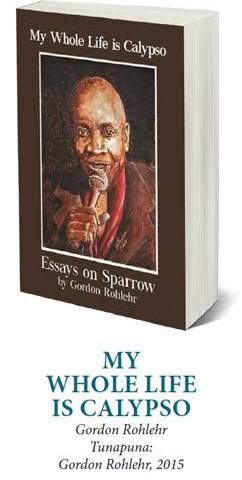
Photo #3: Book Cover “My Whole Life is Calypso: Essays on Sparrow” by renowned Caribbean scholar Professor Gordon Rohlehr. Published in 2015, the book examines the life, work and expansive calypso repertoire of Slinger Francisco, The Mighty Sparrow, and stands as an important scholarly tribute to one of the Caribbean’s most celebrated cultural icons.
About The University of the West Indies
The University of the West Indies (The UWI) has played a crucial role in Caribbean development for over 75 years, consistently contributing to the improvement of the well-being of people across the region. Established in 1948 as a university college of London in Jamaica, with just 33 medical students, UWI has grown into an internationally respected, global university with nearly 50,000 students. Today, it boasts five campuses: Mona in Jamaica, St. Augustine in Trinidad and Tobago, Cave Hill in Barbados, Five Islands in Antigua and Barbuda, and its Global Campus, along with international centres in partnership with universities across North America, Latin America, Asia, Africa, and Europe.
The UWI offers over 1000 certificate, diploma, undergraduate and postgraduate degree options in Culture, Creative and Performing Arts, Food and Agriculture, Engineering, Humanities and Education, Law, Medical Sciences, Science and Technology, Social Sciences, and Sport. As the leading university in the Caribbean, it is home to the largest pool of intellect and expertise in the region, dedicated to addressing the critical issues facing both the Caribbean and the wider world.
Validated by its inclusion in the Times Higher Education (THE) annual rankings since 2018, The UWI has affirmed its position as one of the top universities globally. It stands out as the only English-speaking institution in the Caribbean featured in four of THE's prestigious ranking lists. The World University Rankings evaluate over 2,000 research-focused universities worldwide, while the Golden Age University Rankings highlight institutions established between 50 and 80 years ago. The Latin America Rankings focus specifically on universities within Latin America and the Caribbean. Additionally, the Impact Rankings assess universities based on their contributions to the United Nations’ Sustainable Development Goals (SDGs).This recognition has also spring boarded the establishment of The UWI’s International School for Development Justice (ISDJ), a global online graduate business school aimed at preparing future leaders for sustainable development.
The UWI is an SDG-engaged university consistently recognised among the best in the world. Discover more at www.uwi.edu.
Contact
Marketing and Communications Department
- Tel.: (868)-662-2002 ext.2013/2014
- Email: marketing.communications@sta.uwi.edu

The University of the West Indies
St Augustine, Trinidad and Tobago
Tel: (868) 662-2002 | Fax: (868) 663-9684
© 2004 -
http://www.sta.uwi.edu. All Rights Reserved.
Disclaimer | Privacy Statement
