

Search

Beyond 65

Working for Communities, Country, and Region

As we celebrate 65 years since the establishment of The UWI St Augustine campus, we are celebrating not only the institution itself, but the reverberations of its impact across Trinidad and Tobago and the Caribbean. Political, social, cultural, and economic spaces have all been touched by the intellectual endeavours of the minds emerging from the halls of this campus. Reflecting on the past 65 years, it is clear to see how The UWI has not simply been a witness to the emergence of a post- Independence Trinidad and Tobago, but has been an agent of change and development in altering the trajectory of our region. From powering economies to navigating worldwide medical crises, from facing natural disasters to challenging the foundations of societal violence, the campus and those who have walked through its corridors have enacted a myriad of transformative changes through their work.

The Engine Room

The modern economic landscape of Trinidad and Tobago would be drastically different without the influence of the oil and gas sector. In 1976, The UWI’s Petroleum Engineering Unit was established at the St Augustine campus. At the time, the industry was dominated by a shallow pool of specialised labour, often from geoscientists from other parts of the world.

A 2012 article in the West Indian Journal of Engineering (a publication of the UWI St Augustine’s Faculty of Engineering) states that at that time, “Some 429 students have graduated from the various Petroleum Studies programmes. The impact on the Caribbean, and Trinidad and Tobago (T&T) in particular, has been significant, for example the percentage of local petroleum engineers in the industry has increased from approximately 10 percent in the early 1970’s to 85 percent in 2011.”

Throughout the fluctuations within the field of energy, the Faculty of Engineering and its Petroleum Geoscience Unit have been instrumental in training and producing graduates who would be leaders and key players in a sector that has shaped the country.

However, as T&T has benefitted from enormous economic growth from the sector, it has also had effects on the region’s ecology, economic diversification and steps towards achieving sustainability. Now, as the Caribbean and the world must look to alternative energy as a way forward in the age of climate crisis, UWI St Augustine’s petroleum studies are evolving to reflect this new imperative.

In a 2021 interview with UWI TODAY, then Coordinator of the Petroleum Studies Unit, Prof Andrew Jupiter, acknowledged this: “Moving forward, the programme will be amended to reflect the energy transition that is taking place in the world and definitely in Trinidad and Tobago. A graduate should reflect entrepreneurship and innovation in all disciplines of geology.”

In October of this year, representatives of UWI St Augustine, including Dean of the Faculty of Engineering Professor Bheshem Ramlal, signed an agreement with Niterra Co, Ltd of Japan and Kenesjay Green Ltd, firms in the alternative energy business, for a pioneering green hydrogen project In T&T. The agreement was part of the campus’s initiative to “strengthen collaboration between academia and industry in developing a viable hydrogen economy for Trinidad and Tobago and the wider Caribbean”, a statement from The UWI read.

The engine room of the nation’s energy sector is on the path to green.

Facing Down a Pandemic

As the world came to a standstill in 2020, at the height of the COVID-19 pandemic, the university was forced to upend its functions to adapt to what was then known as “the new normal”. But in addition to managing the impacts of a global pandemic on the campus itself, UWI St Augustine was on the frontlines of the national response finding to the host of problems that arose during the height of the virus’ spread. They served both within the medical community, and throughout the rest of society.

The UWI’s COVID-19 Task Force brought together experts from across faculties to assist the Caribbean in its response to the outbreak. A team spanning from cardiovascular researchers, to emergency paediatric medical practitioners, to virologists, headed up the medical response group, while others from the fields of hotel and tourism management, international relations, economics, and social development helped to map out solutions for the ripple effects of the pandemic on sectors across society.

Campus figures such as then Dean of the Faculty of Medical Sciences Professor Terence Seemungal and virologist Professor Christine Carrington were reassuring voices that spoke directly to the nation, providing their expert knowledge on television and in the print media. In 2022, Prof Carrington was named an Anthony N Sabga Caribbean Excellence Laureate for her role “in developing the human and infrastructural capacity of Trinidad and Tobago and the region to deal with the threat of viruses to public health” the announcement from the ANSA McAl Foundation stated.

Coming out of the campus, staff and students were both frontline workers as well as providing essential support behind the scenes. At the early stages of the pandemic, a campus team was mobilised to produce face masks and other PPE to be used by medical first responders.

In a 2020 article, Senior Engineering Technician in the Department of Electrical and Computer Engineering, and team lead of the manufacturing project Jeevan Persad, said, “All of this is happening because we have unprecedented cooperation and willingness to work together. Partnering with governmental and private bodies to produce the PPE and distribute it to where it was needed most, the manufacturing team worked “Sunday to Sunday” ensuring that they could do their part to help protect the medical community and the nation from the spread of COVID-19.

A Seismic Response to La Soufrière

In the last month of 2020, St. Vincent’s volcanic giant, La Soufrière, woke from its 40-year slumber with a series of effusive eruptions before an explosive event that led to the evacuation of approximately 22,000 people, activation of 88 shelters, and a host of clean-up operations.

As the region rallied to support the island through this natural disaster, The UWI Seismic Research Centre (SRC) was pivotal in the coordinated response to the 2020/2021 eruptions. Although it is most well-known to the public through its earthquake monitoring, the SRC began its life as the Volcanological Research Department in 1953, and moved through several restructurings before the current iteration was formed in 2008. Throughout that time, their mission has remained the same—to provide services which protect Caribbean lives and livelihoods from the hazards associated with extreme natural phenomena such as earthquakes, volcanoes, and tsunamis.

“What some people may not know is that the centre was first established as a volcanology unit to respond to volcanic activity, and then expanded to include seismological services,” said volcanologist and Director of UWI SRC Dr Erouscilla Joseph in a 2023 interview. “We do everything including volcano seismology, earthquake seismology, geology, petrology, geophysics, technical services associated with geothermal energy, ground deformation monitoring, and education and outreach services.”

Dr Joseph was involved in managing the SRC’s response to La Soufrière’s eruptions, where a team of scientists on the ground were able to assist with monitoring, documenting and clean-up, while the university itself conducted relief efforts to assist healthcare, education, and displaced students left vulnerable in the wake of the disaster. This event remains one of the most successful disaster risk management actions in Caribbean history, showing how the region can come together as a community in times of great need.

No More Silence

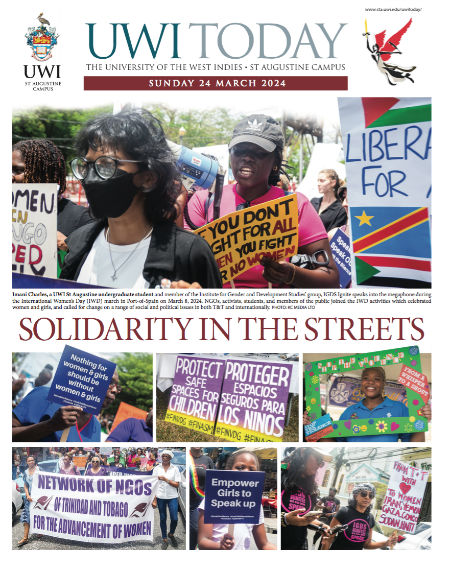
One of the long-standing initiatives coming out of The UWI has been focused on creating safer spaces for children, working collaboratively with agencies and organisations across Trinidad and Tobago. This initiative is the Break the Silence project from the Institute for Gender and Development Studies (IGDS) St Augustine.

The project, and the campaign which followed, has been in existence since 2008, when the UN Trust Fund to End Violence Against Women (managed by UNIFEM), UNICEF, and the then Centre for Gender and Development Studies (CGDS) at UWI St Augustine signed a joint partnership to advance the action-research project Breaking the Silence: A Multisectoral Approach to Preventing and Addressing Child Sexual Abuse in Trinidad and Tobago.

Its goal has been to break the silence on child sexual abuse (CSA)/incest and explore its implications for HIV throughout Trinidad and Tobago by empowering girls and boys, parents, communities, policymakers, and service providers who work in child protection, HIV/AIDS, and women’s rights. The core project team, Emerita Professor Rhoda Reddock, Prof Sandra Reid, and Tisha Nickenig collaborated with the Coalition against Domestic Violence (CADV) and other organisations in its implementation and follow up. While the project officially ended in 2012, its campaign continued.

This project developed a new, community-based action research methodology, established national protocols for reporting, investigating, and responding to child sexual abuse, and generated fresh, gender-informed knowledge on the complexities of CSA. Most importantly, the project was accompanied by the Break the Silence campaign, visible through the Blue Teddy symbol, which expanded locally with marches in various parts of Trinidad and Tobago and regionally through the UNICEF UNITE campaign.

In a 2023 article, Prof Reddock, one of the region’s most accomplished scholars and activists, reflected on its impact: “... the whole climate related to child sexual abuse has changed. The numbers of reports to the police have increased. When we first started, there were very few reports. Now, we have more, and convictions as well.

“Media reporting has also improved. That doesn’t mean [CSA] has ended, but we did generate awareness, and empowered young people to report to their parents or teachers, and parents to seek help.”

Their work called for changing the way we research and advocate for children. It also facilitated the development of research methodologies where communities benefit directly, and researchers simultaneously learn directly from them. This project, through its campaign, empowered a generation of activists and helped to shape national legislation and policy, all while giving a voice to survivors of sexual violence.

In 2014, project team leaders Prof Reddock and Prof Reid received the award for Most Impacting Research Project at The UWI-NGC Research Awards on behalf of the Break the Silence project and campaign.

Looking Back, Look Forward

As UWI St Augustine marks its 65 years and looks to how it might imagine the next 65, its legacy is one of an ongoing, committed engagement with the wider Caribbean community. This campus has been a space where students and teachers from across the region can come together and find ways to solve the problems facing us as a collective. As we face the challenges ahead, we must remember that we have been capable of enacting great change, and in order to envision a stronger, more sustainable Caribbean future, we must truly believe that we are capable of even more.