10
UWI TODAY
– SUNDAY 4TH SEPTEMBER, 2016
FEATURE
It’s early August and the halls are at rest.
Down by the campus car
park Canada Hall sits serenely on the greens. A short walk north
is Trinity Hall, whose only raucous noise comes from a blackbird
steupsing down at the occasional passerby. Off campus, up St. John’s
Rd, the massive Arthur Lewis Hall is quiet but for the sound of the
radio in the lobby, Olympics coverage.
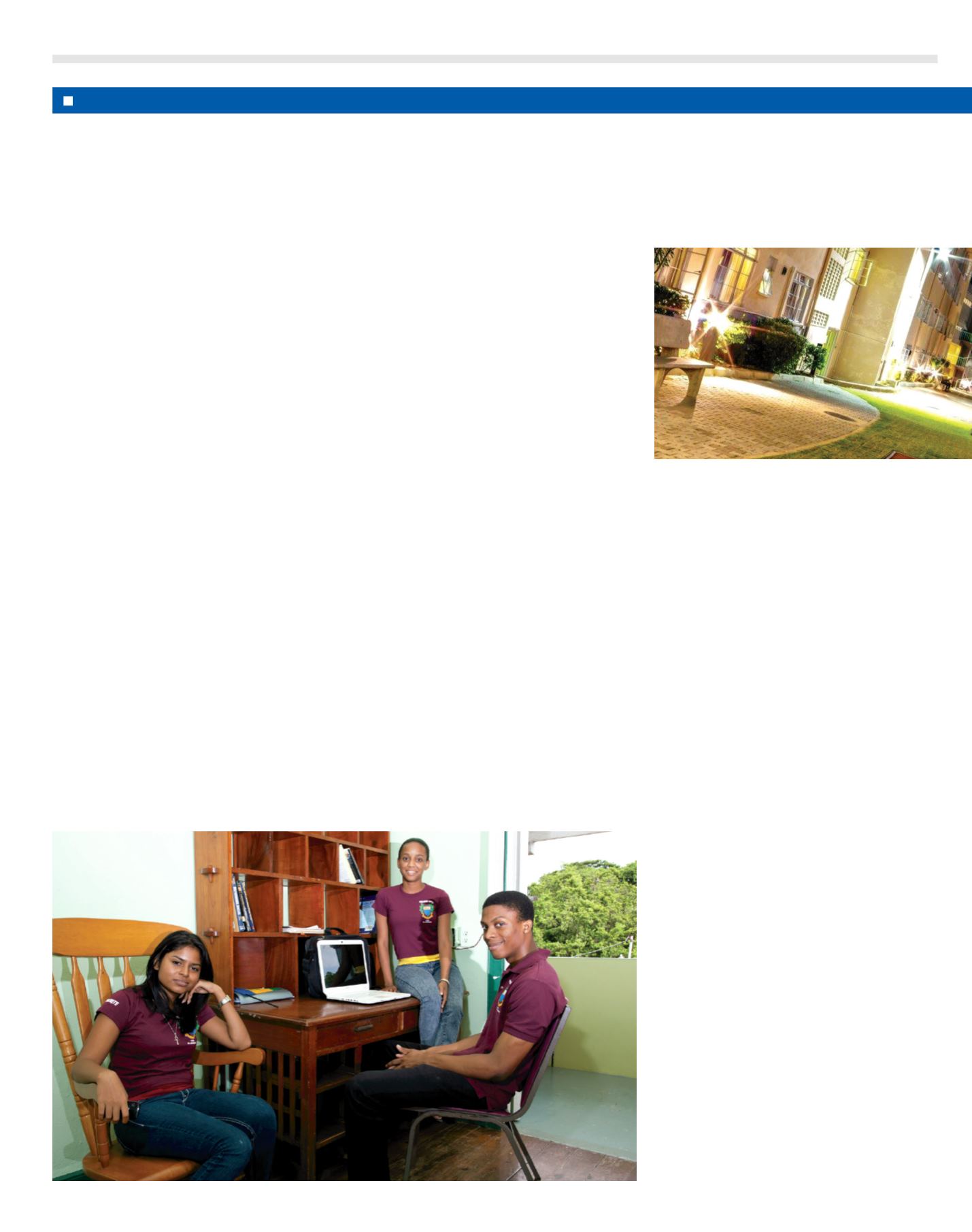
These three, along with Milner Hall and Joyce Gibson-Innis
Hall at the Eric Williams Medical Sciences Complex, comprise
UWI St. Augustine’s halls of residence. Apart from the few
remaining students (mostly international) they are empty. By the
following week that will change. By mid-August the students will
begin to stream in – from the region, the wider world, Tobago
and even areas such as South Trinidad. As many as 1200 new and
returning residents will populate these halls, a community within
the campus community, one of UWI St. Augustine’s most vibrant
communities of all.
“If you want a family atmosphere, if you want to be part of
a community that supports and looks out for your development
and ensures you that you get to the end of the journey, then the
halls are the best place for you,” says Kevin Snaggs, Manager of
Student AccommodationOn andOffCamps at UWI St. Augustine.
Speaking tome fromhis office at Arthur Lewis Hall, Snaggs is
well-placed to explain hall life. Since 2010 he has been the residence
manager at Arthur Lewis, the newest and largest hall of residence
with a capacity for over 450 students. The second largest, Milner
Hall (which can accommodate 330 students) is also the oldest,
founded in 1927 when the campus was still the Imperial College
of Tropical Agriculture.
Last year he was promoted to his current post as part of an
overall restructuring of St. Augustine’s Student Advisory Services,
which has now become the Division of Student Services and
Development. His jurisdiction has grown from one hall to every
hall, along with oversight on off-campus private housing in the
nearby neighborhoods.
His sentiments on a hall life are the same as those of Allyson
Logie-Eustace, hall supervisor of Trinity Hall: “The whole purpose
of being on hall is to give students the opportunity to bond, to
become part of a community and to learn diversity. It’s about
community living”.
Logie-Eustace has developed a powerful reputation for her
work as a hall supervisor. For her efforts she was presented with
UWI St. Augustine’s Overall Employee Excellence Award at the
Employee and Service Excellence Award 2014 ceremony. She sees
enhancing the cohesion of the young women at Trinity Hall (St.
Augustine’s lone all female hall of residence) as one of the most
important aspects of her occupation.
Founded in 1972, Trinity Hall has capacity for more than 140
students, similar to its “brother” residence, Canada Hall. The all
male hall, opened in 1963, has rooms for 168 students.
Speaking on life as a resident on Trinity Hall, Makini Barrow
says, “We form a sisterhood”.
It was the eve of hall committee elections
and Makini Barrow
had prepared her speech. She had written it, practised it and was
ready to speak before the sisterhood of Trinity Hall, to tell them
why she was the candidate they should choose for the position
of hall chairperson, the highest post in hall of residence student
government. But standing before the young women of Trinity Hall,
she decided instead to speak without the prepared statements.
“I threw it away and just spoke,” Makini said. “I told them
what my experiences were from the time I came on hall and how
it contributed to my development. I told them the reason I wanted
to be hall chair was to give back – not just what I have to give as an
individual but also what the hall gave to me in terms of growth”.
Her message resonated with Trinity Hall. She took more
than 70 percent of the 115 votes. After all, her story is very much
a common story for residents at Trinity and the other halls of
residence of UWI St. Augustine. She entered a new environment,
faced certain challenges, found acceptance, built lasting friendships
and felt a sense of personal development through the experience.
UWI Manager of Accommodations On and Off Campus,
Kevin Snaggs, describes experience:
“You are away from home for the first time and you are in
a strange place. People are coming from far away. Even coming
from Tobago or South may seem far to you because you have
never been here before, far less coming from somewhere such as
the South Pacific”.
For Makini, who came from St. Vincent and the Grenadines
to study public sector management, not only did coming to live
on hall in Trinidad mean leaving home, it meant leaving her
young daughter.
“I’m a mother, I have a daughter and leaving her was the
hardest thing,” she says.
It was in becoming part of the Trinity Hall community that
she dealt with these pressures. She dealt with them so well in fact
that she is now hall chairperson.
UWI campuses have a surprisingly well-articulated student
government system that extends to the halls of residence as well.
Each hall as several block representatives that oversee and handle
disputes in the different blocks within the hall (Trinity Hall, for
example, has six blocks).
Above the block representatives is the hall committee, which
consists of committee members that handle different portfolios
related to the hall. Hall committees may include a library
representative, a computer representative, a food and beverage
representative (who caters for all events), an entertainment
representative (who has links to the various night clubs) and even
a “tuck shop” representative for the in-hall snack vendor.
The committee has an executive which includes chair, deputy
chair and public relations officer. Members of the hall committees
are also members of the Guild of Students.
The most recent addition to the hall structure is the resident
assistant (RA). These are older, graduate level hall residents
appointed by the university to provide support for students. RAs
support the hall community by providing assistance, bringing
residents together and resolving disputes.
HAL
B Y J O E
Makini, who is now going into her final year, has fully
embraced hall life. Not only was she formed lasting friendships,
she has taken up positions in student government, first becoming
a block representative and earlier this year winning the election to
become the chairperson of the residence’s hall committee.
Promoting this sense of community on hall is for the comfort
of students. These are people, most of them having never lived
outside of their parents homes, entering a new living arrangement
and quite often a new country.
“We have a big percentage of residents from the region,”
says Snaggs. “Quite a lot come from Barbados and St. Vincent as
well as a growing population from Belize and the Bahamas. In
the region as well we have a small portion from Haiti and we are
starting to see more coming fromGuyana. Internationally we have
students coming from the US, Canada and Europe. And thanks
to CARPIMS (the Caribbean-Pacific Island Mobility Scheme, a
student exchange agreement) we have residents from Fiji, Samoa,
the Solomon Islands, Papau New Guinea and Vanuatu”.
Increasingly, students from Trinidad are staying on hall.
Snaggs says that as much as 40 percent of Arthur Lewis residents
are local (not including Tobago).
In these unfamiliar surroundings with so many unfamiliar
people integration is important for the mental health of the
students. It also helps with the inevitable disputes that arise.
“If there are two individuals sharing a room for the first time
you might have a clash bases in cultural differences,” Makini says.
“Some people come from homes where their parents took care of
everything for them so they are not accustomed to cleaning up
after themselves. They might have a roommate who is super clean
and neat. I might study at night and my roommate might prefer to
study during the day. These differences can cause conflict”.
Community norms can prevent or limit such conflicts
through an atmosphere compromise and a resident driven system
for conflict resolution.
Logie-Eustace says, “Being on hall, being on campus, you are
going to have struggles – academic struggles and social struggles.
Hall life is about facing challenges and finding support. The
students want to do well. They want to make friends. They want
to fit in. We help them do that”.
The other crucial aspect of living on hall is that it contributes
to the development of the student. Learning is about more than
successfully completing a course of study. There are life skills that
can be enormously beneficial (and necessary) for young adults in
both their professional and personal lives.
“Our goal,” Snaggs says, “is helping to develop students
who are well-adjusted, who are engaged and who contribute to
the region. We are looking for people who are culturally aware,
who understand and appreciate diversity and who partake in the
activities of the university and the society. So once they graduate
they become better citizens”.
A COMMUNITYWITHIN A COMMUNITY
THE INSIDE VIE


