Understanding Written Comments
The open-ended questions in the CER questionnaire are where the nuances live. Numbers tell you how frequently a teaching practice was observed; comments tell you why students responded the way they did. Reading and interpreting this feedback thoughtfully is one of the most valuable things you can do with your report.
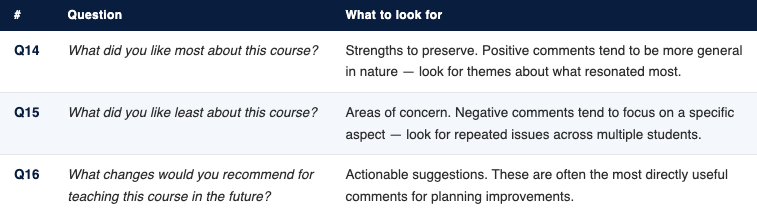
The Three Open-Ended Questions
The CER questionnaire includes three open-ended questions, which students answer in their own words:
How to Approach the Comments
What is the best way to read the comments?
- Look for repeated themes. A concern raised independently by several students carries considerably more weight than a single isolated remark. Frequency of a theme is a reliable signal that it warrants attention.
- Balance comments against the mean. If an item scores 4.5 but one comment is strongly negative, keep it in proportion. Read the comment thoughtfully, but do not allow it to overshadow a broadly positive picture.
- Do not dismiss unique comments. Even a single remark can point to an experience you were unaware of, and may represent others who chose not to write. Consider it alongside the numerical data before deciding how much weight to give it.
- Separate what you can control from what you cannot. Not all comments call for the same response — see the category framework below.
What do the word clouds in the report show?
However, word clouds cannot capture context, tone, or nuance. They are a useful starting point, not a substitute for reading the actual comments. Always follow up by reading the full responses to understand what students meant.
Should I acknowledge the feedback of my students?
This practice reinforces that the CER is a genuine mechanism for improving the course — not a box-ticking exercise — and tends to improve student participation rates in future semesters.
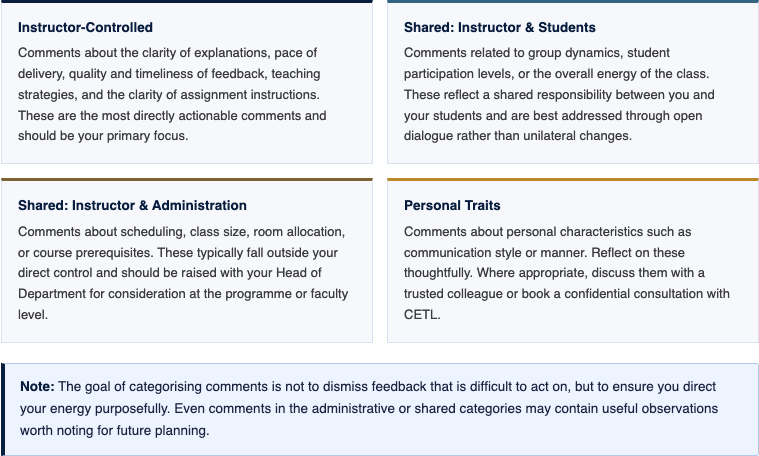
Categorising Comments: What Is Actionable?
Not all comments call for the same response. A useful way to approach them is to categorise each comment by where responsibility for addressing it lies. This helps you focus your energy on what you can realistically change, and identify what may need to be escalated.