
The university of the west indies at saint augustine

CETLinX Studio

Join us at our state-of-the-art studio in the Centre for Excellence in Teaching and Learning. Explore creativity, innovation, and collaboration like never before!

Faculty Café

Come check out our Faculty Cafe where educators can learn from each other’s experiences, discover new strategies for enhancing student learning, and stay updated on the latest trends and developments in education.

CER

Don’t miss this opportunity to voice your thoughts and make a difference in the quality of education you receive. Take a few moments to complete the review and help us continue striving for excellence. Your responses are ANONYMOUS.

Teaching Awards

Step into the spotlight and celebrate excellence in teaching at the UWI/ Guardian Group Teaching Awards ceremony. Join us to honor outstanding educators who inspire and empower.

  • What to Do next

What to Do Next

Receiving your CER report is the beginning of a reflective process, not the end of one. This page offers two complementary frameworks: a step-by-step guide to reading and interpreting your report, followed by CETL’s framework for managing the reflective process around it. An annotated sample report illustrates how both apply in practice.

A Five-Step Guide to Reading Your Report

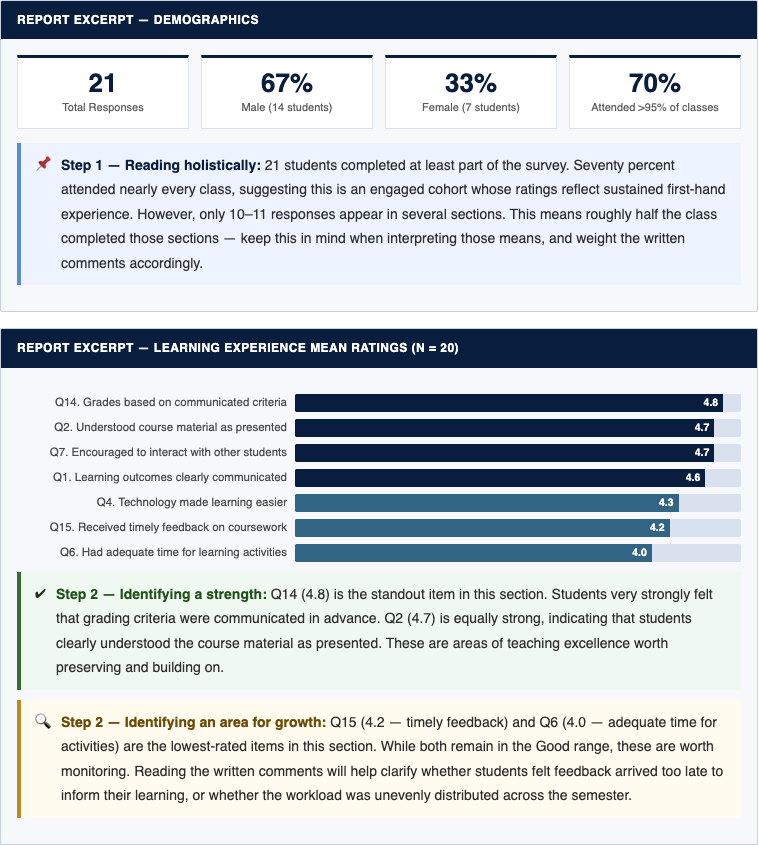
1. Read the report holistically before reacting to individual items
Before focusing on any single question, read the entire report once through. Start with the Ten Principles overview to identify broad patterns across your teaching practice, then return to the individual items with that context in mind. A single low item is far less significant than a consistently low score across a whole principle.
2. Identify one strength and one area for growth per semester
Choose one thing you did well — the highest-rated item or the strongest principle — and one area to improve per semester — the lowest-rated item or the principle with the most room for growth. Attempting to address every item at once is rarely effective. Focused, deliberate change tends to produce better outcomes than broad, scattered effort.
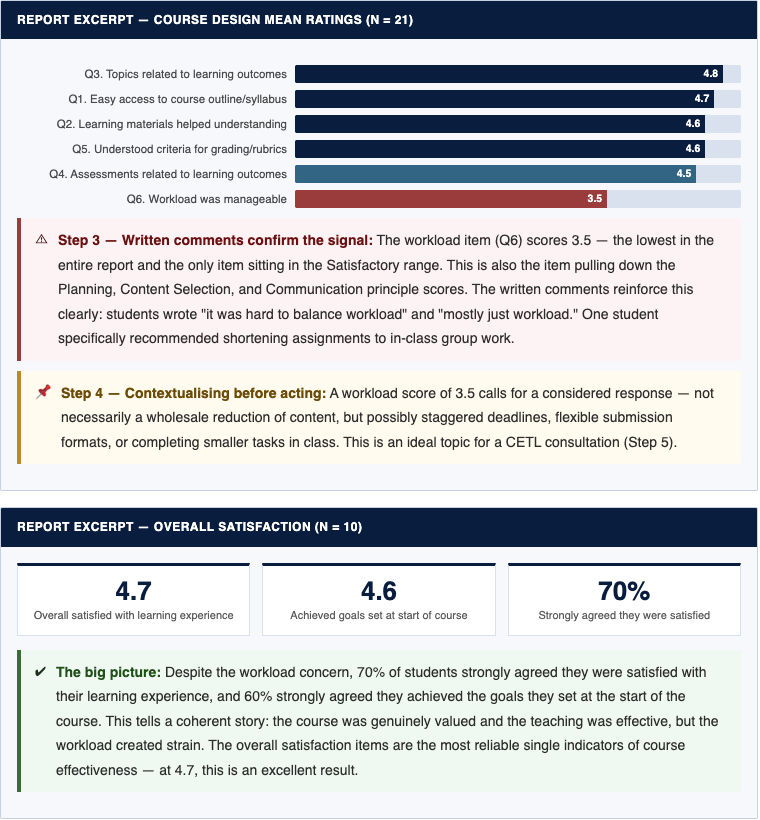
3. Read the written comments with your numerical results in mind
With your key numerical highlights identified, turn to the open-ended responses. Look for comments that explain or add nuance to the patterns you noticed. Note repeated themes and categorise them — instructor-controlled, shared, or administrative — to decide what is worth acting on and what may need to be raised with your Head of Department.
4. Develop a simple action plan
A formal document is not necessary — a few notes to yourself are sufficient. For each area of improvement you have identified, record:

  • What specifically the data and comments suggest is the issue
  • One concrete change you will trial next semester
  • How you will know whether the change worked — for example, an improvement in a specific CER item in a future semester
5. Consider a CETL consultation
CETL offers confidential one-on-one consultations with teaching specialists who can help you interpret your report, discuss evidence-based strategies for improvement, and support your ongoing reflective practice. To book, visit sta.uwi.edu/cetl/book-a-consultation.

Annotated Sample Report

The excerpts below illustrate how the five steps above apply in practice. Annotation boxes walk through what each figure means and how a lecturer might respond to the data.
CETL’s Framework for Responding to Student Feedback

Alongside reading your report carefully, it is equally important to manage the process of engaging with feedback — particularly when comments feel personal or unexpected. CETL’s five-step framework, grounded in Rolfe’s reflective practice model, is designed to help you approach your results with a clear and open mind.

1. Reflect — before you open the report
Before you look at your scores and comments, take a moment to consider what you are expecting to see. Think about what went well in the course and where you felt less confident. This reflective stage connects directly to the first question in Rolfe’s model — What? — and prepares you to engage with the data objectively rather than reactively.
2. Read and React — allow yourself an emotional response
Open the report and read through it. If you feel pleased, proud, frustrated, or stung by what you find — that is a completely natural reaction. Do not suppress it. Acknowledging the emotion is an important part of the process. What matters is what you do next.
3. Relax — step away and process
Set the report aside for a period of time before responding to it. Strong emotions — whether positive or negative — can distort your interpretation of the data. The literature supports being deliberate about when you review your feedback: avoid doing so under stress or time pressure. Returning with a fresh mind produces a more useful response.
4. Revisit — re-approach with a new perspective
Return to the report with a calmer, more analytical mindset. Now ask the deeper questions: What is the student really saying? Is there a broader issue being raised that connects to several items or written responses? Look for patterns rather than reacting to individual remarks in isolation.
5. Respond — make decisions and plan forward
Now decide what you will keep, what you will do differently, and how. Make a note alongside your course materials so you remember what you plan to change the next time you teach the course. This is also an ideal time to book a CETL consultation if you would like support developing your plan.
Need help interpreting your report? CETL is here to support you. Book a confidential one-on-one consultation at sta.uwi.edu/cetl/book-a-consultation, or contact us directly at sta.uwi.edu/cetl.