

This past November, several researchers from UWI St Augustine were ranked in the top two percent of their disciplines in the world. The list, compiled by authors from Stanford University and Elsevier, ranked researchers in the top 100,000 within 22 scientific disciplines and 174 subfields. The selected scientists were Dr Mandreker Bahall, Professor Christopher Oura, Dr Sephra Rampersad, Professor Hazi Azamathulla, Dr Srikanth Umakanthan, and Dr Vinod Kumar.
Research has always been at the forefront of UWI’s agenda, going back to its forerunner at St Augustine, the Imperial College of Tropical Agriculture (ICTA). Well known for its pioneering work with cocoa (the world’s largest repository, the International Gene Bank for Cocoa, is kept in St Augustine’s custody), the Cocoa Research Centre (CRC) has made famous advances in protecting the crop from various diseases, like Witches’ Broom and Black Pod. It was at ICTA also that the conditions for ripening and storing bananas were developed, which led to them being able to be transported globally.
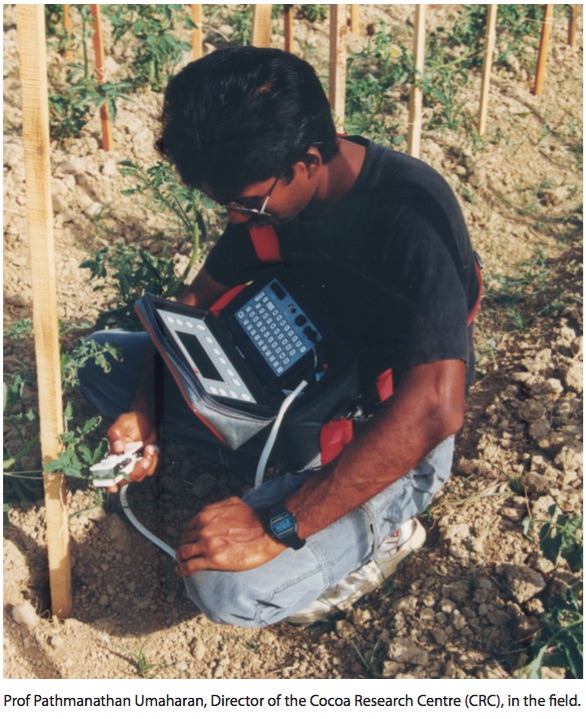
Professor Pathmanathan Umaharan, an expert in plant genetic resources management, genetic analysis, and crop improvement, is head of the CRC. In 2009, he discussed the need for regional food security and how we can use our genetic resources to create economic opportunities.
Dark chocolates had been found to contain healthy antioxidant and nutritive properties: neutraceuticals. The Department of Chemistry was working to chemically characterise the flavour and neutraceutical content of local cocoa beans and to correlate their respective sensory qualities.
“We have developed new anthurium varieties which are resistant to bacterial blight. These are universal diseases in the tropics, so it has widespread application. Mozambique, South Africa, South China, and Hawaii have requested varieties. We can either licence them and earn royalties, or sell them to them,” he said.
These economic opportunities identified by Prof Umaharan are reflected in the latest thrust of the UWI. Campus Principal, Professor Rose-Marie Belle Antoine, informed the Campus Council that the focus was on generating income under the banner UWI MADE. Years of reduced funding from regional governments has led the university to find ways to take its research to market. It had not previously been such an imperative.
In 2012, a Research and Development Impact Fund (RDI) was set up to address “pressing developmental challenges”. The range of categories encouraged multi- disciplinary research—climate change, crime and security, economic diversification and competitiveness, entrepreneurship, public health and technology, and society. In its first two years, TT$14 million was awarded for 22 projects. “They ranged from looking at the impact of climate change on the Caroni Swamp, to the analysis of counselling programmes for at- risk youth, to understanding the heritage of East Port-of-Spain, to finding new methods of detecting and preventing the spread of dengue fever and the development of an agri-knowledge digital portal,” reported UWI TODAY.
Among the various RDI projects in 2020 were the following:
The full list is available at https://sta.uwi.edu/rdifund/project-list
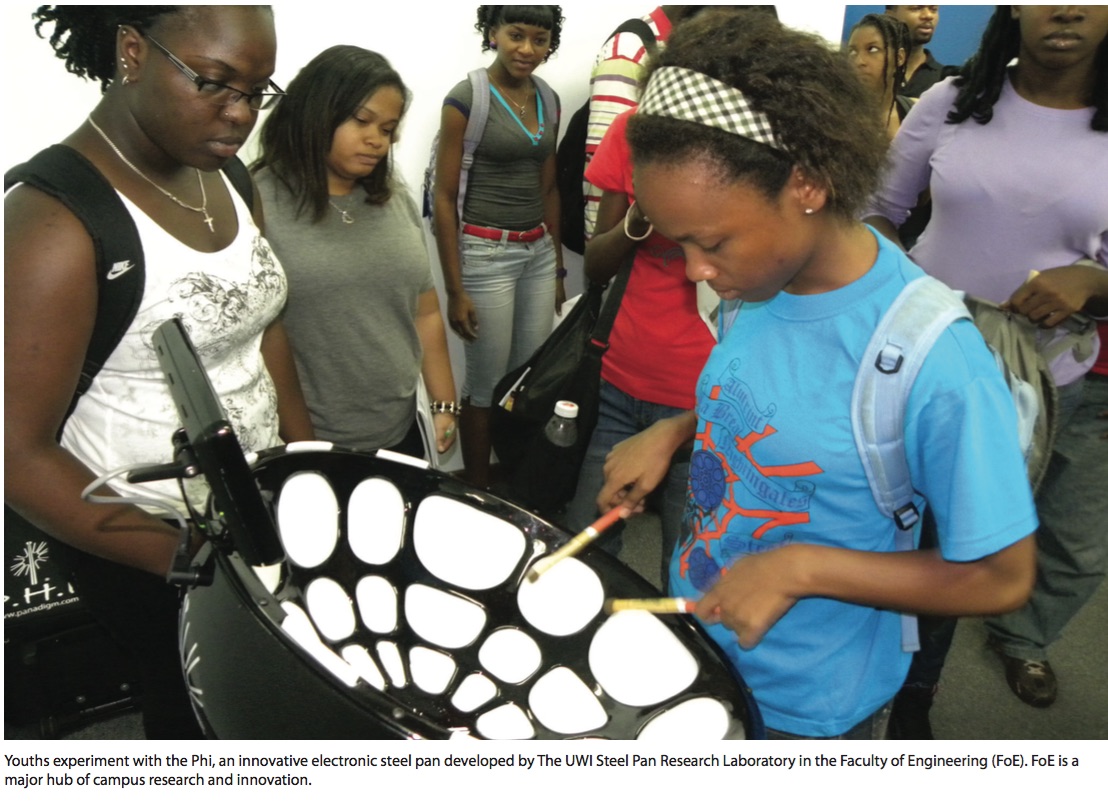
Several innovations have come over the years, for instance, PHI, the percussive harmonic instrument, and the G-Pan in 2007. Under the leadership of the then Engineering Dean, Professor Brian Copeland, a team designed and constructed these instruments, based on a prototype developed by Keith Maynard in the 1980s.
In an entirely different discipline, the pioneering training in bariatric and laparoscopic surgery came from Professor Dilip Dan, who introduced and developed UWI’s doctorate in medicine in surgery programme. Bariatric surgery has not only been used in cases of obesity, but has been effective in diabetes control. Laparoscopy is a method using small incisions, with guided cameras for internal vision. It is now very common.
In July 2025, UWI TODAY announced that the latest major release of the largest biodiversity time-series database, BioTIME, was co-authored by scholars and naturalists from the campus. The open access database has monitored 150 years of changes in biodiversity on the planet from 553,000 locations.
The records now include data from T&T supplied by the Department of Life Sciences. The team of Dr Amy Deacon, Professor Indar Ramnarine, Mr Raj Mahabir and Mr Kharran Deonarinesingh collected data on freshwater biodiversity from the Northern Range.
As it shifts its trajectory toward self-sustainability, the campus has not lost its rootedness in research, which continues to be its lifeblood.