SUNDAY 21ST FEBRUARY, 2016 – UWI TODAY
11
MAKING OUR MARK
Dr. Windsor Frederick
Lecturer, Child Health, Faculty of Medical Sciences,
The University of the West Indies
a. He made a presentation entitled ‘
Critical Issues in
the Paediatric age group
’
b. He suggested that ZIKV virus is expected to
reach our shores in the near future. There may be
challenges in assessment and management of patients
with ZIKV due to the simultaneous circulation of
the Dengue and Chikungunya viruses. This would be
especially so in infants due to the non-specific nature
of disease presentation in this age group and the
similarities in presentation of the viruses mentioned.
c.
If a causative role for ZIKV in these cases of
congenital anomalies, is confirmed this may have
significant implications for the potential burden that
ZIKV may place on the health care system.
d. Affected infants may have complex
neurodevelopmental issues which would
require thorough assessment and long term,
multidisciplinary, follow up.
e.
Identified the challenges
posed by ZIKV
as the
non-specific presentations in younger children
and infants, distinguishing between ZIKV cases
and dengue fever, reports of possible congenital
abnormalities due to vertical transmission.
f.
He highlighted possible complications
of ZIKV as
possible association with Guillain-Barre syndrome
and other neurological complications-– meningitis,
meningoencephalitis, myelitis
g.
Recommended the following management measures
for ZIKV cases: supportive care, rule out other
serious conditions, attention to oral intake and
hydration status, thorough evaluation and follow
up of patients with the possible effects of vertical
transmission.
The Editor will like to thank Professors Abiodun Adesiyun, Clive Landis and Terence Seemungal for their notes, comments and contributions towards the publication of this feature.
Part 2 that covers prevention in greater detail was contributed by Dr Vijay Chattu,
Lecturer in Public Health at the Faculty of Medical Sciences and is available on line at UWI Today:
/
Dr. Michelle Ramjohn
Specialist Obstetrician/Gynaecologist, Mt. Hope
Maternity Hospital
a. She presented a paper entitled ‘
Why Pregnancy is high-
risk for H1N1 and Zika?
’
b. Pregnant women are at increased risk of morbidity
and mortality with the H1N1 virus. Newborns born
to mothers who develop severe illness are at increased
risk of prematurity and low birth weight. Daily new
information is emerging about the effects of ZIKV in
pregnancy requiring us to formulate new strategies to
combat this potentially crippling disease.
c.
She referred to a statement by the
El Salvador Deputy
Health Minister, Eduardo Espinoza that ‘We’d like to
suggest to all the women of fertile age that they take steps
to plan their pregnancies, and avoid getting pregnant
between this year and next.’
d. Information on ZIKV available to date was identified
as:
i.
There is limited but daily increasing knowledge
about ZIKV infection in humans and pregnant
woman.
ii.
October 2015
– Brazil Health officials noticed an
unusual increase in microcephaly
iii. By November 2015 the incidence of microcephaly
– 99.7/100,000 live births,
previous years e.g. 2010 incidence of microcephaly
– 5.7/100,000 live births, which represents a 20 fold
increase in incidence.
iv. In Brazil, ZIKV genome has been detected in
amniotic fluid samples of pregnant women
whose fetus was diagnosed with microcephaly on
ultrasound and in blood and tissue samples of a
baby who died at 5 minutes of life.
v.
The greatest risk of microcephaly or congenital
abnormalities is associated with the ZIKV in the
first trimester.
vi. French Polynesia has reported an increase in
fetuses and newborns with CNS malformations-
fetal cerebral malformations or polymalformative
syndromes, including brain lesions. Some infants
were reported as having brain stem dysfunction
and absence of swallowing.
vii. All of the above suggest that there is a mother to
child transmission of the ZIKV.
e.
The speaker identified the symptoms
of ZIKV infections
in pregnant women as:
i. Generally mild and short lived (2-7 days)
ii. Similar to those of Dengue and Chikunguya:
Low grade fever, Joint pain (swelling mainly
in the smaller joints of hands and feet), rash,
conjunctivitis, headache, muscle pain and eye pain.
f.
Recommendations made by the presenter are as follows
:
i. Thus far the ZIKV has been shown to have adverse
effects on the fetus…….but it is preventable.
ii. Hence pregnant women should consider the risks
of travel to ZIKV endemic areas and consider
postponing their trip.
iii. Educate women about the symptoms of Zika and
the need to seek medical attention
iv. There is no vaccine or specific antiviral to combat
ZIKV, therefore the only way to avoid the virus is
to avoid being bitten by infected mosquitoes.
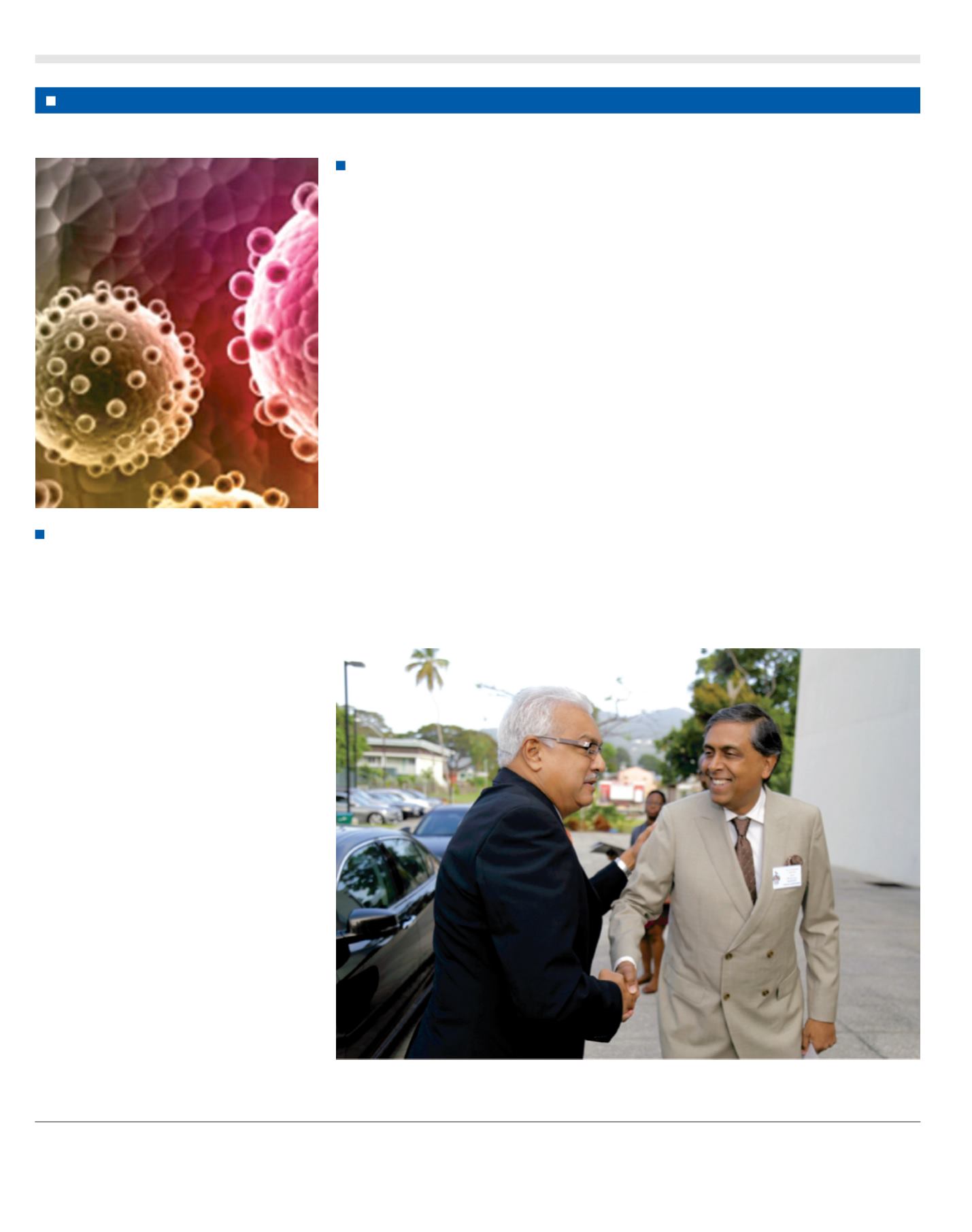
Minister of Health Terrence Deyalsingh (l) is warmly welcomed by Dean of The UWI’s Faculty of Medical Science, Professor
Terence Seemungal (r) at the start of the symposium held at the Teaching and Learning Complex, at The UWI.
The causative agent of
Zika fever, is a mosquito-
borne flavivirus that is
currently emerging in
the Americas.


