SUNDAY 21ST FEBRUARY, 2016 – UWI TODAY
7
MAKING OUR MARK
Legend has it that every man’s dream
job is that of rock
star. For some, the next best thing to rocking out on a stage
to thousands of screaming fans is rocking out in the top 5%
of 32 million researchers visited at one website.
To add another layer of pun to this story, this rock star
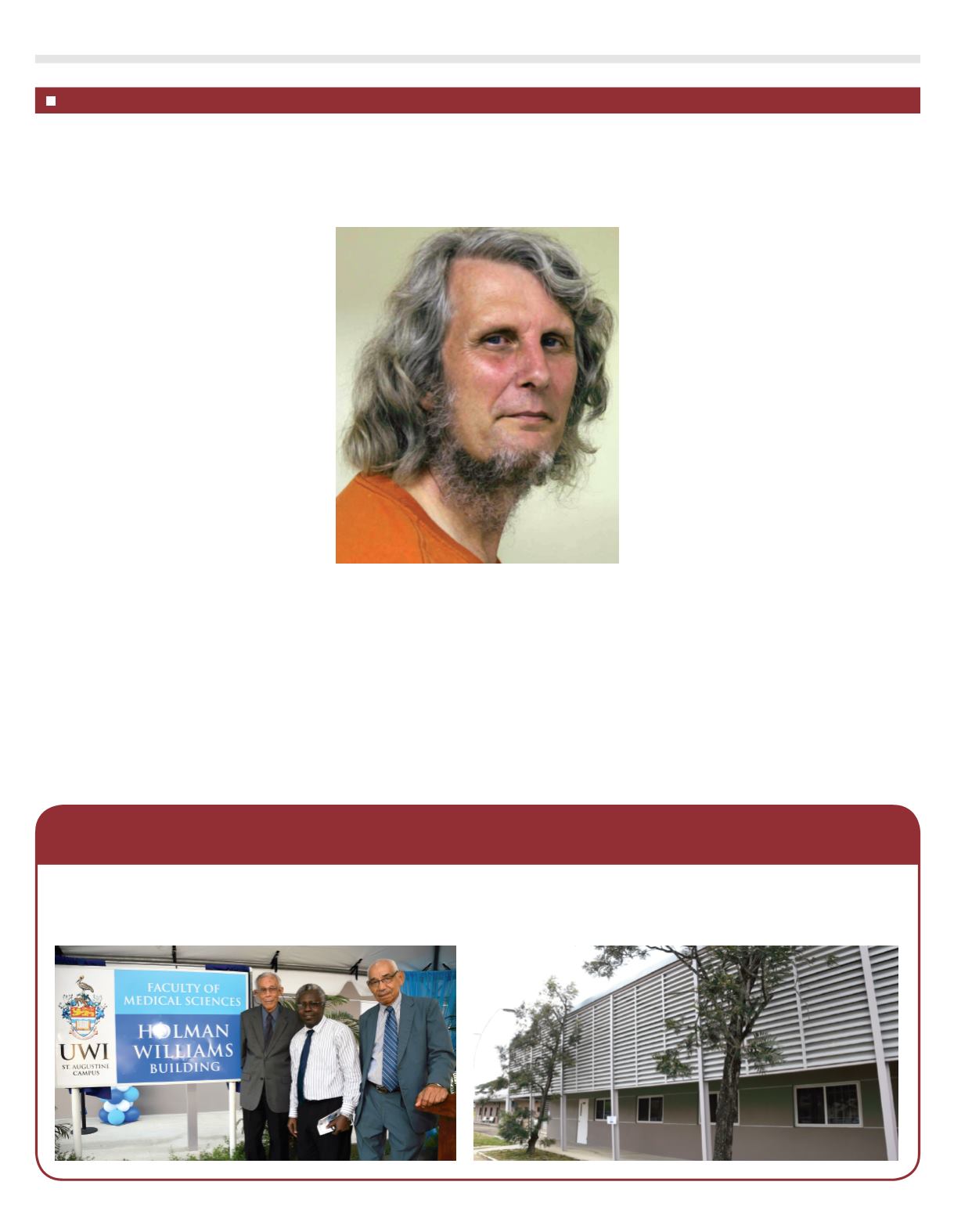
of academia is Brent Wilson, Professor of Palaeontology
and Geology at St Augustine’s Department of Chemical
Engineering, PetroleumGeoscience Programme. In January
alone his work posted on the site Acadmia.edu received
75 profile views and 65 document views from 45 unique
visitors, which put him in the top 5% of all 32 million
researchers hosted by the site.
While tenured atThe UWI, he has published 55 papers
in refereed journals, and 14 articles in newspapers and
books. He has presented research seminars on his work at:
• Smithsonian Institution, Washington D.C.,
of which he was made a research associate in 2014,
• Bedford Institution of Oceanography, Dartmouth,
Canada,
• Dalhousie University, Halifax, Canada,
• IFM-Geomar-Institute, Kiel, Germany,
• Anton de Kom University, Suriname
• University of Georgia, Athens, USA.
A frequent reviewer for papers submitted to
Palaios,
Marine Micropaleontology and Biogeochemistry
, Professor
Wilson is the Caribbean correspondent for the popular
magazine
Geology Today
and an associate editor of the
prestigious
Journal of Foraminiferal Research
, focussing
on the biostratigraphy of the last 25 million years. He is
a Fellow of the Cushman Foundation for Foraminiferal
Research, and served as a Director of the Geological Society
of Trinidad and Tobago from 2008 – 2015, to which he is
a frequent technical presenter and for which he aided in
organising the 20th Caribbean Geological Conference in
2015. He has supervised graduate students working on
micropalaeontology, sedimentology and volcanology.
Thisliteral andacademic rockstar isalsofrequentlycalled
on by BHP Billiton regarding the use of micropalaeontology
in their oil and gas exploration and is currently playing a
large role in the commercialisation of micropalaeontological
services within his Department. These services are proving
to be in high demand. The Ministry of Energy and Energy
Industries has recognised the value of Wilson’s work,
awarding him a sizeable grant to investigate some of the
new techniques that he has developed. Furthermore, oil
giant BPTT has over the past decade repeatedly given him
funds to allow him to involve students in his research, thus
giving them a chance to experience the rigours, techniques
and excitement of research first hand.
Moving from Nevis to Trinidad in 1998, Professor
Wilson initially worked as a biostratigrapher in the
oil industry, using fossil foraminifera to tell the ages
of sedimentary rocks and the environments in which
they had been deposited. He joined the Petroleum
Geoscience Programme in 2003 to lecture in palaeontology,
sedimentology and stratigraphy, using his experience from
Nevis and industry. His research on microscopic fossils at
the UWI has concentrated on two aspects especially:
• using them to decipher the geological history of Trinidad
duringMiocene times (23 – 5million years ago), when the
mountain building associated with the Northern Range
led to huge changes in sea level elsewhere on the island,
and
• using them to unravel the impact of the Orinoco River on
the island’s geological history since the river first began
flowing towards the east about 7 million years ago.
Professor Wilson’s prolific research has arisen from his
ability to find and fill gaps in our knowledge while using a
minimum of equipment. During the 1940s through 1960s,
Trinidadwas a global centre for work inmicropalaeontology
(the study of microscopic fossils). With the nationalisation
of much of the oil and gas industry in the 1970s, however,
academic research in micropalaeontology here in Trinidad
and Tobago came to a virtual standstill but continued
elsewhere. There were thus many opportunities when
Wilson joined the UWI simply applying up-to-date
techniques to our local material. However, this was not all.
Each research project, while answering some questions,
raises other ones. Frequently answering these requires that
new techniques be developed. He has been instrumental
in developing some statistical techniques, such as the
Assemblage Turnover Index, that have deepened insights
into micropalaeontology worldwide. This is evidenced by
the interest his work has garnered online. So the next time
someone verbalises the dream of achieving rock star status,
be sure to ask if that’s of sedimentary rock and its fossils.
Professor BrentWilsonAchieves Rock Star Status
In celebration of the
twentieth anniversary of the School of Veterinary Medicine (SVM) at The UWI, a new building was named after one of its early visionaries, Professor
Holman Williams. Professor Williams was instrumental in establishing the SVM and for over sixty years, demonstrated his commitment to the development of the veterinary
profession. This building is located near the Professor Steve Bennett building and was officially opened in early February. Now in his eighties, Professor Williams was present
for the occasion and is captured sharing the event with University senior staff.
SVMopensHolmanWilliams building


