SUNDAY 5TH JULY, 2015 – UWI TODAY
17
Editor’s Note: The original date for the conference of 6-8 September has been reconsidered
by organizers due to the national election which has been scheduled for 7 September. The new dates are 28-30 October, 2015.
Dr J. Vijay Maharaj is a cultural and literary analyst who works in the Department of Literary, Cultural and Communication Studies.
In the academic world
, work dedicated to Shiva Naipaul has
been greatly overshadowed by that focussing on his older
brother, VS Naipaul, a position Shiva Naipaul anticipated
and rescinded, as the quotes gathered on the Friends of Mr
Biswas website illustrate
pages/shiva-and-vidia-my-brother-and-i).
Such sibling-overwhelming is rather unfortunate
because Shivadhar Srinivasa Naipaul, aka Shiva Naipaul,
benefitted from the literary experiences of his family and
from inception his voice was strong and his crafting unique.
In fact, his very first novel,
Fireflies
, published when he
was twenty-four years old, was longlisted for the Lost
Man Booker Prize 1970 and won the Jock Campbell New
Statesman Award, the John Llewellyn Rhys Memorial Prize
and the Winifred Holtby Prize.
In the sixteen years between that first book and
his death at the young age of forty, he wrote two other
outstanding novels,
The Chip Chip Gatherers
in 1973 and
A
Hot Country
in 1983, which was re-published in 1985 under
the new title
Love andDeath in aHot Country
. Between these
two novels, using his brother’s well-worn methodology of
following the surging tides of displaced humanity to first
write the travel narrative that fosters later fiction, he wrote
two.
North of South: An African Journey
(1978) describes
his visits to Kenya, Tanzania and Zambia, and
Black and
White
(1980) tells about his travels in Guyana prompted by
the Jonestown massacre.
The latter was republished in 1981 with the title
Journey
to Nowhere.
It provided the research material on which
A
Hot Country
/
Love and Death in a Hot Country
is based and
reminds us of what Paul Fussell says in
Abroad
: “To speak
of ‘literary traveling’ is almost a tautology, so intimately
are literature and travel implicated with each other” (212).
In 1984, a collection of short stories and essays
Beyond
the Dragon’s Mouth
was published and in 1986, the year
following his death, another collection of essays, especially
about his travels in Australia and Sri Lanka,
An Unfinished
Journey
, was released
.
Shiva in the Naipaul Dynasty
B y V i j a y M a h a r a j
Prize – awarded annually by
The Spectator
is an indication
of this and the criteria for the prize are worth noting. As
Tom Coote puts it on his travel writing website: “the prize
is not awarded for travel writing in the conventional sense.
You need not have gone anywhere highly exotic or far away:
the prize is for ‘the most acute and profound observation of
a culture alien to the writer.”
Certainly, regardless of its genre or a culture’s alienness,
the works of the three Naipauls share this quality. In
addition, as Michael Joseph Chukwudalu Echeruo notes
with regard to the writer of the foreign novel of Africa,
he (sic) “uses the distanced peoples and lands of his
narrative to make assertions of a large and general kind
about human life and human values.” Distancing to this
effect is a predominant element of the Naipauls’ writing,
and as I have mentioned elsewhere, in the father’s writing
it primarily “demonstrate(s) his Brahminic knowledge of
Hindu traditions as well as the Brahmin right to violate the
explicit rules of community cohesion by criticism, which
in the traditional sense paradoxically speaks to the strength
of a community that can withstand and incorporate such
criticism” (Maharaj, 2008, 182). The stage for the sons’
work is however a much larger one and the criticism is less
linked to religion.
Nevertheless, it incorporates the same moral, ethical
stance. In relation to Shiva Naipaul’s work as a whole, one
may argue in fact that he develops a theme of postcolonial
pusillanimity, demonstrates its pervasiveness in a variety of
societies that have recently been declared independent and
opposes it by illustrating the many ways it is detrimental
in a variety of scenarios and fatal in those situations that
require its exact opposite: moral courage. We will pick
up on this important note next month in the lead up to
the conference -
Seepersad & Sons: Naipaulian Creative
Synergies
, which is being hosted byThe Friends of Mr Biswas
in conjunction with the Department of Literary, Cultural
and Communication Studies of the St Augustine campus
of The UWI.
Discussing Naipaul – Part 2
Like his brother andmany others, such as Isak Dinesen
aka Baroness KarenBlixenwhose life readersmay be familiar
with from exposure to the movie,
Out of Africa
starring
Meryl Streep, Shiva Naipaul has been criticised, especially
for his travel writing on Africa. Nonetheless his writing is
considered outstanding. The travel writing prize that has
been named in his honour – The Shiva Naipaul Memorial
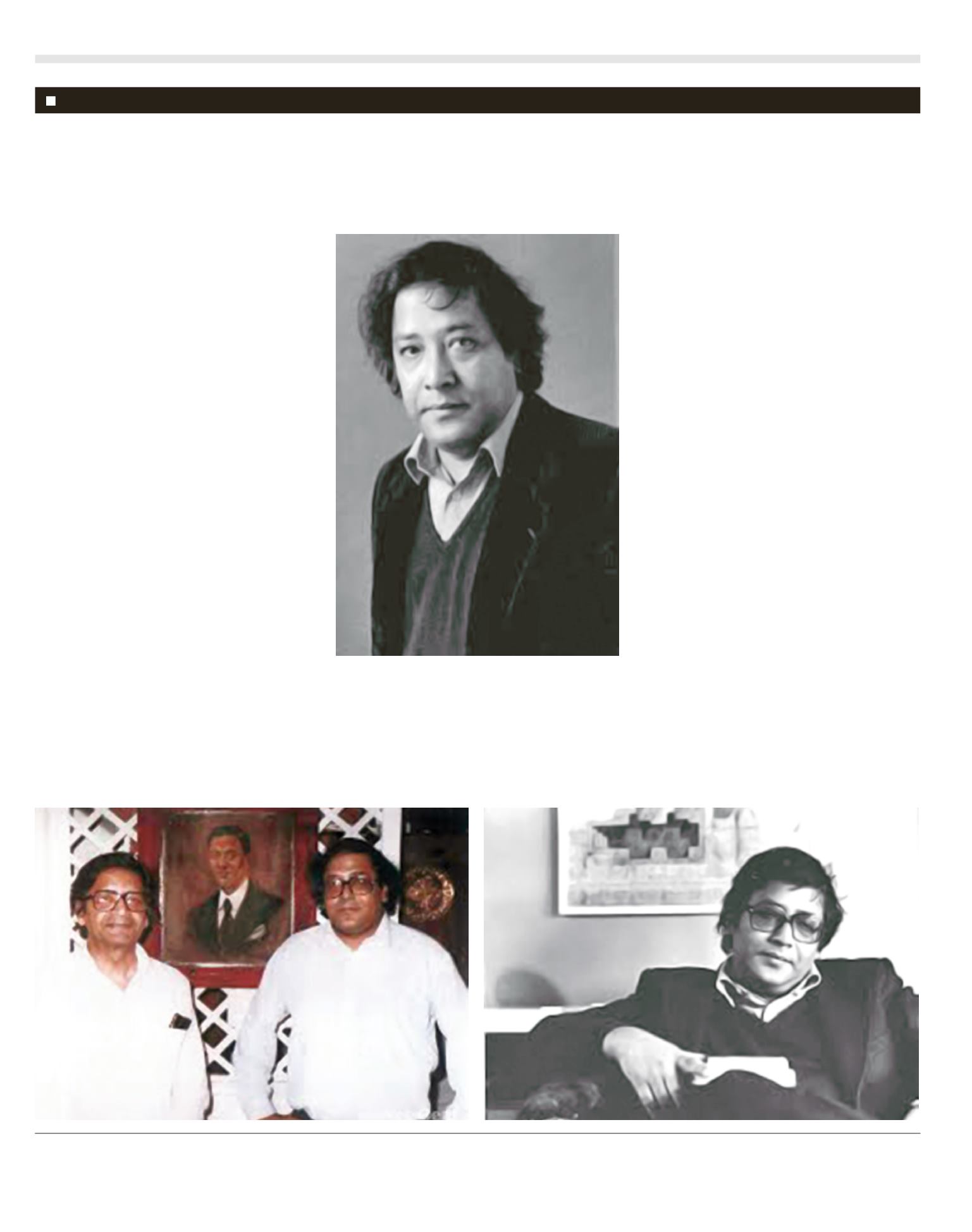
Shiva Naipaul
Shiva Naipaul
Shiva and VS Naipaul
with a portrait of Seepersad


