18
UWI TODAY
– SUNDAY 5TH JULY, 2015
Amar Lall, a farmer from Macoya
who gave remarks at the
opening of the project,
Promoting Agriculturally Important
Microorganisms (AIMS) -
to address the challenges in Food Safety
and Food Security in the Caribbean, said that he has expectations
of what the project can do for his livelihood.
The UWI-TT RDI Fund sponsored project on
Promoting
Agriculturally Important Microorganisms (AIMS)
to address the
challenges in Food Safety and Food Security in the Caribbean
was
launched on 25 June by Dr. Isaac Bekele, Dean, Faculty of Food
and Agriculture at UWI. The launch was attended by farmers,
vegetable producers, Director from the ResearchDivision, Ministry
of Food Production, Deputy Director Research (Crops), Deputy
Director Extension, Regional Administration North, Agricultural
Extension Officers, NAMDEVCO, Representatives from regional
organizations like USDA, CABI, IICA, CARDI, FAO, the Campus
Registrar Richard Saunders, Academic, Technical staff and students
from the Faculty of Food and Agriculture, Faculty of Science and
Technology, Cocoa Research Unit, UWI, St. Augustine.
Mr Lall went on to explain that the repeated application of
pesticides to his crops was not able to contain the pests and diseases
so he welcomesThe UWI community’s interest in working closely
with the farming community to solve their problems to ensure food
security and reduce the cost of application of pesticides. He also
emphasized that the farmers need to be educated on early diagnosis
of plant pest and disease so as to deal with holistic approaches.
Dr. Gaius Eudoxie, Lecturer (Soil Science), Department of
Food Production, Faculty of Food and Agriculture, chaired the
session with briefing about the significance of the project in the
region, more specifically the relevance of soils component in the
project.
Professor Neela Badrie, Head, Department of Food
Production welcomed the gathering andmentioned the suitability
and relevance of the AIMS project within the UWI strategic
plan 2012-2017. Prof. Badrie reminded the audience of the UN
definition of food security: ‘An access to safe and secure food is
a basic human right and thus each country has a responsibility
to address food safety issues’. During her opening remarks, she
quoted the reports that reminded all that there are unacceptable
levels of pesticide residue in some of the food commodities in the
Central America.
Dr. Saravanakumar Duraisamy, Senior Lecturer (Plant
Pathology), and Team Leader of the AIMS Project on his
introduction to the project spoke about the
Plantwise
programme
- a UK report on the crop production losses to the value of US$
240 million due to pests and diseases attack worldwide; and
that for every 1% reduction in pests and diseases, it is estimated
The AIMS are to use
Bio-control and Bio-fertilizer
Environmental innovation
that we would be able to feed an extra 25 million people. Dr.
Saravanakumar Duraisamy acknowledged the UWI-TT RDI
Fund and thanked Prof. Clement Sankat, Campus Principal for
project approval.
Mr. Assim Dilbar, Director, Research Division, Ministry of
Food Production on his special remarks mentioned theMinistry of
Food Production’s involvement in the promotion of bio-fertilizers
especially VAM in corn through Mexicon collaboration and
emphasized the need for good agricultural practices and crop
integrated practices to manage the pest and disease problems.
The Director has also give insights into the research taking place
in the Ministry of Food Production in the use of Metarhizium on
the red palmmite control under laboratory conditions and wished
the project for successful implementation.
As part of the promotional activity and more importantly to
sensitize the students, research scholars and interested groups on
the utility of beneficial micro-organisms in agriculture, there was
an AIMS logo design contest. The AIMS research team selected
the logo for the project with the slogan of
safe and secured food
which was submitted by Carla Washington Mclean. Her award
was presented on the same day of the project launch by Dr. Isaac
Bekele, Dean, Faculty of Food and Agriculture.
Dr. Isaac Bekele on his launch address emphasized the
necessity for food security and self-sustainability in the region.
He also stressed the importance of growing the network between
Institutions, Extension Officials, Ministry of Food Production
and Regional Organizations. He emphasized the need to sensitize
the graduate students’ research in the basic and applied aspects
of agriculture so as to address the challenges in food security of
the region. He mentioned that the Faculty received 6 projects to
the funding of TT$ 2 million from the 3
rd
call proposals from
the UWI-TT RDI Fund. He ended his remarks by saying that he
appreciated the efforts of faculty members in bringing out quality
publications and marching towards quality research in the region.
Dr. Wendy-Ann Isaac, Lecturer (Weed Science), proposed the
vote of thanks recognizing the efforts taken by the students and
staff of the Department of Food Production and Faculty of Food
and Agriculture to organize the launch.
Facts about the UWI-TT RDI AIMS PROJECT
The UWI-TT RDI fund recently sanctioned the project
on
Promoting Agriculturally Important Microorganisms (AIMS)
to address the challenges in Food Safety and Food Security in
the Caribbean
to the Department of Food Production, UWI,
St. Augustine. The project will be for three years commencing
from May 2015 to April 2018. The AIMS project is envisioned
to identify, characterize and promote agriculturally important
indigenous microorganisms as bio-control agents and bio-
fertilizers in the perspective of an effective plant disease and soil
fertility management in an effort to reduce the use of hazardous
pesticides in the region.
Plant diseases are the major constrains in vegetable
production of the Caribbean and viewed as the vital challenges
to be addressed to ensure food security of the region. Further,
an indiscriminate and intensive use of hazardous pesticides to
control pests and diseases have revealed the great concerns over
environmental and human health hazards posing serious threats
to the safe food especially in vegetables where most of them are
consumed without processing and or consumed as raw materials.
In addition to this, the continuous and intensive application of
inorganic fertilizers has deteriorated soil biota thereby reducing the
yield potential in the Tropical agriculture. These practices warrant
the development of locally adaptive novel and sustainable strategies
to ensure food safety and food security of the region. One such
holistic approach which is foreseen to address the above said issues
in a sustainable manner will be the promotion of Agriculturally
Important Micro-organisms (AIMS) which has so far received very
little attention in the region.Thus the current proposal justifies and
demand the basic and applied research on developing potential
AIMS suitable for the tropical agriculture.
The main aspect of the project will be to explore native micro-
organisms with the perspective of developing it as the elite bio-
control and bio-fertilizer strains for quality vegetable production
system in Trinidad and Tobago so as to reduce the use of chemical
pesticides in the region. The project will utilize various traditional
pathological, biochemical and advanced molecular techniques to
track novel elite microorganisms to thwart pests and diseases in
the vegetable cultivation and to fix and facilitate the mobilization
of the nutrients in the soils to improve soil fertility ultimately to
increase plant growth and yield.
The potential of AIMS will be demonstrated in the vegetable
crops viz., hot pepper, lettuce, okra and bodi as model systems at
greenhouse and field conditions. The utility of AIMS in vegetable
crops will be demonstrated by the conduct of field day and
awareness on AIMS will be created among the farmers, nursery
entrepreneurs, vegetable growers and protected cultivation systems
by the conduct of workshops and trainings.
This would also be a viable input in future to the organic
vegetable producers, home gardeners and school gardens for plant
disease and soil fertility management as it would reduce the risk of
pesticide exposure to common public and school children as well.
Email:
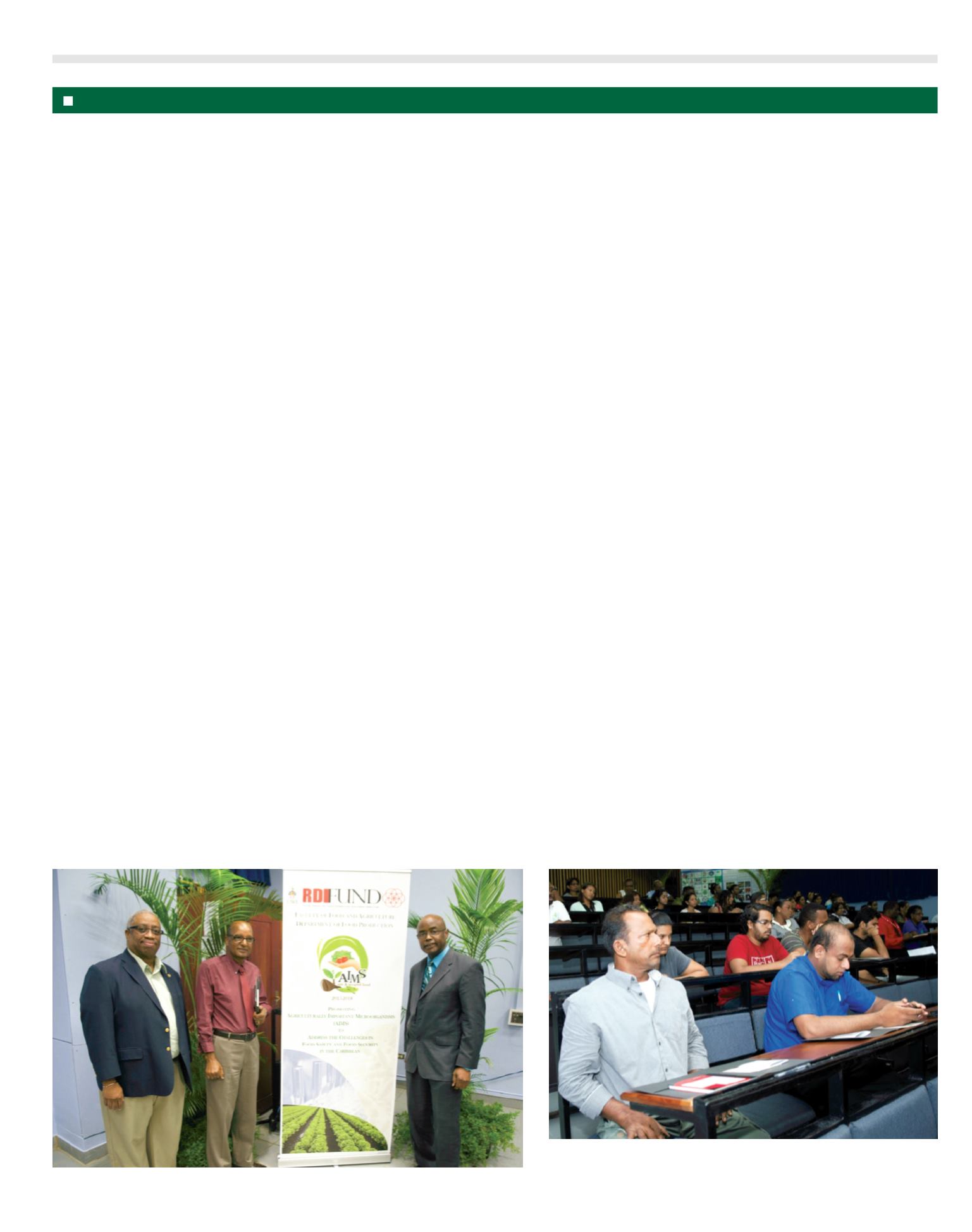
AIMS Launch attended by the Farmers, Representatives from Regional Agricultural
Organizations, Officials and Extension Officers from the Ministry of Food Production,
Staff and Students of UWI
The AIMS launch was attended by a wide cross-section of the senior campus staff as well as stakeholders in agriculture


