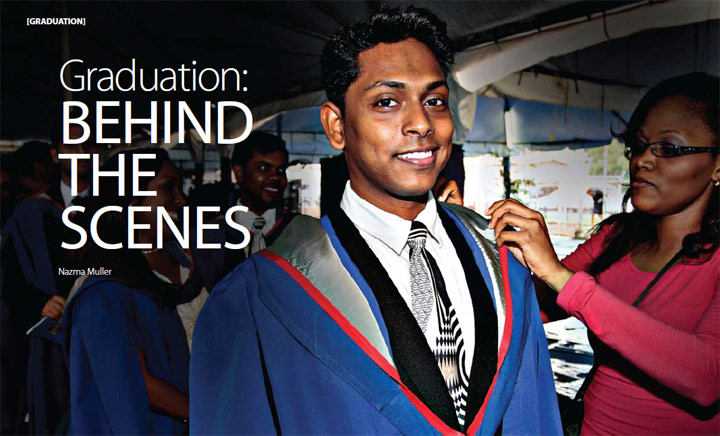
For Zameed Juman-Ali, the most memorable moment at graduation was hearing his name called and walking across the stage. He had endured many trials on his way to earning his MSc in Tropical Animal Science and Production, including being in an accident that made it almost impossible for him to write. Eventually he was able to write again, and he returned to UWI to complete his Master’s degree.
“Just before exiting the stage, I threw my hands in the air, pumping it up and down, and my parents in the stands were jumping up with me,” he recalled. “It was there that I reflected on the past. Once you are determined to do something, there is nothing that can keep you from accomplishing it.”
Zameed’s triumph was felt by many others who had trod difficult paths to attain their academic goals. Every year The UWI prepares a survey on the graduation experience and many graduates say that the moment their name is called and they cross the stage, shake the Chancellor’s hand and receive their scroll from the Registrar, is by far the most treasured memory of the ceremony. Others say that the highlight of the day for them was the procession, seeing their friends, taking photos, the honorary graduand’s speech, and having their families there to witness their shining moment.
 Over the last 18 years, Betty Mc Comie, Personal Assistant to the Campus Principal, has played a key role on the organising committee, which is chaired by the Principal or his representative (the Deputy Principal or the Campus Registrar). This year, she also took part in a different role – as a graduand, having earned a Postgraduate Diploma in Sports Management. Not surprisingly, she revealed that it takes months of planning to ensure that everything runs smoothly at these ceremonies. This year, as has been the case for the past few, there had to be six ceremonies to accommodate the 3,642 graduands. Over the last 18 years, Betty Mc Comie, Personal Assistant to the Campus Principal, has played a key role on the organising committee, which is chaired by the Principal or his representative (the Deputy Principal or the Campus Registrar). This year, she also took part in a different role – as a graduand, having earned a Postgraduate Diploma in Sports Management. Not surprisingly, she revealed that it takes months of planning to ensure that everything runs smoothly at these ceremonies. This year, as has been the case for the past few, there had to be six ceremonies to accommodate the 3,642 graduands.
She explained that, while the physical planning can begin as early as May, planning for the next year’s graduation starts the day after the last ceremony, especially for the Examinations Section and the selection of the honorary graduands. An evaluation meeting is held as soon as possible after the graduation exercise to review and make recommendations for the following year.
To pull-off a massive operation such as the graduation ceremonies, the committee usually comprises between 15 and 18 people. Among the most crucial areas they must handle are the undergraduates, the post-graduates,the honorary graduands, and the physical arrangements.
“Graduation is all about the graduating students,” Mc Comie pointed out, “so we spend a lot of time making sure they are taken care of. Without them, there would be no graduation ceremonies.” Betty Mc Comie also carries out the functions of a Campus Events Manager and handles all protocol arrangements for the Principal, the Vice-Chancellor, the Chancellor and visiting dignitaries.
Jessie-Ann George, Senior Assistant Registrar, Campus Examinations, has responsibility for all aspects as it relates to the graduand: obtaining the final results and pass lists for all graduating students; preparation of the graduation package that is sent out to students; printing of certificates; gowns; and preparation of the Programme and Order of Ceremony for the entire exercise.
These days, students receive their certificates a few weeks after their degree has been awarded. A decision was taken by The University’s Board for Undergraduate Studies that certificates should be prepared and made available to students as soon as they have been awarded their degrees, which makes looking for jobs or the transition to the next level of tertiary education much easier.
 Deborah Charles-Smythe, Senior Assistant Registrar, Graduate Studies and Research, takes care of the postgraduate or higher degree graduates. This can take a little longer to award, due to the sometimes lengthy process to complete theses/projects, followed by the process to award the degrees, which must be fair, trustworthy and meets UWI/international standards. At the same time, The UWI also makes every effort to graduate its students. Deborah Charles-Smythe, Senior Assistant Registrar, Graduate Studies and Research, takes care of the postgraduate or higher degree graduates. This can take a little longer to award, due to the sometimes lengthy process to complete theses/projects, followed by the process to award the degrees, which must be fair, trustworthy and meets UWI/international standards. At the same time, The UWI also makes every effort to graduate its students.
The preparation of citations, which presents the honorary graduands to the Chancellor for the conferment of the honorary degree, is another very important aspect of the ceremony. This is undertaken by the Campus’s Public Orator, Professor Surujpaul Teelucksingh, from as early as July. He does diligent research on each honorary graduand and presents a very concise but comprehensive summary of each individual’s work and contribution to society.
Days before the start of the ceremonies, committee members’ days can begin as early as 6am and end as late as 11pm, to ensure that all arrangements are put in place. The actual physical arrangements include organising adequate seating for everyone – all the graduands, plus their guests.
On the Monday of the week before the ceremony, Jessie-Ann George holds a rehearsal for all graduating students. Included in the information provided to students is a video presentation covering all details of the ceremony – from the students’ arrival to their departure – as well as how to wear their gowns, and the significance of the hood and their different colours.
Then there is the marketing, the security arrangements, ensuring that everything conforms to OSHA specifications, preparing the SPEC auditorium, booking photographers, videographers, lighting technicians, electricians, Port-a-Cool, tents, transportation, accommodation where needed, sorting out parking arrangements and the order of the ceremonies.
“Luckily, we have a lot of fairly young [administrative] people in senior positions who have been involved in the planning and execution, so they can carry on with the succession planning,” said Mc Comie. “Most of us have been involved in planning graduation for more than 20 years, so when we leave, these trained persons can do it themselves.”
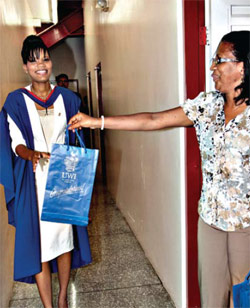 She has watched the process evolve from one ceremony in the JFK quadrangle to two at the SPEC, then, as the cohorts increased, to six ceremonies. Catering has to be ordered for the hundreds of support personnel, as well as the police and regiment bands, entertainers, ushers, and university staff working on the event. “It [catering] generates goodwill,” explained Mrs Mc Comie, “and it’s a good way of containing people in one spot. Sometimes when a few people disappear, they don’t return in time for the afternoon ceremony.” She has watched the process evolve from one ceremony in the JFK quadrangle to two at the SPEC, then, as the cohorts increased, to six ceremonies. Catering has to be ordered for the hundreds of support personnel, as well as the police and regiment bands, entertainers, ushers, and university staff working on the event. “It [catering] generates goodwill,” explained Mrs Mc Comie, “and it’s a good way of containing people in one spot. Sometimes when a few people disappear, they don’t return in time for the afternoon ceremony.”
Another informal dining room is set up at the Office of the Campus Principal for the Chancellor’s platform party, which includes the Vice-Chancellor, other Campus Principals, Deputy Principals and members of the organising committee. Here they can have a meal and take some time afterwards to refresh themselves or go to their respective offices to catch up on email or matters as it relates to the St. Augustine Campus.
As new technology became available, it was adopted to make the entire process easier; for example, a teleprompter is now used to call out the names of the graduates, and students can confirm their attendance online through the MyUWI website. All of the proceedings were streamed live for the first time too, this year.
The stock of robes, one of the most important features of graduation, has also grown over the years. In the early days, the St Augustine Campus would borrow and lend from/to our sister campuses. As the number of graduands increased, so did the gown count. Indeed, the Campus may still need to purchase some more.
“It takes a lot of people to do graduation,” concluded Betty Mc Comie. “And there is still room for some tweaking and improving, but this year was one of the best graduations, I think.”
|