
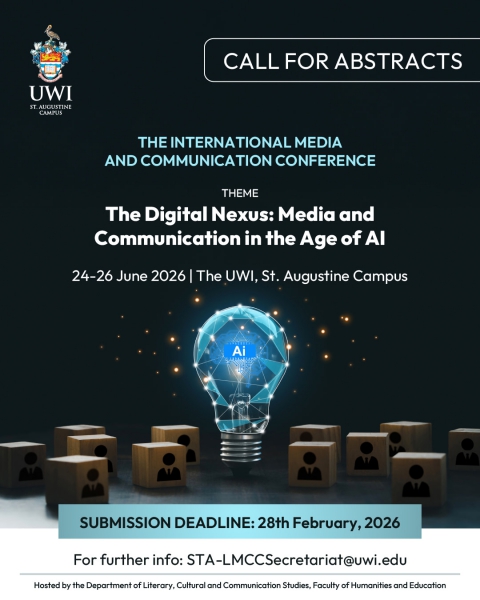
THE INTERNATIONAL MEDIA AND COMMUNICATION CONFERENCE
THE UNIVERSITY OF THE WEST INDIES
ST. AUGUSTINE, TRINIDAD AND TOBAGO, WEST INDIES
FACULTY OF HUMANITIES AND EDUCATION
DEPARTMENT OF LITERARY, CULTURAL AND COMMUNICATION STUDIES
THE INTERNATIONAL MEDIA AND COMMUNICATION CONFERENCE
At The UWI St. Augustine Campus, Trinidad
24th-26th June 2026
Theme: “The Digital Nexus: Media and Communication in the Age of AI”
The Department of Literary, Cultural and Communication Studies of The University of the West Indies, St. Augustine Campus is pleased to invite submissions for the 2026 International Media and Communication Conference: “The Digital Nexus: Media and Communication in the Age of AI.” As artificial intelligence reshapes every aspect of communication and media production, distribution, and consumption, we stand at a critical juncture in the history of media and communication. This conference serves as an extension of The UWI’s commitment to leading the regional conversation surrounding these transformations. We invite academic scholars, media practitioners, policymakers, communication specialists, business leaders, social media influencers, creatives and graduate students across disciplines to submit abstracts of original research papers, panels and posters that explore the evolving landscape of media and communication as it relates to the increasingly digital and AI-centric developments.
This conference aims to create a rare space for cross-sectoral exchange, where academic inquiry meets industry experimentation, where regional needs intersect with global trends, and where new alliances can form beyond familiar silos. Efforts are already underway to position the Caribbean not only as a networked space, but as a digitally empowered and globally competitive one, creating a place where technology, and people come together to shape meaningful futures.
This conference is designed to spark timely conversations and collaborations on topics ranging from AI and communication, to algorithmic governance, to the future and role of the region within this space, as well as community-building beyond the local. By bringing together diverse voices and visions, we aim to not only understand communication and its evolving role in an AI-driven world, but to actively shape how that world unfolds, both here in the Caribbean and on a global scale.
Conference Objectives
1. To examine the impact of Artificial Intelligence on Caribbean and global media ecosystems, and strategize how to navigate rapid digital transformation in media, business and communication industries.
2. To curate a culture of media literacy, public trust, and the ethical usage of generative AI technologies, amid algorithmic biases and widespread mis-information.
3. To (re)imagine the role and resilience of the Humanities in the digital age through transdisciplinary engagement with AI models and media technologies.
4. To create a forum for postgraduate students and early-career researchers to showcase innovative work on AI and media.
Topics and Strands
1. Digital Media & Transformation
- Digital Media Strategies in a Hyperconnected World
- Digital Transformation: Challenges and Opportunities
- Emergent Digital Technologies & the Future of Work (including job loss and reskilling)
- Legacy Media vs. New Media: Convergence and Conflict
- Media Ethics in the Digital Age
- AI and the Evolution of Media Production (automated reporting, AI-generated content, etc.)
- Digital Activism & Online Movements in the Caribbean
- Leveraging Digital Media for Election Campaigns in the Caribbean
- (Re)Imagining Cultural & Literary Arts in the Age of AI
- Archives & Preserving Cultural Memory using Digital Humanities Tools (Mining, Mapping, Analysis, Visualisation)
2. AI and the Future of Media & Communication
- AI and the Changing Nature of Journalism
- Virtual Influencers and AI Presenters: Redefining Media Personalities and Ideologies
- Hyperreality, Deep-fakes, and Trust in Media
- Generative AI and Creative Media Production
- The Intersection of AI, Credibility, and Misinformation
- AI in Political Communication: Campaigns, Diplomacy, and Soft Power
- AI and the Perceived Crisis (Death? Threat?) of the Humanities: The Value of Knowledge & Creativity in the Digital Era
3. Social Media & Society
- Social Media Influencers: Power, Ethics, and Regulation
- Social Media Policing, Censorship, and Freedom of Expression
- Echo Chambers, Filter Bubbles, and the Personalization of Truth
- Social Media and Crisis Communication (integrating health and emergency communication)
- Privacy, Surveillance, and Data Ethics in Social Media
- Social Media as a Tool for Political Mobilization and Diplomacy
- Political Satire & Its Impact in the Caribbean
- Memes as Political & Social Commentary in the Caribbean
- Social Media Influencers in the Caribbean: Making a Living or Living a Lie
4. Media Literacy, Trust, and Globalization
- Media Education & Literacy in the Age of AI and Misinformation
- The Politics of Representation in Digital Media
- Media and Globalization: Bridging Divides or Amplifying Inequalities?
- Issues of Trust & Credibility in the Digital Media Landscape
- Media Analysis in the Context of Digital Transformation
- Building Cultural Competence in the Age of AI
5. Health, Crisis, and Climate Communication in the Digital Era
- Digital Health Communication: Strategies for Preventive and Crisis Messaging
- AI and Data Analytics in Health Communication Campaigns
- Social Media and Emergency/Disaster Communication
- Climate Communication in the Age of Misinformation
- The Role of Digital Media in Public Health Education
- How Caribbean Media Spreads & Fights Health Misinformation
- Exploring the intersection of AI and Climate Change
Guidelines for the Submission of Abstracts
You are invited to submit abstracts in English for your individual presentations, poster presentations or panels. Your abstract should be a maximum of 250 words and must include the title of the presentation, the background to the study, methodology and the results & discussion or the proposed findings if the study is ongoing at the time of submission. You are required to select five keywords which are relevant to your article.
Abstracts must be submitted as a Microsoft Word document, font size 12, 1.5 line spacing and must be accompanied by a cover page which would have the name(s) and title of the authors, affiliated institution/organisation, topic/strand of the presentation, format of the presentation (paper, poster, panel) and email address.
Abstract for Panels: Submit one abstract for a panel of 3-4 persons. The abstract must indicate the theme/strand, topic, research question, methodology and a summary of each presenter’s contribution. List the names of the presenters and the titles of their individual papers, affiliations and email addresses.
Abstract for Posters: The abstract for the poster must include the theme/strand, title of research, research question, methodology and results. List the names & titles of the author & co-authors, affiliations and email addresses.
Abstracts must be submitted to: STA-LMCConference2026@uwi.edu
|
Submission system opens |
January, 2026 |
|
Submission deadline |
28th February, 2026 |
|
Review begins |
1st March, 2026 |
|
Review ends |
15th March, 2026 |
|
Notification of acceptance |
March, 2026 |
For more information contact the conference secretariat: STA-LMCCSecretariat@uwi.edu
We look forward to seeing you at the International Media and Communication Conference at UWI St. Augustine.
Conference Chair – Dr. Wanda Chesney
Click HERE to submit abstract!


