4
UWI TODAY
– SUNDAY 13TH MARCH, 2016
CAMPUS NEWS
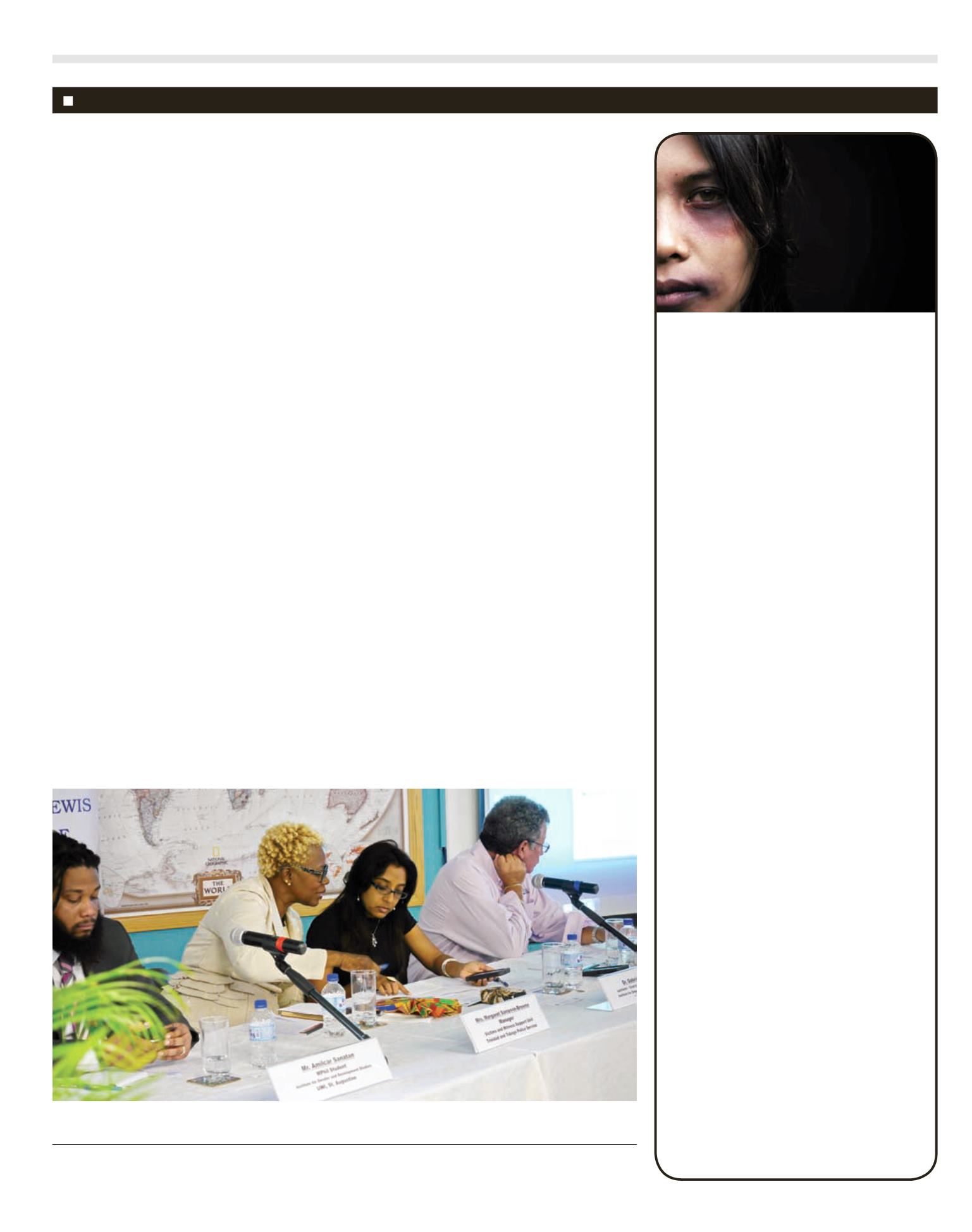
From left, the panel: Mr. Amilcar Sanatan, Mrs. Margaret Sampson-Browne, Dr. Gabrielle Hosein and Professor Patrick Watson.
Mr. Louis Lee Sing is not in photo.
PHOTO: VIBERT MEDFORD.
The Sir Arthur Lewis Institute
of Social and Economic
Studies (SALISES) hosted a forum on
Violence Against
Women: A Political Issue?
, on February 24 to the standing
room only Institute of International Relations lecture room
with panelists Dr. Gabrielle Hosein, Lecturer, Institute for
Gender and Development Studies (IGDS); Mrs. Margaret
Sampson-Browne, Victims and Witness Support Unit;
Amilcar Sanatan, IGDS and surprise panelist Mr. Louis Lee
Sing, former Mayor of Port of Spain. He was a last minute
substitute for Keron Valentine, the current Mayor, who
canceled on the morning of the event much to everyone’s
disappointment.
Hosein addressed this at the beginning of her
presentation, “I could only hope that themayor’s cancellation
this morning is not a sign of the kind of behaviour we can
expect from him in terms of keeping to his commitments
on this issue of gender-based violence.”
Each person was to give a 20-minute presentation
followed by an openQ&A session. Hosein’s presentationwas
the longest, coming in at over 22 minutes – a remonstration
against the notion that gender-based violence is a women’s
issue.
“This is not a Government issue or a State issue, it’s a
national issue.”
Change in the attitudes of state officials, Hosein
stressed must come from a change in their language and
recommended the IGDS manual: Guidelines for the use
of non-sexist language by Valerie Youssef and Sue Ann
Barratt as a resource. She ended with a call to action for
government officials.
“It’s not enough to say that the Government will
undergo gender education, there must be a deadline for the
Mayor’s deliverables and consequences for the Government
when they do not follow through,” she said, noting that the
Forum was dedicated to eliciting action-based items.
1. Focus not just onDomestic Violence, but also
safety in public spaces.
2. Training on gender sensitivity should also
include training on Non-Sexist Language in
Political Life
3. Local Government should take responsibility
for taking discussion about gender based
violence into communities. GBV is a political
issue and therefore a matter for government
because it is related to the public good and
public health of the country
4. There should be a particular focus on rural
communities, south trinidad and women
who work at home as ‘housewives’ so that
these groups also get access to education/
perspectives about GBV
5. Family violence, including violent forms
of discipline, need to be targeted as these
socialise children into violent relations
6. Use the Sustainable Development Goals to
frame lobbying and drive policy reform
7. Continue training of state officials who
interface the public. Keep in mind that
trainings eg of police officers, magistrates
and so on is already ongoing by various
institutions, including UNWomen and
different state machineries
8. Court process, especially in terms ofDomestic
Violence cases, offers a site for specific and
achievable reforms, including reforming how
victims experience the process, the space of
the courts, testifying, delays and so on.
9. Educate children in GBV and reproductive
health and rights. Population Services
International has developed a GBV training
manual for children, has been gathering data
and is available to support those who want to
extend this work.
10. Enact sexual harassment legislation and
create supportive protocols/focal points and
so onwith state structures for its effectiveness.
Should include public education.
11. Create a space for girls to stop them from
being housed in the women’s prison.This has
been budgeted, but never achieved. Advocacy
on this front is necessary.
12. Each Regional and City Corporation should
have its own gender policy. This has been
done before in the Penal/Debe Regional
Corporation. Allan Sammy and Sabrina
Mowlah Baksh can advise.
13. Child Line was reported as having an
inappropriate response to a caller. Engage
themon their effectiveness and what support
is needed.
14. Reform the process of the Maintenance
Courts, particularly around delays and cases
being dismissed.
15. Liaise with those already working on violence
issues e.g. the women of Medina House, PSI.
– IGDS on Facebook
SALISES
Violence Against Women Forum
Gender-based violence affects everyone
B Y J E A N E T T E A W A I
Jeanette G. Awai is a freelance writer and Marketing and Communications Assistant
at The UWI St. Augustine Office of Marketing and Communications.
Mrs. Sampson-Browne followed with statistics on
domestic violence victims that shocked the audience,
“between 2005 to 2015, 300 women were murdered as
a result of domestic violence.” [Those figures were later
clarified to include men and women.] She also expanded the
conversation to includemale and female victims of domestic
violence, emphasising that victims need advocates like
the Victims and Witness Support Unit’s AVA: Addressing
Victims Anywhere Project. Changing traditional beliefs was
the theme of the forum and came up in Amilcar Sanatan’s
presentation which was centered on men’s commitment in
the long struggle against gender-based violence and the
need to challenge the idea that young people are apathetic.
“Domestic Violence and gender-based violence are
men’s issues...and sexist statements will not be tolerated.
Since sexist statements aremade fromsexist seeds of thought
on a patriarchal plantation.”
Louis Lee Sing echoed these sentiments in his
impromptu presentation answering the forum’s question
that “domestic violence is a political issue, it is no longer
a social issue.”
The almost two-hour long Q&A session brought out
a litany of concerns, questions and personal stories from
activists, civilians and victims of gender-based violence
alike, who voiced their frustrations with the courts’
treatment of victims; the need for focused lobbying to drive
criminal reform and how to fix the culture that creates
domestic violence abusers just to name a few. The Forum
ended with audience members fromorganisations aimed at
ending gender-based violence identifying themselves such
as the Rape Crisis Centre, PSI Caribbean, Madinah House
- Shelter for battered women, I am One and others vowing
to work together and talk to each other to help continue the
discussion and create change on the ground and at all levels.
Recommendations
that came out
of the discussion
SALISES
Violence Against
Women Forum


