14
UWI TODAY
– SUNDAY 13TH MARCH, 2016
Pathways toDiversification
The Economic Recession
“The UWI’s role is to provide scientific
and technological
support to the region,” says the Dean of the Faculty of Food
and Agriculture, Isaac Bekele. He thinks that this economic
downturn demands a social transformation, and the role of
agriculture must be magnified. But with limited resources
everywhere, he does not think that the University should be
extending its reach arbitrarily into commercial enterprises.
Its role should be to enable and empower both the public
and private sector to fully develop their capacity.
“For us to add value to the ongoing debates about
development, we need to do things that others are not
doing,” he said.
Agriculture can be income-generating through export
to foreign markets, he says but first you have to build and
target niche markets. He cites the way English taste buds
have blossomed with the spices from India – tikka might
now be the national dish, he ventures.
Food security has to be the main priority, he says. You
have to identify the demand-driven crops for the country,
those needed for local consumption, and you have to
develop the local sector so that it can feed its population.
“Our task has to be to provide good lines of crops.
We have to do the breeding, and partner with the farmers
to grow them and process and package them. There is no
reason to import food crops,” he says.
His Faculty (FFA) has been reorganizing itself over
the past few years at various levels. With decreasing
numbers in regional enrolment, not only is there reform
of the curriculum, but the Faculty is proposing a two-year
diploma/associate degree which will shorten the actual
Bachelor’s degree programme.The Faculty is also developing
a matriculation pre-university certificate programme for
CSEC certificate holders in CAPE subjects, which should
come on stream this year.
So, while they are trying to encourage more people to
see agriculture as a career, they are also trying to broaden
the scope of what is being taught and to encourage more
research.
One of the major thrusts of the Faculty is in graduate
training, and the partnership with the China Agricultural
College (CAU) is a fine example of how these relationships
can work. UWI graduates spend two years at CAU pursuing
anMSc in plant genetics and breeding (including a practical
project) and return to St. Augustine to do the PhD under
joint supervision. Four Caribbean students are involved at
this point and the hope is that they will formpart of the cadre
of teachers in these areas. The Dean hopes that livestock
genetics and breeding will be the next step.
In his most recent internal report on the FFA, the Dean
stresses the need to develop its infrastructure and diversify
its income sources. The FFA earns income from short-term
courses and its farm operations.
“Over the last three years, the Faculty has been engaged
in the development of a new farm at the Orange Grove site
while strengthening and expanding the livestock operations
in the Mt Hope farm,” he wrote. “Well-developed modern
farms are critical for training at the undergraduate and
postgraduate levels so the focus on farms at one level is part
of the Faculty’s focus on curriculum reform.”
He notes though that this involves “a modern
technology-based foundation” and he cites the introduction
of greenhouse technology to the region as one example.
The Faculty currently operates 2234m
2
newly constructed
greenhouses at Orange Grove.
Inside are tomatoes of all kinds and sizes at different
growth stages, they are trellised with strings so efficiently
rigged that the tautness can be simply adjusted by a twist of
the wrist.There are chili peppers: hot, mild, flavourful, long,
short, red, purple, green (one type of bell pepper has some
heat we are warned). There are thin-skinned cucumbers,
and hardy pawpaws, gorgeously veined swiss chard. And
delightfully, miniature watermelons, “Single-serving,” says
the Dean.
These are among the first harvests fromOrange Grove;
there have been new varieties of corn as well, coming from
China – and this is what the Dean means when he talks
about the University’s role in seeking out crops that can
be grown in this tropical environment and breeding and
propagating them so farmers can reap that bounty.
Conceptually, it is not like the State-run mega farms,
which have all but crumbled, according to the Minister of
Agriculture, Land and Fisheries, Clarence Rambharat.
“None of themega farms are productive,” he said, saying
that the UPick one inChaguaramas is only about three acres,
and the most productive one at Orange Grove, west of the
Piarco International Airport is about 200-300 acres. That
one is being run by the Cunupia Farmers’ Association, he
says, adding that this is the way the mega farms experiment
should go.
TheMinister was discussing plans for agriculture in the
climate of an economic recession, the need for regional food
security and the enormous food import bill.
While he admits the challenges are daunting, he is
unfazed.
“I know the sector well,” he says as he relates how his
father worked in Forestry and he grew up running around
its offices and has always had an interest in politics, despite
his legal background.
He drafted the PNM’s agriculture policy, which
contained 18 points of action designed to “increase
agriculture’s share of our GDP, increase employment in
the sector and in particular increase the contribution
of agriculture to economic growth and development in
Trinidad and Tobago.”
Agriculture
Everybody has to eat
New technologiesmake
farming a real option
B Y V A N E I S A B A K S H
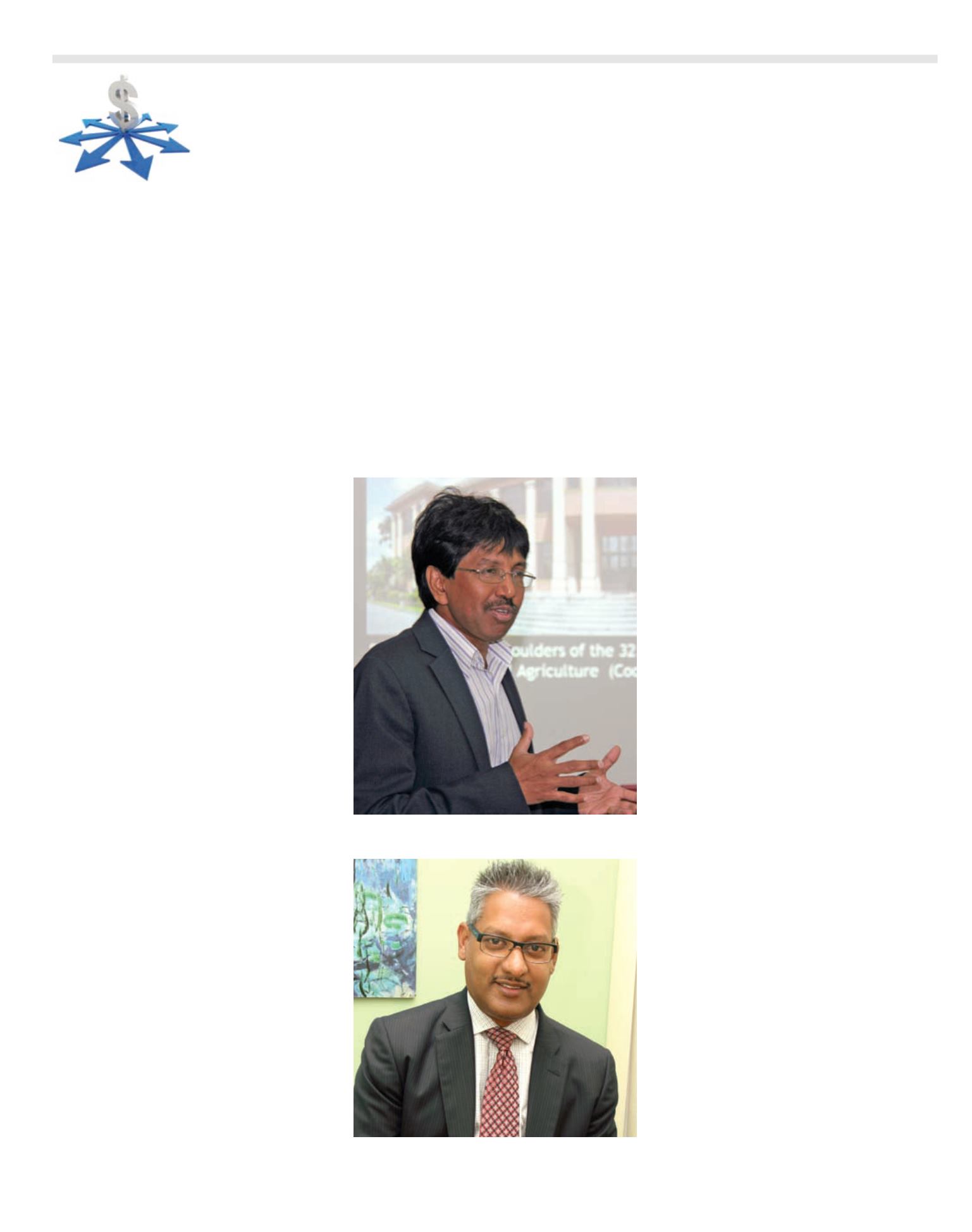
Minister of Agriculture, Land and Fisheries, Clarence Rambharat:
The Ministry has the responsibility to develop and execute
government policy.
PHOTO: ANEEL KARIM
Professor Pathmanathan Umaharan, geneticist, believes
the industry can be revitalized.


