SUNDAY 13TH MARCH, 2016 – UWI TODAY
13
example of precisely this kind of collaboration for economic
development. This level of partnership, each performing
its role in a clearly defined strategy, is what is required to
develop a sector.
What is interesting is that knowing the limits of his
power in the situation, Professor Chowdary, a very soft-
spoken man (every sentence seems to trail away into
a whisper, the more emphatic his point, the quieter he
becomes), remains resolute. If training and research is
not enough, then the next step is big-picture strategy and
advocacy.
“Bygones are bygones, we have to do what we can do
now – The UWI, industry and governments,” he says.
The closer the better
A good example of the kind of limitations regional
manufacturing faces is the ubiquitous water bottle. Water
bottles are everywhere and we manufacture them locally.
What we don’t manufacture is the bottle cap. That means
every water bottle you see or buy, even though local
manufacturers are involved in the process, adds to the
import bill, the negative trade balance and the loss of US
currency.
Why is this?The cost of acquiring the rawmaterials and
manufacturing the cap is three to four times what it costs
to import them. And why is it so much more expensive –
because of import duties on the necessary rawmaterials and
manufacturing process-related costs. Put another way, in
this scenariomanufacturers are limited because of structural
hurdles that make local manufacturing inefficient.
“As a business person you cannot justify the risk,”
Professor Chowdary says. “There is no research, no
encouragement, no incentive.”
This is why he believes the business-government-
university partnership is so crucial. Policymakers’ role
is to create the enabling environment through laws and
regulations and provide incentives through direct funding
or provision of resources to the industry and the university.
The industry and entrepreneurs invest in modernisation
and labour and embark on new manufacturing ventures.
As for The UWI’s role – Professor Chowdary has no
shortage of ideas:
“We definitely need to do more. We must build
confidence in the university. If we are not showing anything,
if we are sitting in our offices, if we are not exhibiting our
talent, nobody will realise our strengths.”
Confidence, the Professor believes, is one of the keys to
making change work, especially to bring the manufacturers
and entrepreneurs on board, who, more than the other
groups, face fatal financial risk if new schemes fail.
To instil greater confidence, the department will host
exhibitions of mechanical and manufacturing engineering
projects every May/June to showcase the capacity of its
students and staff. In addition, working with academic
staff such as Rodney Harnarine (who has been featured in
earlier issues of UWI Today for his work with students in
agricultural innovation, see
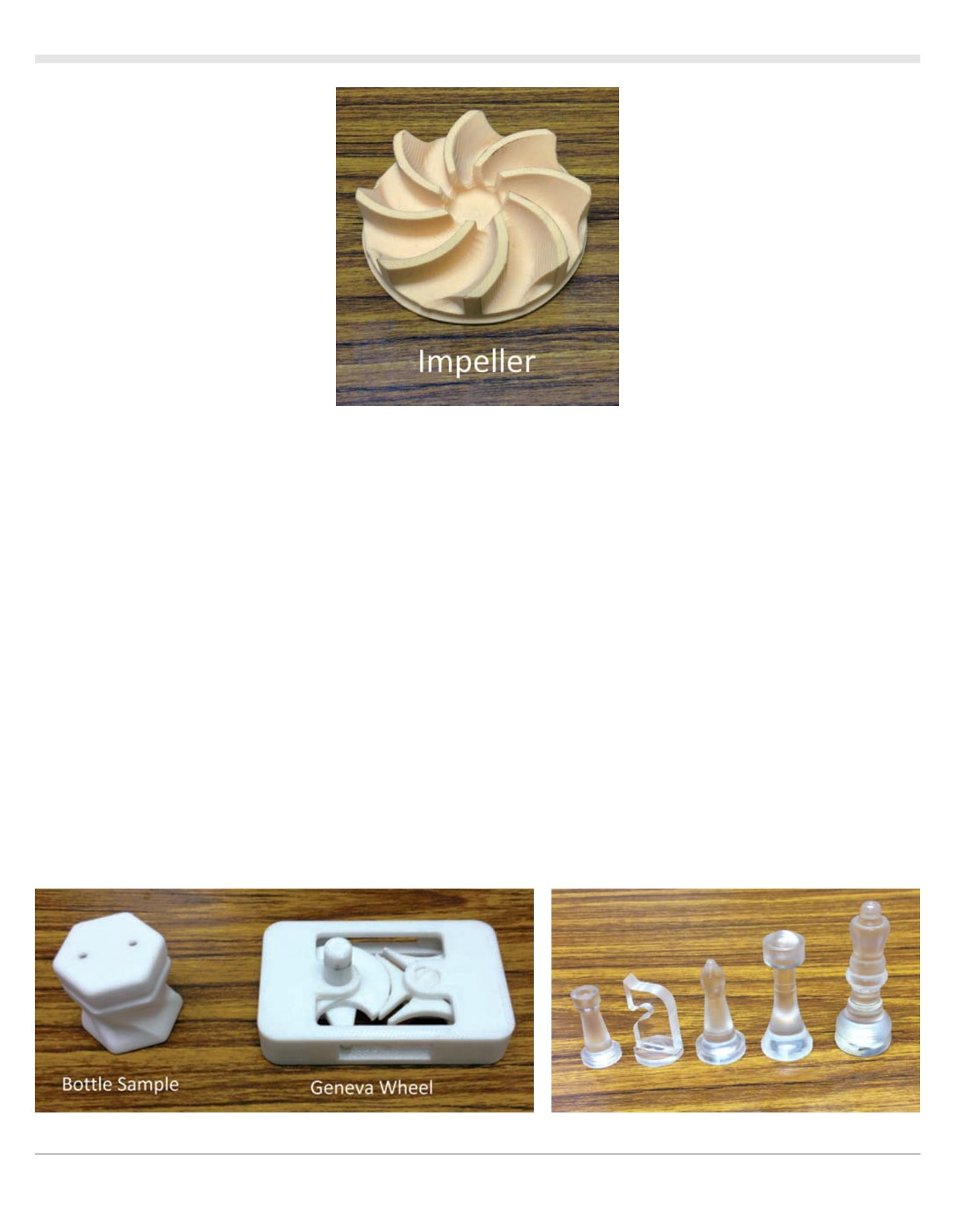
Chess pieces manufactured through the Computer Numerical Control machining process.
Joel Henry is a professional writer and media consultant.
archive.asp) the department has designed, constructed and
sold a functional model of a channa-splittingmachine.There
are several other projects in the works focused specifically
towards food processing.
“Our approach is incremental,” he says. “We are
targeting specific sectors like agriculture to show what we
can do. For example, we are working on cassava grating
machines that can be used to process cassava flour from
what is being farmed in Moruga. This will enable farmers
and the community entrepreneurs to sell a finished product
to stores and bakeries.”
This goes beyond showing what The UWI can do to
contributing directly to the development of the sector. The
benefit of this as well is that by using machines developed
through UWI research the cost to manufacturers is much
lower. The university’s research objective is to contribute to
development and impact on the society, not turn a profit.
One of Professor Chowdary’s most ambitious goals
is the creation of a design and manufacturing innovation
centre that is specifically tailored to meet the needs of
industry – regional and international.
“I have discussed a proposal with Professor Stephan
Gift, Dean of Engineering, for a school of engineering that
focuses more on the business and commercial aspects,”
he says. “I would like a space where companies can set up
offices within the institution so that we can collaborate
more closely. We can tweak our curriculum and training
programmes to suit their needs. We can support their
existing operations. We can create a pipeline for our students
from the university to employment in the industry.”
The Professor points out that this type of institution is
nothing new. In fact, he has experienced it first hand at the
Indian Institute of Technology in Delhi, where these types
of relationships with big multinational players in science,
manufacturing and technology are the norm. To this end
he has already been in discussion with regional and even
international players about partnering with The UWI.
“We will be the engineers to meet their requirements,”
he says, “whatever they want.”
MSc inManufacturing
Engineering andManagement
No matter what measures the Department takes, it will
come down to the quality of its educational programme and
its graduates. Because of this the MSc in Manufacturing
Engineering and Management is a comprehensive
programme that stresses the technical, professional and
managerial aspects of the profession.
“I am linking the programme with the current and
future needs of the industry,” Professor Chowdary says.
“To have confidence in us the industry needs to see our
capabilities. We have to show them that there is no need
to send their engineers for training in the US or Canada.”
The programme will provide training in flexible and
cost-effectivemanufacturing technologies like computerised
numerical control (CNC) and 3D printing. With six
compulsory and four optional courses and extensive hands-
on experience in the laboratory and on machines, the MSc
is aimed at producing “complete” manufacturing engineers.
“The industry needs a crossbreed of engineers and
technicians that will service and deal with all areas of
mechatronics. If I’m going to hire a technician that
technician must be capable of doing multiple jobs,” he says.
And like the Department Head himself, the MSc
graduates, apart from specialising in modern design and
manufacturing, will have the big picture view of Caribbean
manufacturing and be its advocates and enablers.
“They are going to give the kind of awareness and
exposure we need to the people in the system. These
manufacturingmanagement engineers will implement what
they have learned and show its benefits,” he says.
The potential of these moves and the persistence of the
man behind them are hard to deny but the forces of inertia
have been more resolute than any plan of change when it
comes to Caribbean diversification. Since our last interview
it is clear that Professor Chowdary has come up against the
inertial wall that has resisted so many efforts to drive past
it. Nevertheless, he is still fighting.
“People keep asking ‘where is manufacturing in this
country?’ Who will answer those questions for this region,
God?We are the people whomust answer this question. We
are the people who must create change.”
Professor Boppana Chowdary can be reached at
Parts built using the Rapid Prototyping process.
An impeller manufactured through the Computer Numerical
Control machining process.
Chess Pieces


