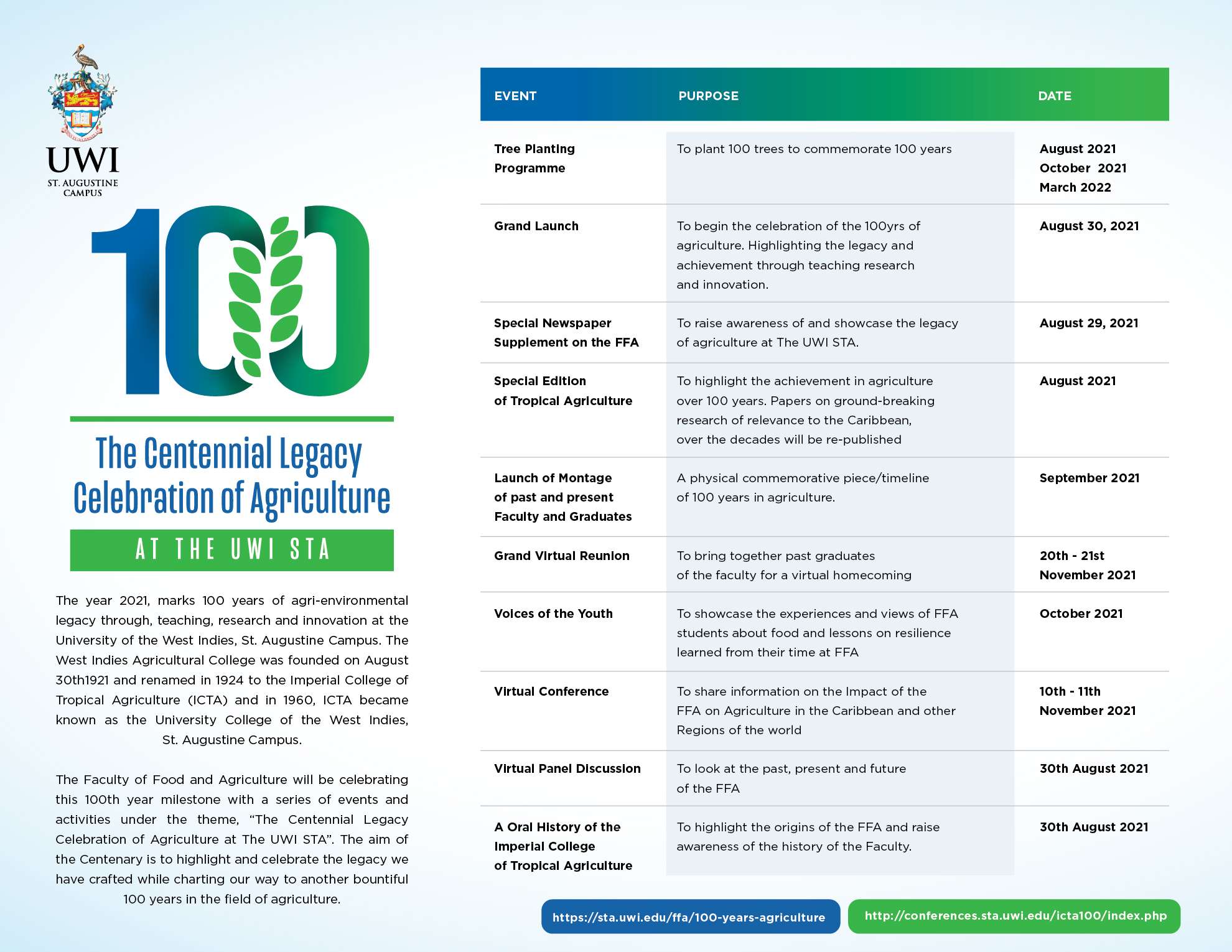
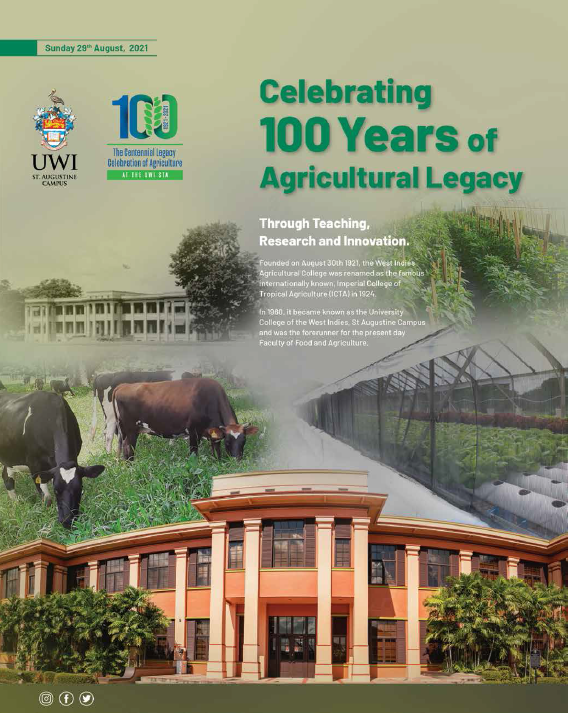
The West Indies Agricultural College was founded on August 30th 1921 and was renamed the Imperial College of Tropical Agriculture (ICTA), the precursor to the Faculty of Agriculture, in 1924. In 1960, ICTA became known as the University College of the West Indies, St. Augustine Campus.
The year 2021, therefore, marks 100 years of agricultural legacy through, teaching, research and innovation at the University of the West Indies, St. Augustine Campus. The Faculty of Food and Agriculture will be celebrating this milestone with a series of events and activities under the theme, The Centennial Legacy Celebration of Agriculture at The UWI STA. During this year, the faculty highlighted and celebrated the legacy we have crafted while charting our way to another bountiful 100 years in the field of agriculture.
TA Special Issue in commemoration of 100 years teaching and research
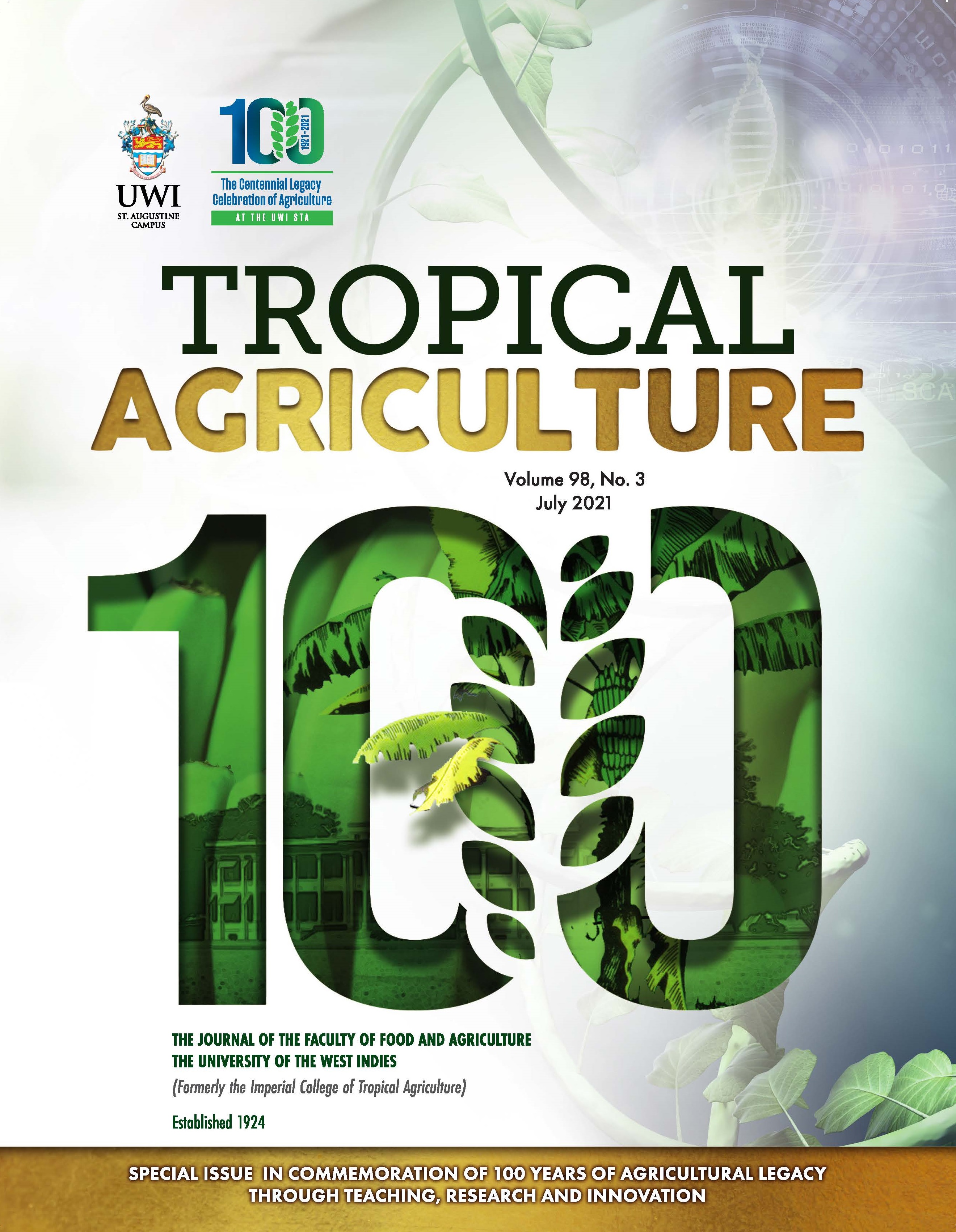
Tropical Agriculture (TA) was first published in 1924 and this issue contains republications of 20 of the papers published since the first issue, in commemoration of the faculty’s 100 years of teaching and research. The criteria for choosing the papers to be republished was that the articles should have been ground breaking when published with emphasis on (but not completely comprising) Caribbean work. It was decided to include two papers from each decade from the 1920s up to the 2010s. The 20 articles chosen were published in their original formats. The first paper published in this special issue is a republication of the first article in the first issue of TA; the second paper reminds us that the principles of biological control were known to the earliest humans. These two papers are followed by description of some early efforts to control Witch’s Broom and then the studies in West Indian soils by Professor Frederick Hardy was one of the few unanimous choices by the selection panel. The 1940s were times when plantation export crops were still the mainstay of West Indian economies and this is reflected by the works on sugar cane and banana improvement. Two tree crops, coconut and mango, were selected for the 1950s. The 1960s articles republished are on soil surveys and ticks affecting cattle. In the 1970s the late Professor George Sammy pioneered research into value addition in Trinidad and there is another paper on the work of the breeding of sugar cane in Barbados. The 1980s are represented by a paper on modern methods of commercial fruit production and an interesting review of the status of cocoa research in Jamaica. Another paper on cocoa is published as an example of the 1990s, together with a review of farming systems work which came to the forefront during the last 20 years of the last century. A further paper on small farming systems leads the articles chosen from the current century and this is followed by a detailed study on the management of soils in high rainfall situations. The last two papers are on breadfruit and yam, emphasizing perhaps the shift from working on export crops to food security crops and the need for tropical populations to increase consumption of tropical crops in preference to imported produce.
Newspaper Supplement 29-AUG-2021
Centennial Legacy Conference Report
Sponsor a Tree
The Year 2021-2022 marks 100 years of agricultural legacy through teaching, research and innovation at The University of the West Indies, St. Augustine Campus.
To commemorate 100 years of excellence in agriculture at The UWI, St Augustine Campus, a total of 100 trees will be planted on the Main Campus at St Augustine, South Campus at Debe and the University Field Station (UFS) at Mt Hope.
During the Centenary Year, tree plantings will take place in August-September 2021, November-December 2021 and March-April 2022. The first of three tree planting ceremonies will coincide with the launch of the celebration on 30 August 2021.
You are invited to sponsor a tree by selecting one of the packages and let us know your choice.
We are happy to provide more information and look forward to your engagement to PLANT A TREE in your name marking one hundred years of excellence!
We solicit your support to this activity to make the Centenary Year celebration a grand success.