Did you know that around 75% of recently emerging infectious diseases that affect humans, including the likes of COVID-19, Dengue, Chikungunya, Zika and Ebola, began as animal diseases?
To protect the health of our animals and us, and to avoid the onward spread of diseases from animals to humans, it is critical that we know what viruses, bacteria, parasites, and fungi are present in our animals here in Trinidad and Tobago. This is why surveillance for animal, as well as human diseases is so important.
In looking at surveillance and security systems that are designed for financial institutions to secure their monetary assets, and that of investors and clients, multiple layers of surveillance are implemented. To name a few, all staff members are subject to rigorous background checks, there are 24/7 camera recording systems, there are multiple security checkpoints to access certain areas, and there are essential network and data security requirements. All these surveillance measures ensure some guarantee of loss prevention. Can you imagine this level of surveillance being implemented in the field of health?
If we look specifically at human health and COVID-19, surveillance has been critical in enabling health institutions across the globe to prepare for and to navigate the waves of infection, as well as to determine appropriate courses of action to manage, control and prevent further spread of the disease. Even now that the COVID-19 status of a public health emergency of international concern has been lifted, viral surveillance must continue to ensure we remain aware of the global circulation of the virus, and more specifically the changes in the virus (mutations) that will continue to occur over time.
Throughout the national COVID-19 response, the UWI has worked in partnership with the Ministry of Health supporting diagnostic and surveillance efforts. Even today, the Faculty of Medical Sciences, through the leadership of Professor Christine Carrington, continues to assist with SARS-CoV-2 genomic surveillance, looking specifically at those new mutations that are present in the variants circulating now in T&T, and contributing to the regional and global understanding of the changing virus.
Like what we saw with COVID-19, in the animal world, diseases can also quickly spread among populations, causing pandemics. Surveillance helps to identify outbreaks early, allowing for prompt actions to contain them and prevent widespread harm. Examples are Avian Influenza and African Swine fever, two diseases that are currently spreading around the world at faster rates than ever seen before. These two diseases have so far kept out of Trinidad and Tobago, but they are knocking on the door, having been identified in other Caribbean, Central and South American countries. Also, many of the animals we raise for food carry diseases that can affect human health if not properly monitored and controlled. Surveillance helps ensure the safety of our food supply. Animal diseases also can have significant economic consequences. Surveillance helps protect our farmers from financial losses due to disease outbreaks.
Over the years, the UWI School of Veterinary Medicine, in partnership with the Ministry of Agriculture, Land and Fisheries (MALF), has been instrumental in initiating several surveillance-based research projects seeking to identify and understand more about the viruses, bacteria and parasites that are circulating in domestic animals and wildlife species in T&T. These graduate student-run projects have unearthed important information on the presence of viruses in avian (chickens), porcine (pigs) and bovine (cows) species. These studies have confirmed the presence and circulation of several economically important viruses, enabling more effective control and prevention strategies to be implemented.
Surveillance is also important in our fish. A current graduate-student research project at the UWI-SVM is investigating what viruses and bacteria are affecting our freshwater-farmed tilapia, shrimp and freshwater ornamental fish populations. For some time now, it has been suspected that Mycobacteria species may be infecting some of our farmed and ornamental fish, causing in some cases severe disease and death. Some Mycobacteria species capable of infecting fish are known to be zoonotic, in that they also infect humans, and some can cause a neglected tropical disease that destroys human skin and soft tissue known as Buruli ulcer. This study emphasises the importance of carrying out surveillance in all animals, including fish, so we can not only identify the risks posed to all animals by circulating pathogens but also to farmers, food handlers, fisherfolk and the public. Aside from the studies highlighted above, there are multiple surveillance-based research projects that are ongoing at the UWI-SVM, in partnership with the MALF, to better serve communities and support animal health. These studies are helping to build understanding, improve animal management, welfare, and productivity, and reduce the risk of spread of pathogens from animals to humans.
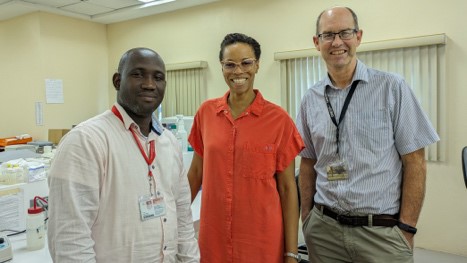
(right to left) Professor Chris Oura (Professor of Veterinary Virology), Dr Arianne Brown Jordan (Honorary Lecturer/ Laboratory Coordinator/ Research Scientist) and Mr Lemar Blake (Laboratory Technician/ Graduate student) Faculty of Medical Sciences
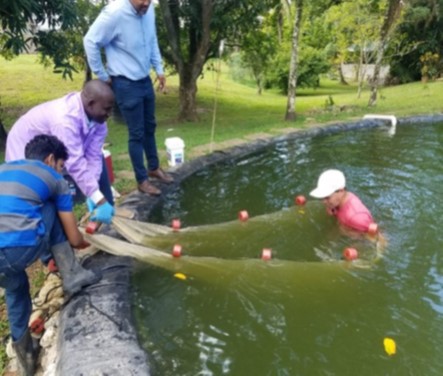
Farmed fish being caught for sample collection to determine the presence of any infectious agents of disease.
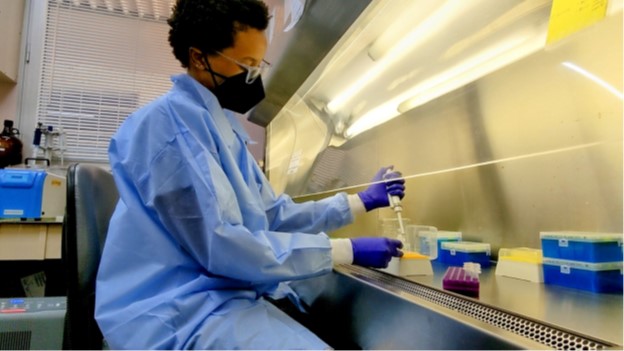
Laboratory work for the detection of viruses, conducted as part of the surveillance activities.