
From March 21st to 24th, the St Augustine Campus hosted the 2nd Caribbean Future of Science Symposium. This multidisciplinary event, co-chaired by Professor Shirin Haque from the Department of Physics, aimed to unite international and Caribbean leaders in science to advance the region.
The symposium featured an impressive lineup of speakers, including Nobel laureate Michael Kosterlitz and Professor Sylvester James Gates, President Obama’s Science Advisor and a recipient of the Highest National Medal of Science. The event also celebrated the contributions of remarkable women scientists from the Caribbean diaspora. Noteworthy participants included Dr Camille Alleyne and Dr Renee Horton, both of whom have made significant strides at NASA, as well as blind astronomer Dr Wanda Diaz Merced, who emphasised the value of multi-sensory approaches in scientific research.
The keynote address was delivered by Trinidadian Dr Alexandra Amon, a distinguished recipient of the prestigious Sloan Award in science. Her insights were a highlight of the event, inspiring attendees to continue pushing the boundaries of scientific exploration in the Caribbean and beyond.
The Caribbean scholars proudly highlighted the exceptional scientific advancements emerging from the region, showcasing their diverse expertise across various disciplines. From the campus, Professor Pathmanathan Umaharan, Head of the Cocoa Research Centre, presented the remarkable production of SPIRIT chocolate. Dr Donna Dyer from the Department of Mathematics and Statistics shared insights into the mathematics behind crime epidemiology, while Dr Andre Coy from Mona discussed the application of AI in Creole languages. Additionally, there were several technical presentations that emphasised the multigenerational nature of our audience, paving the way for the future of science in the Caribbean.
The symposium expertly fused music and science, highlighted by Mr Hopeton “Scientist” Brown, the renowned inventor of dub reggae, leading an engaging panel discussion. Participants enjoyed musical meditations from exceptional musicians and scientists, including Tobago’s own Professor Phillip Phillips, a professional opera singer from the University of Chicago. A standout moment was the participation of all nine high schools in Tobago, who attended a special session on the intersection of Soca and science, presented by the symposium’s director, jazz musician and physicist Professor Stephon Alexander. These students had the invaluable opportunity to interact with eight other inspiring Caribbean scientists, enhancing their understanding and appreciation of both fields.
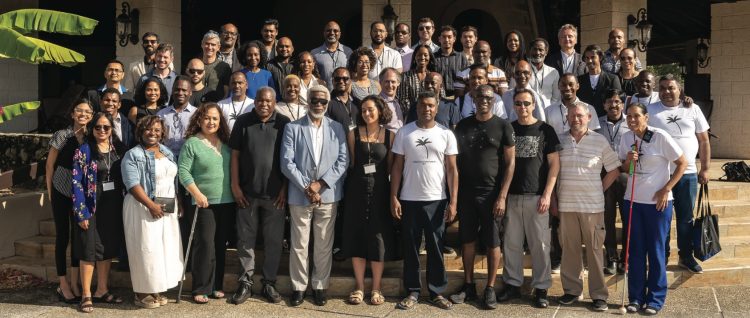
Renowned scientists from Trinidad and Tobago, the region and the world, pose for a photo at the Mt Irvine Bay Resort in Scarborough, Tobago, for the four-day Caribbean Future of Science Symposium