
Sit back and join me on the lesser beaten path – of how Astronomy at the University of the West Indies (UWI) has engaged the world and uplifts our Trinidadian society. How is that even possible, you ask?
How can one possibly contribute to a field that begs big budgets, resources and large research groups – against one lonely professional Astronomer at UWI? There is this amazing binary black hole system that we have data on since the 1800s – known as OJ 287. This provides a wonderful environment of the intense conditions where Einstein’s theory of General Relativity can be tested. A team of researchers in Finland led by Prof. Mauri Valtonen had their eye on this beast – modelling its behaviour. Models are never good enough on their own if they cannot be backed up with observation in Astronomy. Finland is so northerly that at times OJ 287 would not be visible at their observatories. The same idyllic location of Trinidad near the equator that gives us our tropical environments suddenly was ideal to continue observation on OJ 287 and thus was born SATU observatory. With the support of volunteer students and helpers we were able to monitor OJ 287 to help unlock the mysteries of this enigmatic object. Our location turned out to be a boon for this project.
The passing decades show the rise and fall of fields and new cutting-edge fields emerge. Towards the end of the 20th century, a huge breakthrough came in Astronomy with the discovery of exoplanets around other stars. Other worlds were out there apart from the planets in our own solar system. Is it any wonder, that this gave an impetus to a fringe area in Astronomy prior to this discovery – searching for life in the universe known as Astrobiology?
Surely, that was now beyond the reach of Trinidad to contribute! Once again, our natural resources come to the rescue. Starry skies are what comes to mind when you think of astronomy, certainly not mud volcanoes and pitch lake! Yet, our journey into Astrobiology had us hiking to mud volcanoes and sampling at the pitch lake to try and understand how life could possibly arise in the harsh and toxic conditions of these environments – acting as analogues to environments on planet Mars and Titan, Saturn’s largest moon. The work with our international collaborators on these projects landed the seminal paper in the prestigious journal “Science” which was covered by all international major news outlet, showing how life at the microbial level could be sustained in the microhabitat of water droplets. Could this be happening in other seemingly toxic environments in other parts of the universe that Trinidad had shed light on? What a wonderful thing when Scientific American got in touch, in my capacity as an astrobiologist to comment on other current related research in Astrobiology!
It is certainly not enough to be in our ivory towers churning out papers accessible to only experts. How could we engage our nation to be part of this noble enterprise we call Astronomy that kickstarted the Scientific Revolution? As the National Outreach Coordinator for Trinidad and Tobago in the International Astronomical Union, I had the opportunity lead Trinidad and Tobago to name in perpetuity an exoworld (a star and its exoplanet). On a clear night, with the aid of a telescope can be seen a faint star in the constellation Leo in our Trinidadian skies. Orbiting that star is an exoplanet. The name of the star is “Dingolay” and the exoplanet is “Ramajay” celebrating our culture and us (the winning proposal came from UWI’s own Dr. Jo-Anne Ferreria).
But can astronomy actually improve lives of persons in our society, you ask? We have recently formed a group called Caribbean Astronomy for Inclusion and are earnestly working on bringing astronomy to the visually impaired with turning light into sound and using sonification. NIHERST is very excited by this project and has partnered with us. I also was the recipient of one of ten grants in the Americas from Women and Girls in Astronomy Project for girls in children’s homes across our country to build interest in Astronomy and thus STEM careers. It was also recognising the value of the calming effect of watching stars for mental health and well-being that is also being promoted. It has truly been a journey to the stars but the greatest joy has been bringing astronomy to Earth for us in Trinidad!
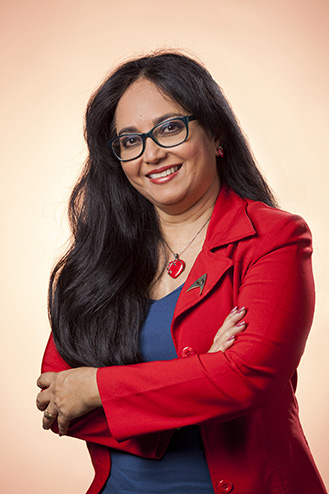
Shirin Haque is a professor of Astronomy at the University of the West Indies. Her areas of research include observational astronomy, cosmology and astrobiology and she is a fellow of the Royal Astronomical Society.