
In 2019 Dr Arvind Singh and I co-led the ARC Labs team of UWI, partnering with researchers from Tallinn University and Estonia’s national power company Elering AS to develop deep-learning object detectors for predictive asset management of their electrical grid. We were successful in developing algorithms that could accept extremely large resolutions of fly-by image data and process it to give a Health index of the electrical infrastructure. This enables the grid operators to determine where to spend effort and resources before a black-out can occur.
In 2020 I was part of The UWI’s Engineering COVID-19 response team to develop solutions to mitigate the spread of the virus. We were tasked with developing face masks, face shields, protect a doctor kits, and splash boxes. I was the principal investigator for developing the ventilators, CPAP devices, air decontamination systems, and UV sanitization robotic systems. The robotic and decontamination systems used machine learning algorithms to determine cleaning regiments based on room and airflow parameters. We worked with researchers from the University of Florida, and officials from the Ministry of Health, with funding from NGC and the Canadian High Commission to develop and implement these systems. Through this process, we’ve established standards, redundant supply chains, and industrial linkages to rapidly deploy protective systems against future pandemics.
In 2022 I partnered with researchers from Rutgers University, to develop collaborative omnidirectional robots capable of transporting objects on a deformable sheet via optimization and reinforcement learning algorithms. The applications of this technology are widespread as the robotic team can lift any shaped objects, rotate, and transport them. This research paved the way for exploring areas like attack resiliency, given the vulnerability of collaborative autonomous systems to wireless hacking. From this, my postgraduate research students are investigating platoons of electric autonomous vehicles and the intelligent control algorithms that enhance their resilience to cyberattacks.
Large language models (LLMs) are now well accepted by the public and industry. I have been involved in machine reasoning and separately large language model research for some time now, developing our own LLMs and making them smaller and more intelligent. Part of my work is to better educate our nation’s workforce to use these tools responsibly and safely and understand their limitations. This is necessary to boost productivity and to keep globally competitive. In that trend of thought, with Faculty colleagues, we have developed short courses through our department targeted at a wide range of education profiles. The industry has been keen on the adoption of this technology. I have worked with organizations to implement these systems in their supervisory control and data acquisition, alarm, and control systems.
Education research and its future are also impacted by these LLMs. My work in this realm has been two-fold; in the immediate case it revolves around how education institutions should react to students’ use of LLMs to ensure integrity and honesty in students’ submissions. Secondly, I explore what the future of teaching could look like with reasoning machines. In this case, the LLM algorithms and integrated systems are modified to support pedagogy and the course’s learning outcomes rather than the current global norm which is the use of LLMs as a tool within the course. The latter, if not done well, can significantly degrade the quality of teaching. To this end, with an interdepartmental group at the UWI, we have developed a novel AI-enabled software platform for the application of digital twins. In this work, AI aids in training, decision support and designing controllers for robotic, power, and industrial systems. This tool can help both industry and students to study systems and their behaviours.
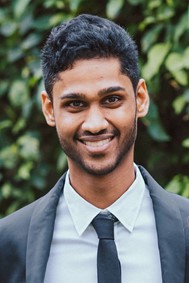
Dr Craig Ramlal
Dr Ramlal is the Leader of the Control Systems Group, Postgraduate Coordinator of the Department Electrical and Computer Engineering, The UWI, St Augustine. He was appointed to the 38-member United Nations High-Level Multistakeholder Advisory Body on Artificial Intelligence in October 2023.