The HEU, Centre for Health Economics (HEU) has contributed to regional efforts to address non-communicable diseases (NCDs) in the Caribbean through research, technical support, training, and policy analysis. Its work has included studies on the economic impact and cost of NCDs, support for evaluations related to the Port-of-Spain Declaration on NCDs, and analysis of policy measures such as tobacco and alcohol taxation to support NCD prevention and control.
The HEU has also participated in regional forums and collaborations focused on the economic and public health implications of NCDs, while providing technical support to Ministries of Health and regional agencies in areas related to health financing, health systems strengthening, and evidence-based policymaking.
Featured Research
1. Investment Case on the Prevention and Control of Non-communicable Diseases for various countries in the Caribbean. The components of the Investment Case include:
- Economic Burden of Diseases;
- Costing of Interventions;
- Assessment of the Health Impacts and Economic Benefits of Implementing Interventions;
- Return on Investment; and
- Institutional and Context Analysis.
2. Future Health Spending in Latin America and the Caribbean
- The HEU, Centre for Health Economics together with Professor Alafia Samuels estimated national health spending by ICD classification for Trinidad and Tobago, which was then used as one of the model countries to estimate health spending by ICD classification for other countries in Latin America and the Caribbean.


3. Improving Household Nutrition Security and Public Health in the CARICOM
- This International Development Research Centre (IDRC)-funded project, implemented in collaboration with regional and international research partners, examined the nutritional adequacy of diets among children and adults across different gender, age, socio-economic, and geographic groups. Surveys conducted in St. Kitts and Nevis, St. Vincent and the Grenadines, and Jamaica explored the factors influencing food consumption patterns. The findings contributed to the evidence base for public policy and public health decision-making aimed at addressing risk factors associated with non-communicable diseases (NCDs).

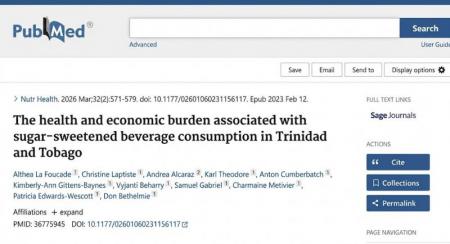
4. Empowering Healthcare Decision Makers to Achieve Regional Needs in Sugar-Sweetened Beverage [SSB] Policies in Latin America and the Caribbean: Building a Framework to Evaluate the Disease Burden and the Cost-Effectiveness of available Interventions; and Estimating the Disease Burden in Four Countries.
- The overall objective of this project is to empower decision makers to implement policies to reduce SSB consumption through the provision of an evidence base for decision-making. The study seeks to (i) map interventions associated with SSB; (ii) provide information on the burden of disease potentially attributable to SSBs (both the health and economic impact) and (iii) estimate the potential impact and cost-effectiveness of different strategies for the control of the SSB consumption, which are being implemented or considered in the region.