14
UWI TODAY
– SUNDAY 3RD JULY, 2016
COMMUNITY SERVICE
Recent reports show that
Trinidad and Tobago
generates approximately 14.4 kilogrammes of
trash per capita per day – the highest in the world.
Similar reports were refuted by the Solid Waste
Management Company Limited (SWMCOL) in
2015 and today, despite not collecting complete
statistics, the physical evidence is most glaring.
The fact that we have left the cleaning to
be shouldered by others in society and future
generations results in mosquito and other pest
reproduction as well as problems with drainage and
soil degradation, for example. Further downstream
the nation suffers fromflooding, pollutedwaterways
and beaches. Waste, in this scenario, is harmful
to the marine eco-system and tourism prospects
leading to a loss of income for fishing communities
and renders the fishery unsustainable.
In perhaps the first public effort since the
report, a group from a co-curricular course
at the UWI which exposes students to service
learning and community engagement, “Workplace
Protocol for Students,” teamed up with the Diego
Martin Regional Corporation, Councillor for
Chaguaramas/Point Cumana Enroy Slater, National
4-HClub, Tableland Pineapple Farmers Association,
fisherfolk and residents to clean St Peter’s Bay in
Carenage of solid waste.
Speaking on behalf of the group, Karen
Siewnarine felt that communities need to take
responsibility for their space and waste. “While
it is important to understand that pollution has a
negative effect on wildlife, communities and the
economy, initiatives like ours can empower people
to help keep our beaches clean and preserve the
environment. We hope that this effort will continue
along the coastline in the Carenage area.”
Minister of Agriculture, Land and Fisheries
ClarenceRambharat also supported andparticipated
in the clean-up effort.
“The clean-up highlighted the critical need
for the country to develop a modern approach to
waste management, particularly reducing, reusing,
and recycling. Plastic bottles and other single-use
containers continue to dominate the trash on our
beaches and in our garbage. We must act,” he said.
Which to teach first
– how to use YouTube or send an
email? For many, both can be done without guidance, if not
altogether at the same time, so a student volunteer could
not hide the feeling of incredulity that neither is the place
to start the class.
The coursewas anAdult Computer Literacy programme
by ClickToStart a not-for-profit organization, coordinated
by a member of The UWI’s Campus IT Services (CITS)
which literally, started with teaching how to click a mouse.
There is a segment of the Trinidad and Tobago society
that is lagging way behind on accessing the benefits of ICT
because their knowledge on the how-to-do has not been
supplied in tandem with developments. The ClickToStart
programme aims to shrink that knowledge gap.
With its intake this July being its fourth cycle, the
programme has already graduated around 70 people of
all ages and walks of life back into personal lives and jobs
where they are more connected, cyber-confident and cyber
safe too.
The vision is simple: to empower people through
technology. The team giving their expertise and time
towards this vision are all volunteers.
Keeping a group this size coordinated for regular work
assignments must be challenging, one located in extra-
curricular, possibly doubly so. So what keeps them pressing
into a fourth year while seeking to expand?
This was the question to coordinator, Abigail Wren
and technical consultant, Vishwanath Samsundar, who
agreed that seeing the ripple effect of helping people is a
satisfying feeling. Between the verbal feedback they get from
programme alumni and the student course evaluations, the
15-week programme has enabled men and women to help
their children and grandchildren with internet-based tasks,
CREATINGA
CULTUREOF
CLEAN
A cross-section of some of the volunteers including
Minister Rambharat, Senator Ali and Councillor Slater
PHOTOS: OMARDATH MAHARAJ
be cyber-safe, become more productive in their work or
NGOs based activities.
Samsundar repaired a transparent PC donated by Roger
Mc Farlane, president of The UWI branch of OWTU, as
part of the ClickToStart instruction package, illustrating
the internals of how computers work. (Samsundar is also
well known on campus for teaching staff how to maximize
the features on smart phones).
The once per week class teaches use of productivity
tools such as those in the Microsoft suite, how to send
emails, browse the internet, social media navigation, and
yes, they do get around to YouTube.
There are tutorials where volunteers are ready to help
and there are take-away assignments, as well as quizzes
created in the LMS (Learning Management System), which
are sometimes Moodle-based for reinforcement. These
count toward confirming the skills of the participant and a
completion certificate.
Another major accomplishment of ClickToStart is
that is has softened the community perceptions about the
functionality and reach of The UWI. Many students come
from communities through the St. George (East) District
Office of the Ministry of Community Development, Village
Councils, community groups as well as NGOs – age is not
a filter for sign up. As students come to the well-equipped
computer labs on campus, that are rent-free to the
programme, through the kind offices of DCIT and CITS,
the environment and interaction build relationships and
promote synergies.
It fits with the University’s efforts to reach out and better
serve communities. So in one click, ClickToStart has become
a model of a win-win-win (staff-community-institution)
programme at The UWI.
CONNECTED
and
CYBER-CONFIDENT
B Y R E B E C C A R O B I N S O N
Rebecca Robinson is a writer and editor.
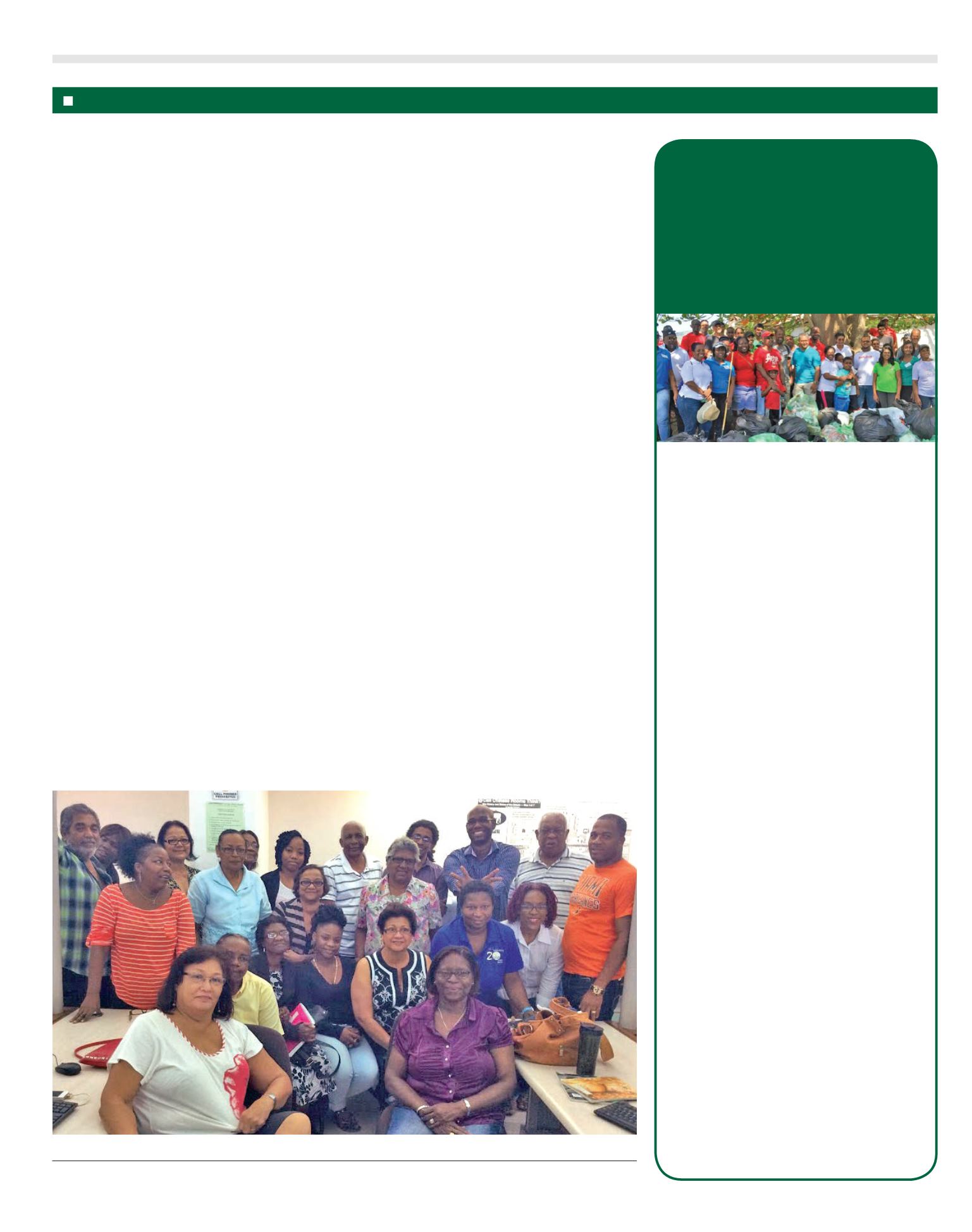
The 2014 group in one of the labs made available by DCIT.


