22
UWI TODAY
– SUNDAY 3RD JULY, 2016
BOOK REVIEW
Professor Ramesh Deosaran’s
latest book focuses on the
inequality and inequity of Trinidad and Tobago’s education
system and its correlation to crime. Looking at the country’s
past, present and future, he examines how ethnicity, social
class, gender, family background, place of residence and
type of school attended affects the equality of educational
opportunities. The book traces the background of the
country’s education system, investigating the changes arising
out of political independence in 1962 and the prospects
of education as the great hope for decolonisation, where
meritocracy would lead the nation into industrialisation.
Deosaran unmasks the reality faced by the present
education system and how inequality and inequity plagues
the dual system of education in Trinidad and Tobago:
denominational vs government school. Assigning prestige
to one school over another, he wrote, causes a large number
of students to feel less significant and under-educated. He
believes technical-vocational schools need to be brought
to the same level as grammar schools as they provide
mainstream learning for students and are very important
to the development of the country.
Deosaran closes off by identifying the impact of the
pressures and strain of inequality experienced in the
education system, which he says causes students to be
involved in criminal activities. However, not all uneducated
persons commit crime, as there are other factors that
contribute to criminal behaviours. Interestingly absent are
the issues surrounding persons who commit corporate
crime.
F r om h i s i mme n s e r e s e a r c h De o s a r a n’s
recommendations for changes in Trinidad and Tobago are
concentrated on policy changes and reformation of the
current system of education. The topics covered reach far
beyond the struggles of the education system, including
issues of race, social class and place of residence, which have
arisen in the areas of employment and general socialisation.
All in all, it is an important work in the area of education
and contributes significantly to the understanding of its
correlation with crime.
On June 1, a panel discussion was held at The UWI to
look at how this work could go forward. Mediated by retired
educator, Dr. Lennox Bernard, the discussion covered a
number of issues. Former Senator, Dr. Eastlyn McKenzie,
an educator herself, pointed out that the book reads as a
book on Trinidad, exclusive of Tobago, as she identified
differences of the Tobago experiences in relation to its
Fo l l ow i n g t h e
s u c c e s s
o f t h e
Wo r l d Fe s t i v a l
o f E m e r g i n g
Cinema’s (WOFEC)
inaugural edition,
hosted byThe UWI
Film Programme
(May 19-22), the
festival will tour
Tr i n i d a d a n d
Tobago and the
Caribbean through
2 0 1 7 . WOF E C
audiences were treated to a notably diverse
festival lineup, selected from approximately
700 submissions from 76 countries, showcasing
some of the best animation, documentary and
narrative works by emerging international
filmmakers.
Around 200 films made the final cut,
including features from Albania, Colombia,
France, Guinea-Bissau, India, Italy, Mexico,
Netherlands, Peru, and Spain, along with
specially invited films from Trinidad and
Tobago and the Caribbean. The first edition of
the Festival, which was non-competitive, did
afford recognition to films, based on audience
impact and engagement. Great emphasis was
placed on active youth engagement, in the
hope that this translates to a love for film and
a deeper understanding of themselves through
this medium. Thus the festival featured specific
blocks for secondary level students, and the
organizers sought meaningful interaction with
the participating students.
Dr. Heather Cateau, Dean of Humanities
and Education, recognized the festival and film
as necessary to the St. Augustine Campus and
Faculty being a “global force”. She added that we
must put the perspectives of artistes front and
centre, as they are integral to the opening of new
frontiers in a time when we are met with many
economic challenges.
Festival director and coordinator of the
UWI Film Programme, Yao Ramesar said,
“One takeaway of the festival was how strong
and diverse audiences felt the lineup of films
was. This speaks volumes about the quality
and quantity of films being produced around
the world and provides us with a window to
the global marketplace that we have to operate
in. The festival on tour is an embodiment of
the festival and its image “Caribbean Man #
2” by Stanley Greaves, which depicts a mobile
Caribbean vendor.”
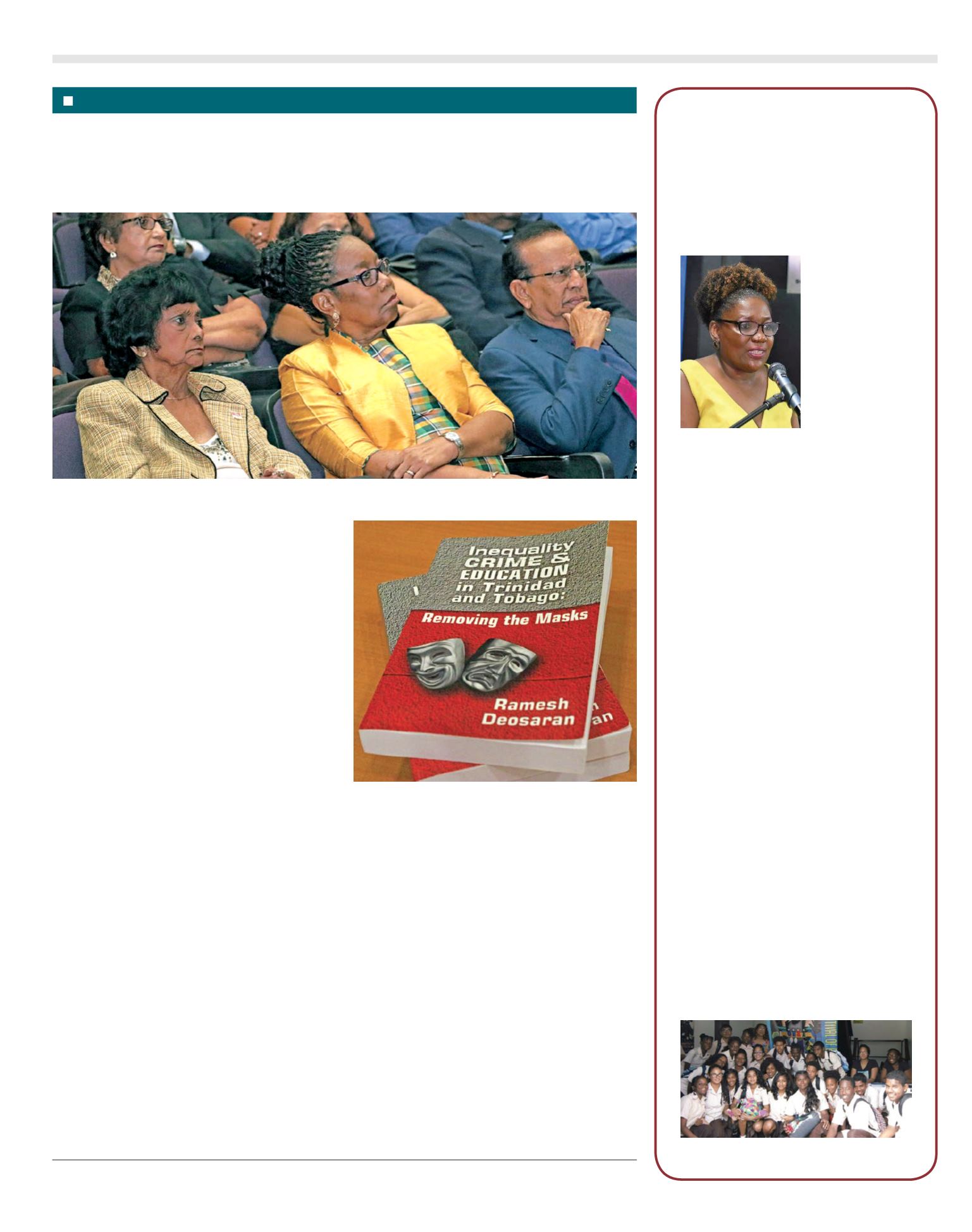
In the audience at the panel discussion, from left: Ms. Anna Mahase, Mrs. Hazel Manning and Professor Ramesh Deosaran.
Students of St. Joseph’s College at WOFEC.
PHOTO: COURTESY FILM PROGRAMME
Deosaran’sUnmasking of Education
B Y L I E S E L N O R V I L L E
history, population diversity and lack of denominational
schools. Mr. David Sinanan, President of TTUTA, noted
that people are being denied a chance tomake a meaningful
contribution in society because they are being force-fed the
illusions of equality. Senior Lecturer in Behavioural Sciences
at The UWI, Dr. Nasser Mustapha’s main focus was that
government schools are well maintained and managed, but
are under-appreciated by society as places of good quality
schooling. How does a culture get away from itself?This was
the difficult question posed by Dr. Gillian Paul, President
of COSTATT. Dr. Winford James agreed that the book
may not apply to the Tobago experience. He added that the
book gave the impression that if you are ignorant you will
commit crime. But he also felt it provides vital information
on the distinction between denominational and government
schools, noting that there are government schools that are
performing very well but do not receive the recognition
they deserve.
The panelists agreed that there is a need for policy
changes and reform in the education system to be less
exclusive of certain denominations and sectors of the
society. As the audience became very responsive to the
discussion, the main conclusion was that the school is not
the sole educator and families must be engaged for real
change to occur.
Liesel Norville is a student in the MSc Criminology and Criminal Justice programme at The UWI St. Augustine.
EMERGING
CINEMA
hits the road


