SUNDAY 3RD JULY, 2016 – UWI TODAY
17
Agri-Based Projects (2016)
Melangeur for Chocolate Production
Cocoa Bean Winnower
Robotic Arm for Industrial Spraying
Pulveriser for Oyster Shells
Thermal Insulating
properties of Banana Leaves
Automatic Duck Roaster
Coconut Picker
Collector for dried leaves
Manure cake remover
Hand held Fertilizer Applicator
Cassava Harvester
Automated orange peeler
Automated cassava peeler
Coconut water extractor
Bamboo Bed
Agri-Based Projects (2015)
Chataigne Shredder
French Fry cutter for cassava,
sweet potato, plantain
Black Eye sheller
Tomato Grader for size
Pigeon Pea Sheller
Cocoa Pod Splitter
Channa Splitter
Shreedevi Sahadeo made her way
to the podium; perhaps
a bit nervous but handling it well. She was presenting her
final engineering project, one of four standouts for the
academic year along with Yvan Dass, Salisha Khan and
Harold Raghubir. And in the audience before them were
staff and students from the Department of Mechanical and
Manufacturing Engineering, St. Augustine administrators
as high up the chain as Campus Principal Professor
Brian Copeland and guests from sectors as varied as
manufacturing, tourism and agriculture.
In her project she outlined how she had researched
the deficiencies in local greenhouse agriculture, designed
and made a model of a much more efficient greenhouse. It
was the kind of research that in the right hands, with the
right funding could contribute to the revitalisation of food
production, in a time when food security is a great concern.
In fact, all the projects – from an automated orange
peeler that smoothly removed the skins of four fruits at
once, to research on measuring the integrity of roofs for
solar panels, to a company specific plan for optimising
warehouses for one of Trinidad’s major food processing
companies – could potentially form the basis for viable
products or processes that could create value for Caribbean
economies.
But most impressive of all, just outside in the Undercroft
of the Kenneth S. Julien Building of the Engineering Faculty
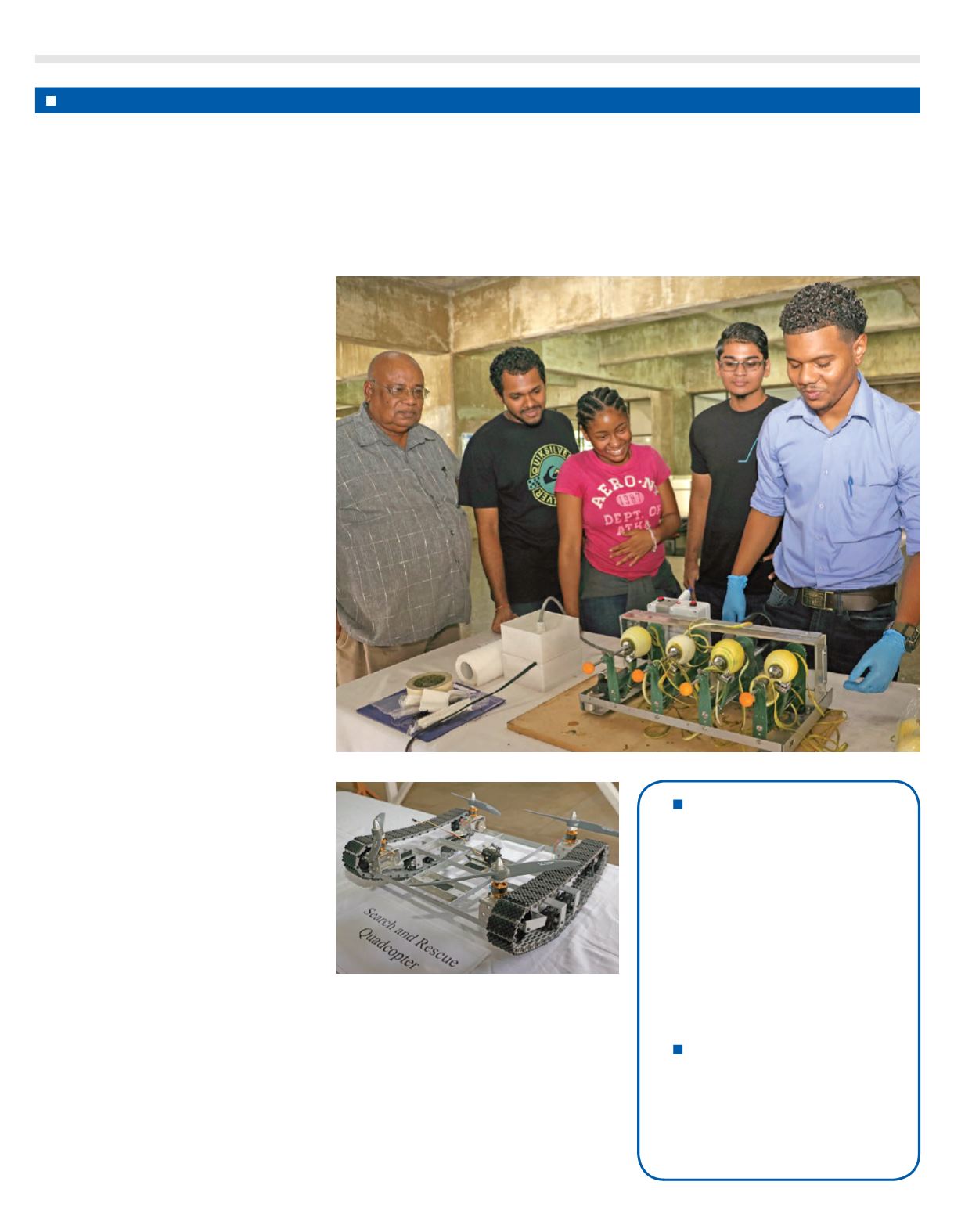
was an entire exhibition of projects, the work of over 120
students. Innovation on display.
“What you are seeing here is a seed that we will make
grow”
Titled “The Final Year Exhibition of Engineering
Students: Design and Build,” the two-day event was created
by key personnel within theMechanical andManufacturing
Department for several reasons. Firstly, it encourages
students with an interest or inclination for innovation by
recognising their work. As it stands there are several cultural
and structural disincentives for anyone with such passions.
Secondly, it brings sectors that could benefit from
research and development together with new ideas and idea
generators. Among the organisations in attendance were
the Trinidad and Tobago Manufacturer’s Association, the
TourismDevelopment Company, the National Agricultural
Marketing and Development Corporation and the
Agricultural Development Bank.
The exhibition also makes a statement about UWI
and its role as an agent of regional development through
research and development that is responsive to the needs
of the Caribbean.
“[Universities] are supposed to be the ones who are
on the cutting edge,” said Professor Copeland. “That’s
what allows for the growth and development of science
and technology. Then we further harness that science and
technology to create products and processes.”
The May 2016 exhibition is the second since the idea
became reality in 2015 but this year the energy seemed
more urgent, perhaps because of the starkness of the region’s
economic fortunes.
“As with any business sector we know that opportunity
is critical and timing is everything, and with the recession
there is opportunity,” said FrankaMcKenzie, Director of the
TTMA. “It is no coincidence that there are so many ‘Made
in T&T’ and ‘Buy Local’ campaigns. It is because there are
more opportunities. We see it right here. We see it with the
products on display.”
Professor Copelandmade similar statements, telling the
audience that fostering innovation was one of his mandates
as Campus Principal.
“We live in an opportune time,” he said.
Projects at the exhibition fell into five categories:
dynamics, automotive, agriculture and agro-processing,
manufacturing and alternative energy, and environmental
and medical. Because food processing in particular is seen
as an especially necessary and viable area for growth, several
related projects were highlighted. These included, among
others, an automated duck roaster, a pulveriser for oyster
shells, a cassava harvester, and even one that demonstrated
the thermal insulating properties of banana plant leaves.
INNOVATION
Exhibit A
Mech Eng unveils its student innovation
B Y J O E L H E N R Y
Both the exhibition organisers and guest speakers
acknowledged that the culture of innovation being fostered
by the exhibition is still in its earliest stages. Mr. Rodney
Harnarine, Development Engineer with theMechanical and
Manufacturing Department and one of the Campus’s most
dedicated advocates for practical research and development,
told those in attendance, “What you are seeing here is a seed
that we will make grow.”
Listening to students such as Yvan, Shreedevi, Salisha
and Harold – inventive young people with their whole
professional lives ahead – the enormous potential is evident.
The aspiration in this new era is that institutions such asThe
UWI, the private sector and regional governments nurture
that potential.
Automated orange peeler
PHOTOS: ANEEL KARIM


