20
UWI TODAY
– SUNDAY 3RD JULY, 2016
Vegetable production in the Caribbean
is yet to achieve self-
sufficiency, despite this region having a conducive environment
for growing a variety of tropical and sub-tropical vegetable crops.
The huge spending on importing food and vegetables may not
be necessary if crop production systems are made more efficient.
In this region, yields and quality of the harvested produce have
been lower than other parts of the developing world because of
the poor productivity, high incidence levels of pests and diseases,
poor cropmanagement practices and drought and erratic climatic
conditions. While the latter factors are purely weather-related,
they in fact contribute to the changing scenario of disease and
pest status in the Caribbean.
One common practice that is contributing to poor quality
of vegetables in the region is the indiscriminate use of pesticides
such as insecticides, fungicides and weedicides. This results in
high levels of chemical residues which also present a serious
health risk to the consuming public. The problem is becoming
grave in the eastern and southern Caribbean, which has been
moving on a “pesticide treadmill,” relying on large quantities
of pesticides for crop production. It is often speculated that
the high pesticide usage might be a contributing factor for
increased occurrence of cancer and other malignant disorders
among the Caribbean population. The effect of pesticide residual
contamination on human health is muchworse in vegetables than
in other food crops, because obviously vegetables are consumed
either raw or semi-cooked.
The region is beset with problems that affect crop protection,
including the lack of awareness on integrated systems of disease
management. There is also inadequate knowledge on pests
and diseases that often lead to misdiagnosis and improper
management practices. It is common for farmers to use incorrect
chemical pesticides or too high dosages. Chemicals are often
applied at greater frequencies than necessary and sometimes with
incompatible mixtures are used. There is often monotonous use
of pesticides with similar active ingredients which influence the
development of resistance of pathogens to the chemical agents.
The research group at UWI, St. Augustine led by Professor
Jayaraj Jayaraman and Dr. Adesh Ramsubhag is studying the
disease trends of vegetables in Trinidad and Tobago and in the
Southern Caribbean and conducting research on developing
field-level integrated disease management systems for vegetable
crops. Extensive field surveys revealed the above mentioned
pitfalls and problems. More than 50% of the farmers were using
pesticides at weekly intervals and some even twice a week, while
the standard recommendation is generally every twoweeks, based
on need only. This excessive pesticide use results in a cyclical
problem, with greater incidence levels of diseases and pests often
occurring, despite application of chemical pesticides. This is due
to development of resistance among the pests and pathogens. To
cite a few examples, the UWI group has isolated several strains
of bacterial and fungal pathogens that are resistant to commonly
used copper fungicides and even to other commonly used
systemic fungicides (Fig 1). The excessive usage of insecticides
including synthetic pyrithroids have resulted in widespread
resurgence of many sucking insect pests. One such striking
example is increased prevalence of whiteflies and whitefly-
borne virus diseases in vegetable crops which were neither
reported in Trinidad nor in the Caribbean earlier. For instance
we have observed the increased prevalence of yellow leaf curl in
tomato (Fig 2) all over Caribbean in recent times. This virus is
spreading to other crops including cow pea (bodi) as white fly
population proliferates. We observed new pathogens such as
the zucchini mosaic virus that is severely affecting pumpkins
and other cucurbits in Trinidad. Considering these scenarios,
there are imminent risks of development of new epidemics in
the Caribbean region through emergence of new pathogens and
pests in the very near future.
Any attempt to improve vegetable production would need
to address the primary issues of management of crop pests and
diseases, including reducing the indiscriminate use of pesticides
by employing multiple approaches in a well-integrated and
harmonious manner. This relates to the concepts of integrated
pest management (IPM), integrated disease management (IDM)
and integrated crop management (ICM) systems. IDM/IPM
approaches are balanced, environmental sensitive and sustainable
approaches that rely on a combination of common sense practices
applied on a timely fashion to control the incidence of diseases
and pests to levels below the tolerable limits. The approaches
employed include cultural, biological, biotechnological and
chemical approaches which are environmentally compatible,
economically feasible and socially acceptable, and effect the least
possible hazards to people, ecosystem and the environment.
Prof. Jayaraman’s team is working on a research project
funded by the African, Caribbean, Pacific-European Union
(ACP-EU) to develop IDM systems for model vegetable crops
including tomato, cowpea and pumpkin. Under this Project,
protocols were optimized for early diagnosis of pathogens and
diseases employing contemporary molecular based tools. Several
IDM packages were developed and tested in farmers’ fields that
were proven to be successful in controlling diseases of the above
vegetable crops. By implementing such methods, it is expected
that the amount of chemical usage can be cut down to at least 50%
which effects a big saving on the cost of production and above all
minimizes the risk of residual toxicity, environmental pollution
and health hazards which are otherwise caused by over use of
chemicals. Farmers are welcome to interact with the DLS-UWI
group to gain further knowledge on IDM methods.
The Department of Life Sciences, UWI-St. Augustine
recently hosted an International Conference on Integrated
Disease Management of Tropical Vegetables (June 16th and
17th, 2016.
)
which was widely attended by farmers and stakeholders from
the Caribbean region.
FOOD AND ENVIRONMENT
TooManyChemicals in theCrops
Caribbean on a pesticide treadmill
Contacts: Professor Jayaraj Jayaraman
) • Dr. Adesh Ramsubhag (
(Fig 1) Resistant Xanthomonas campestris pv campestris (bacterial
blight pathogen affecting cruciferous vegetables) strain growing in
copper fungicide medium.
(Fig 2) Yellow leaf curl virus disease of tomatoes occurring recently
in serious proportions in the Caribbean.
(Fig 2b) White fly insect vector transmitting Yellow leaf curl virus.
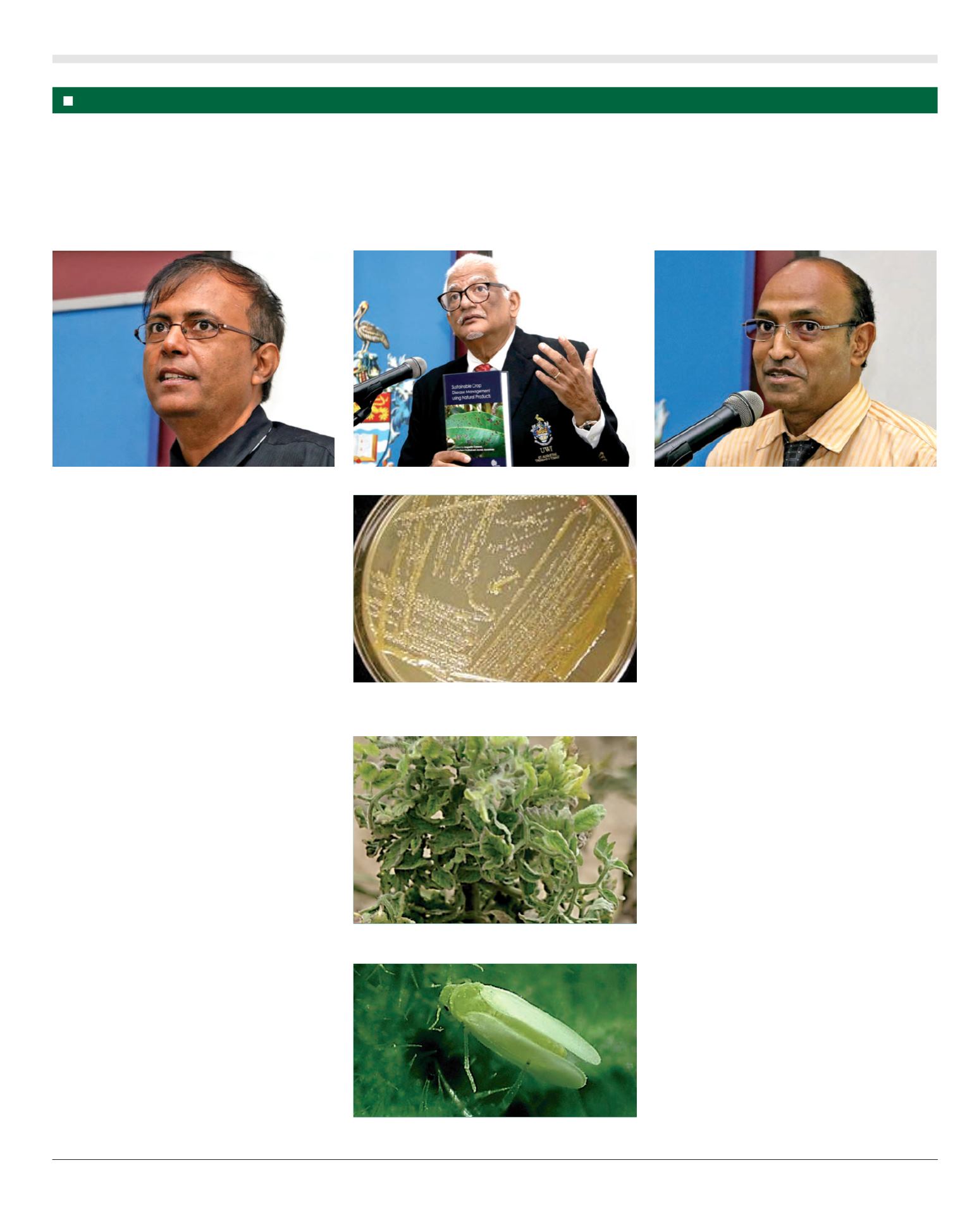
Dr. Adesh
Ramsubhag
Professor Clement Sankat
talks about the book,
Sustainable Crop Disease
Management using
Natural Products.
Professor Jayaraj
Jayaraman
PHOTOS: ANEEL KARIM


