SUNDAY 3RD JULY, 2016 – UWI TODAY
19
CAMPUS NEWS
No t i on s o f human
worth
and dignity have
a long history. They are
socially contextualized,
evolving concepts which
are being negotiated daily.
That these concepts are
embraced so passionately
within diverse cultures
and multiple generations,
tells us something about
the nature of the human.
Within all facets of our
social order – from the
state authorities who dispense national awards, to the gang
members whowould kill over a “dissing” – concepts of worth
and honour assume extreme significance.
In western world views, dignity has been associated
with conferring autonomy. To treat persons and nations with
dignity then is to treat them as autonomous and capable
of choosing their own destinies. In eastern world views,
the honour of the collectivity, takes precedence over the
autonomy of the individual. Each focus has implications for
how we live as individuals and as a community.
Societies have derived their sense of human worth and
dignity from value of the individual within primary social
institutions: the family, the community, workplace, the
place of worship and the nation. And yet, arguably human
life and personhood are interdependent; the value of the
human extends beyond the sum of her parts. Moreover
human worth transcends the confines of a fit and vigorous
body, the prowess of a beautiful mind, and the yearnings of
an adventurous soul.
Within each individual, there are facets and synergies
which go beyond the sum of individual parts and bring
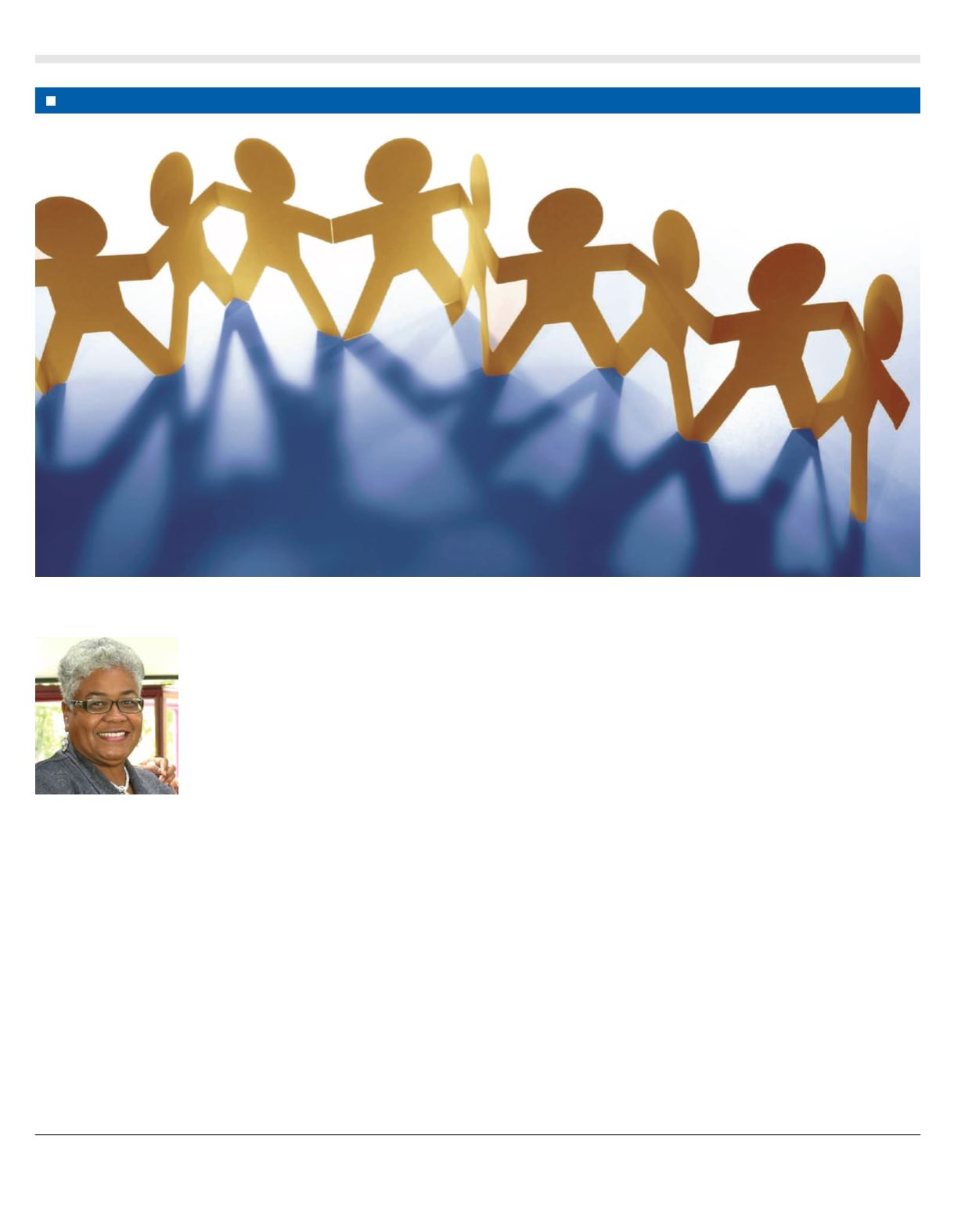
HUMAN
Worth andDignity
Professor Paula Morgan is Head of the Institute for Gender and Development Studies at UWI St. Augustine.
his is from her presentation at the International Conference on Social Work Education and Social Development:
“Promoting Human Worth and Dignity: Social Work and Social Development in Trinidad,” on March 16, 2016.
value added. And this increases exponentially when we
bind ourselves into collectivities – families, communities
and organizations, researchers and activists working for
a cause. Together, we magnify our capacities, are fortified
by our complementarities, and even our shortcomings and
weaknesses. Together we are stronger, accomplish more;
travel further. We therefore owe each other the duty of care
encapsulated in the saying: “until all have crossed none have
crossed and some we have to carry.”
Synergies between the individual and group enhance
the worth and dignity of all. Consider the commonly
accepted notion that a group or a nation can be bounded
together by such commonality, that all member share
common value and honour. Simple country lads evolve
from throwing coconut branch spears on the beach or
playing with homemade crickets bats into Olympic athletes.
In the process they enhance collective worth and opens
potentialities and pathways to every other boy whose
immediate resources do not extendmuch beyond articles of
everyday use – bits of scrap wood, fallen coconut branches
and discarded oil drums.
I reap the benefit.
My heart swells with pride when I listen to steel pan
on the street in Korea and when I introduce myself as a
Trinidadian to a stranger in Holland, who responds with
a twinkle in the eye: “You come from Brian Lara country.”
My worth has been boosted by connection to world class
sports men and musicians whom I have never met and
whose skills and accomplishments I can never match. Trust
me on this one.
Similarly as a member of the family, community or
nation, I stand to be devalued based on the dishonorable
actions of one. The bottom line is we share a collective
responsibility for the worth and dignity of all.
Dynamic notions of human worth and dignity play
themselves out in a multiplicity of ways. The Institute
for Gender and Development Studies (IGDS) recently
collaborated with the Food and Agriculture Organization
and UN Women to mount a regional workshop to develop
a programme of work and to build public policy for rural
women in agriculture in the Caribbean. The dignity and
value of these farmers shone as they testified of challenges,
adversities and hard won victories.They spoke with pride of
incredibly long working hours, training their children from
infancy to grapple with the land and wrestle a yield from it.
Their sacrifice and diligence were inspirational.Their dignity
and worth to their nations is unparalleled.
Consider a different scenario. Why do women weep
violently when they lose their children who have become
both perpetrators and victims of violent crime? It is because
within the most antisocial and destructive of humans there
exists inherent worth and the potential for beauty and order
and redemption. Why do families deeplymourn the passing
of physically and mentally disabled relatives? The value of
the human transcends physical and mental capacity, just
as it transcends seasons of social usefulness. The IGDS is
currently engaged in a study of work life balance and the
ageing. The research team is impressed continually with the
preciousness of each person struggling to retain dignity in
the face of compelling work and care demands, ageing and
failing mental and bodily functions.
One can conclude then that human worth and dignity
in their diverse meanings and manifestations are pivotal to
life itself. They bring value to troubled existence and lend a
meaning to toil and adversity. They confer significance on
our accomplishments and victories and then some more.
The centrality of human dignity and worth ultimately
speaks to a straining towards eternality, a conviction of
significance beyond this life, with its extremes of adversity
and brutishness, joy and accomplishment.
Professor Paula Morgan
B Y P A U L A M O R G A N


