SUNDAY 3RD JULY, 2016 – UWI TODAY
23
CONFERENCE ON SPORT AND HIGHER EDUCATION
In childhood we are movers by nature.
Children dance
without the need for music. They climb anything they
can find. An open space is an invitation to run. Their
imaginations power them forward – superheroes, martial
arts experts, warrior princesses saving the day in the front
yard. As they get older, most of them will move less and
less. As societies become more complex and less safe, this
phenomenon becomes even more pronounced.
There is a growing body of knowledge that shows we
have underestimated howdetrimental this lack of movement
is to children’s physical andmental health. So says Dr Dean:
“You want every boy and girl to be able to throw, jump,
run, hop, skip and swim. If they can do that we have found
it generates confidence and if they have confidence that
generates motivation. If you are motivated that generates
more participation.”
“If you participate in life in ameaningful way you thrive.
You also have better mental and physical fitness. Physical
literacy is cognitive and physical at the same time,” he says.
The International Physical Literacy Association defines
physical literacy as, “the motivation, confidence, physical
competence, knowledge and understanding to value and
take responsibility for engagement in physical activities
for life.”
Professor DeanKriellaars, or Dr Dean as he has become
known through his international work, knows quite a
bit about physical literacy. He is renowned as one of the
architects of the Physical LiteracyMovement. For more than
15 years he has combined his knowledge in neuroscience
and physical therapy with advocacy about the importance
of movement. He works with several organizations such as
the International Sports for Life Society, the Aspen Institute
and even Cirque du Soleil.
“In essence, I’m a physical literacy evangelist,” he says
during our interview at the University Inn just off campus
in St Augustine.
Even while sitting, Dr. Dean is in constant motion.
He leaps to catch every question, absorbs it quickly and
races away with his answers. Compact and middle-aged,
it’s obvious he is a practitioner of physical literacy as well
as a preacher.
Dr Dean, an associate professor in the Department of
Physical Therapy at the University of Manitoba in Canada,
was inTrinidad for the Second Biennial Conference on Sport
and Higher Education held from May 18 to 20 to give the
keynote address. Trinidad and Tobago is only one stop on
a sprint that carries him across the world.
“Last week I was in Calgary, Toronto; thenWashington
DC, Miami and Trinidad. After this I am going back to
Winnipeg, then New Finland, Quebec City and Montreal
before June 3,” he says.
At his stop in Washington DC his presentation on
physical literacy was followed by a speech from Michelle
Obama, First Lady of the United States of America, at the
2016 Project Play Summit. Project Play was a gathering of
over 450 specialists that focused on children and sports.
On his first of what he believes may become many
visits to Trinidad, Dr. Dean says he was very impressed by
the awareness of physical literacy issues at the Sport and
Higher Education Conference hosted by the St. Augustine
Campus at the Learning Resource Centre.
“It way exceeded my expectations,” he said. “The
conference showedme that people knowwhere they want to
go. They understand the problem and are passionate about
it. I’m very excited for the future and the interrelationships
in terms of what we can do.”
“If you participate in life in a meaningful way you thrive. You also have better mental
and physical fitness. Physical literacy is cognitive and physical at the same time.”
His keynote presentation, energetic and informative,
was a highlight of the event. Dr. Dean told a story of societies
– almost all societies – losing the ability tomove.The results
of that loss he measured in rising rates in type 2 diabetes
(afflicting an estimated 30% of the population in the US
and Canada). Children, he told the audience consisting
of representatives from the health, education and physical
education sectors, should “huff and puff” at least 60minutes
a day. Adults should do the same for at least 20minutes a day.
“Learning to move is just as important as learning to
read and write,” he said.
Dr. Dean also stressed the importance of encouraging
girls to continue to take part in physical activity:
“Kids, particularly girls become inhibited by failure and
withdraw. They stop participating. At five, six and seven,
boys and girls play together. By 12 years old that stops.That’s
not because girls aren’t capable. Parents are six times more
likely to caution a girl than a boy on the playground. If you
are not equipping girls at the same level as boys, that is a
crime. But yet every culture does it.”
But Dr. Dean was enthusiastic about the possibility
of change. For much of history, we had no choice but to
move. The average occupation was outdoors, not inside
an office seated at a desk. Today movement is a choice and
the physical literacy evangelist believes that people can be
convinced it is the right choice.
“It’s about spreading the word,” he says. “The game
is finding a community, possibly a country that starts the
domino effect. In Canada, the example was recycling. It
spread. It’s really about showing good examples.”
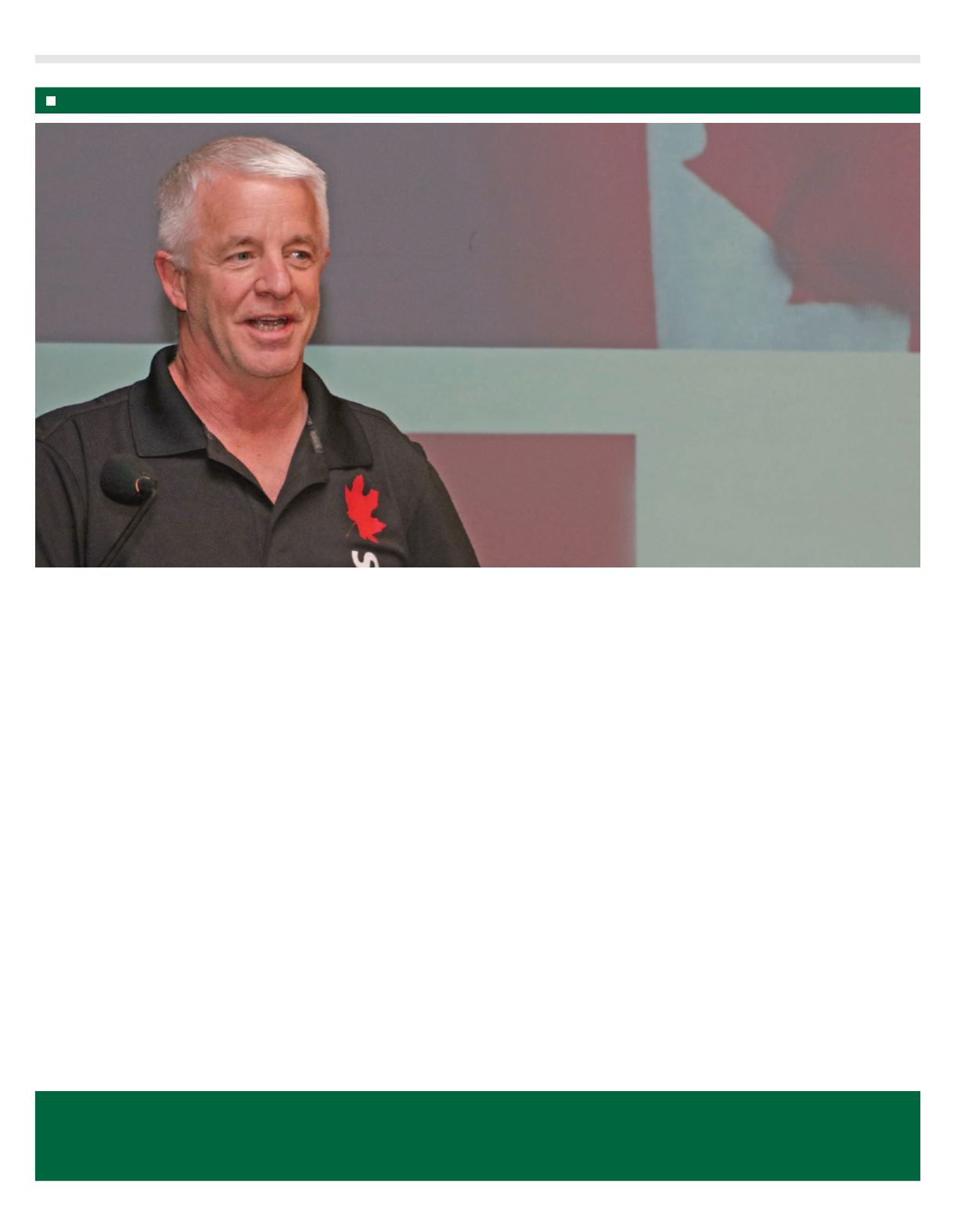
Professor Dean Kriellaars
B Y J O E L H E N R Y
Physical
Literacy
sets the pace


