18
UWI TODAY
– SUNDAY 3RD JULY, 2016
CAMPUS NEWS
For the second year running,
the Alma
Jordan Library has captured the OCLCAward
for Innovation given at the annual conference
of the Association of Caribbean University,
Research and Institutional Libraries (ACURIL)
held in Haiti in June.
The awardwas for innovative cooperation
initiatives in the Caribbean and is an annual
one presented by the Online Computer
Library Centre, a non-profit, computer library
service and research organization whose
membership includes over 72,000 libraries,
archives and museums in 170 countries.
The ALJ won for its innovation in the
application of information technology for
the delivery of library services, in this case
the development of a platform to host the
electronic books produced by the University
Press.
“This is indeed cause for celebration,
as it is a testament to the excellent work of
members of Library staff, and the vision of
the Campus Libraries in going forward,” said
Campus Librarian, Frank Soodeen, as he
congratulated staff.
The news of the award is headlined, “A
Leader on Innovation,” and gives details of
the AJL’s holdings and services and its new
initiatives. Congratulations to AJL!
For more on the OCLC Award,
please visit
-
oclc-award-on-innovation?ref=email
It’s not an obvious connection;
that’s why these kinds of
information are unearthed by research. In this case, some
dental research discussed at a lecture series hosted by The
UWI School of Dentistry in May offered some interesting
historical connections among sugar, money and rotted teeth.
“For instance, the rotted teeth of characters in ‘Pirates
of the Caribbean’ would be most likely to occur in wealthy
people who could afford sugar and not in poorer people
as portrayed. The common practice of wealthy people
buying or taking healthy teeth from poorer people for
transplantation into their own mouths continued until the
mid-1800s when it was realised that other diseases were
transplanted as well,” says Professor MontgomeryMcAulay-
Rieger, the Dentistry School’s Director.
Professor McAulay-Rieger was adding to information
provided by Professor Michael Anthony Pogrel, who spoke
on “Stents” and how it was originally the name of a dental
impression material, and of Dr. Charles Stent, the man
whose surname now covers many different medical devices.
Prof. Pogrel, Head of the Department of Oral and
Maxillofacial Surgery at the University of California San
Francisco, also provided data to show that dental caries was
negligible worldwide until the introduction of sugarcane
agribusiness in Jamaica by the British. He summarized his
talk for UWI TODAY.
“The basic story is that from the early years from
the 19th century, it was necessary to be able to do dental
impressions in order to make reasonably well-fitting false
teeth. The reason for this is that dental decay and gum
disease had arrived in Europe. It had been known previously
but was actually very rare. The reason it became almost
epidemic from the late 1700s is coupled to the arrival of
sugar.
“Sugar cane is native to Southeast Asia. It was probably
brought back to Europe and theMiddle East byMarco Polo,
and sugar was certainly known to the Crusaders in the 11th
and 12th centuries, but was really unobtainable in Western
Europe. Most sweetening was done by the use of honey
which was both rare and relatively expensive. Therefore,
most foodstuffs were unsweetened. The big change came
when Britain captured Jamaica from the Spanish in 1665
and managed to grow sugar quite successfully.
“Attempts had beenmade to introduce sugarcane to the
NewWorld prior to this. The Portuguese had tried to grow
it in Brazil but not terribly successfully, and the Dutch had
also tried. It is probably from these people that the British
obtained their first sugarcane to plant in Jamaica. The
sugarcane actually thrived in Jamaica and later began to be
exported back to Britain. As you may know, the growing
and harvesting of sugarcane is very labour intensive,
and indirectly, this led to the introduction of slavery in
the Caribbean. By 1770, the cost of sugar in Britain had
plummeted and everybody could buy as much of it as they
wanted. This directly fueled the upsurge in dental caries
in Britain and the rest of Europe, and the loss of teeth
necessitating dental impressions with Dr. Stent’s impression
material and the manufacture of false teeth.
“The main problem was actually making realistic-
looking false teeth, and attempts were made to carve them
from walrus tusks and even from wood. The situation was
saved by the Battle of Waterloo where 51,000 relatively fit
and healthy people died in a relatively small area of Belgium.
The teeth were collected from the dead bodies and shipped
back to Britain in barrels to be used for false teeth that were
actually called Waterloo Teeth. They did look realistic, but
unfortunately, were as prone to decay as the original teeth.
By about 1820 (the Battle of Waterloo was in 1815), the
supply of Waterloo Teeth was exhausted, and that is when
Claudia Ash came up with the first porcelain teeth.”
This was just one of the fascinating topics covered at
the External Examiners Lecture Series hosted by the School
of Dentistry.
Prof. Alan Gilmour, Associate Dean of Undergraduate
Studies (BDS) Cardiff University, presented “The Dental
Graduate: Independent Practitioner or Safe Beginner.” Dr.
David Felix, Postgraduate Dental Dean, NHS Education
for Scotland, presented “Prescribing Update.” Prof. David
Bearn, Professor of Orthodontics and Associate Dean
for Learning and Teaching, University of Dundee Dental
School, presented “Interceptive Orthodontics – An
Evidence-based Update.”
Privilege and
RottenTeeth
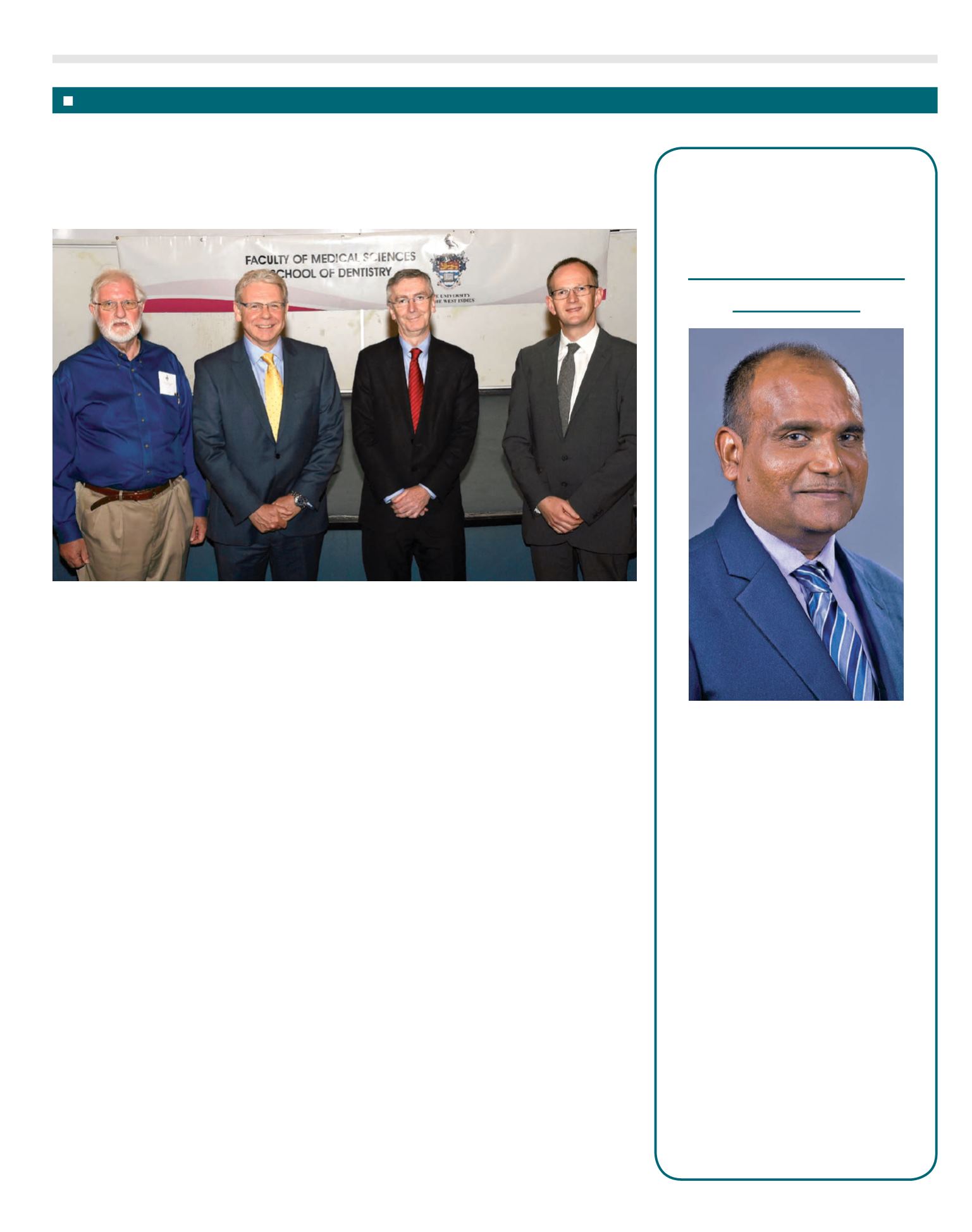
From left, the four external examiners who spoke: Prof. Michael Anthony Pogrel, Prof. Alan Gilmour, Dr. David Felix, and Prof. David Bearn.
Alma Jordan
LibraryWins
INNOVATION
AWARD
Frank Soodeen
Campus Librarian


