SUNDAY 13TH MARCH, 2016 – UWI TODAY
15
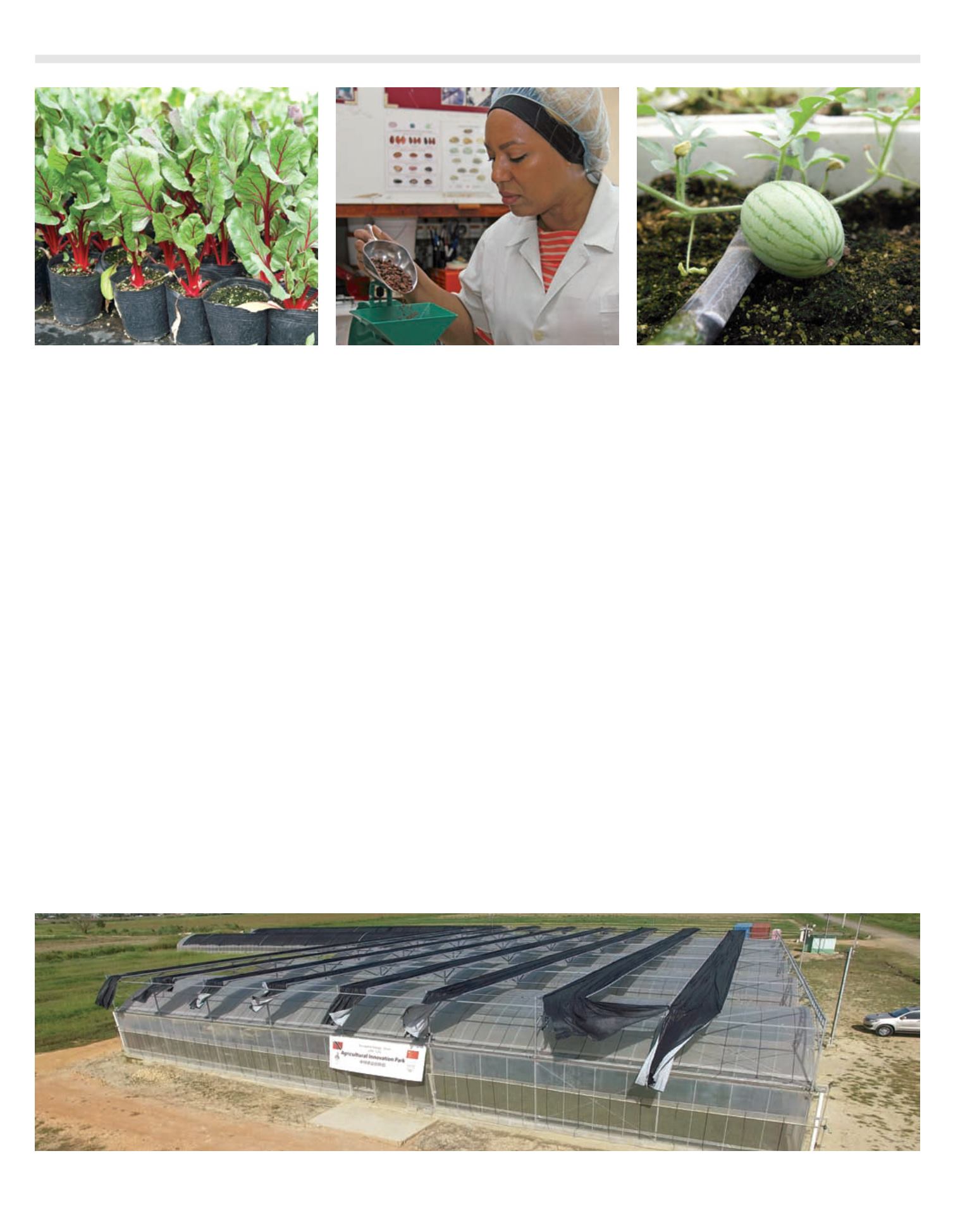
Swiss Chard from the greenhouse.
PHOTO: TERRY SAMPSON
An aerial view of the Orange Grove site with The UWI’s greenhouses.
PHOTO: TERRY SAMPSON
He had noted in this draft policy that “Agriculture
contributes just 0.5% of our GDP, while our food import
bill is now $4 billion,” a situation he considered untenable.
(Elsewhere in this issue, Gerard Best reports that half of
CARICOM countries import more than 80% of their food.)
And from his contribution to the House of Representatives
on October 20, 2015, he believes it is time to get cracking.
“I have said across the Ministry, I believe everything
that has to be researched in agriculture, fisheries, food
production, has already been researched.There are very few
things for us to research. I believe that every conference that
has to be attended to, Trinidad and abroad, has been gone
to. I believe that every publication that is to be published
and produced has been produced, and it is time for us to
get down to the business of putting farmers and fisherfolk
in front of this country.”
He has taken personal responsibility for two areas he
considers priority in the first year: oversight for spending
and governance. And he has found them to be both
complex and challenging and fraught with obstacles. A
Ministry like his, with many sub divisions (like the ADB,
NAMDEVCO, Seafood Industry Development Co. Fisheries
Division, aquaculture: the IMA, the Cocoa Development
Company of Trinidad and Tobago Ltd, to name a few), was
full of duplications in myriad ways. The structures had to
be recalibrated, he thought, and he needed to identify the
areas that needed to be centralized.
“The first priority was moving out of Port of Spain,” he
said, and the Ministry should occupy its new headquarters
in Chaguanas by April. He’s had a lot of issues to manage,
one of which was the recent appointment of the Cocoa
Development Company’s Board.
“Beginning all over again, we have a new Board, to be
funded by Government. We have lands, using CEPEP,” he
said, as he talks about the Government’s plan to “rebuild
and rehabilitate” the cocoa industry.
“We should be aiming to be up in the high end
production of gourmet beans.”
Professor PathmanathanUmaharan, head of the Cocoa
Research Centre (CRC) at The UWI, gave an idea of what
the basic beans can fetch.
“The price varies depending on whether it is bulk cocoa
or fine flavor cocoa. The bulk cocoa sells around US$2500
per ton. Fine flavor itself has varied prices. Trinidad cocoa
sells between US$5000 to US$7000 per ton because of its
reputation. Specialty branded cocoa is known to sell as high
as US$12,000 per ton or more, but this is small volumes,”
he says.
This is where the Minister wants to see things going.
“For the cocoa industry to take off, we need to bring
confidence to the sector, through the Cocoa Board [CDC],”
he said. “Rehabilitate, replant, change some of the practices,
and bring the beans together; they have to be aggregated. I
think it will happen in cocoa.
Dr. Darin Sukha, a research fellowand food technologist
at the CRC, had been a member of the Board of the CDC
when it replaced the Cocoa and Coffee Industry Board in
2014. He no longer sits on that Board, but in a sense, the CRC
is represented as the chair of its Cocoa Research Advisory
Committee, Winston Rudder, has been named to chair the
CDC. He believes cocoa’s time has come.
“A confluence of factors within recent years
has contributed to cocoa emerging as a prospect for
consideration. A key has been the leadership provided by
CRC in taking responsibility to examine and document
issues along the entire cocoa value chain from farm/bean
to consumer/chocolate bar; to coordinate with other
institutions/organizations: the Ministry of Agriculture,
farmers, exporter, cocoa growing communities/leaders,
chocolatiers local and foreign, in addressing issues
impacting the different stakeholders. As a result, cocoa is
poised to be a significant earner of foreign exchange not
only through production and export of high quality beans
but high quality chocolate. A key incentive too is the trend
in international cocoa prices: they have been consistently
high and rising!” he said.
Obviously, any conversation about the development of
cocoa in this country has to include the CRC. The under-
resourced CRC located at the St. Augustine Campus is a
colossal name globally for its research and training and
its cocoa pedigree as custodian of the International Cocoa
Genebank.
The CRC has been hosting several regular workshops
for farmers, for chocolatiers, for cocoa research over the
years, and just hosted a labour consultation to compile the
concerns of farmers and workers in the sector. A group of
54 members of cocoa estates and farmers had been formed
to look at moving germplasm around the estates as a
conservation method and they are facing labour shortages.
At the consultation, three models were to be presented
for discussion and possible adaptation for different sized
estates – one was a CEPEP model. The recommendations
from this were to be sent to the CDC and then to the
Ministry. Sukha talks about these elements of the work
of the CRC as critical aspects of nurturing an industry
which can be rehabilitated as the Minister says. Talking
about the chocolate making workshop he was facilitating
the following day, he says, “You cannot teach how to make
chocolate if you don’t know how. We have trained over
100 people in chocolate making. It’s a responsibility, if you
want to promote development of the sector. You’re talking
value-addition.”
T&T won at the International Cocoa Awards last year.
“Two of our samples won and five made it to the top fifty,”
says Sukha proudly. “We have some beans left over from
that and we decided to make some chocolates and have a
farmers’ appreciation day.”
This is essentially an extension of what the Dean of the
Faculty of Food and Agriculture meant when he said that
the university’s role is to provide scientific and technological
support to the region.
That’s how you are adding value. That’s how you are
building a sustainable economy.
A participant at a chocolate making workshop.
PHOTO: ANEEL KARIM
Single-serving miniature watermelon.
PHOTO: TERRY SAMPSON


