SUNDAY 13TH MARCH, 2016 – UWI TODAY
21
ENVIRONMENT
From 1498 to now,
85 to 106 tsunamis were
reported the Caribbean. The most devastating was
the 1946 tsunami in the Dominican Republic which
resulted in the loss of 1800 lives. The 2010 Haiti
earthquake resulted in a tsunami which caused at
least three fatalities. Trinidad and Tobago experienced
tsunamis/‘tsunami-like’ events in 1795, 1825, 1831,
1991 and 1997.
Is it likely that T&T will be subject to a future
tsunami? It is likely andmay be caused by the eruption
of Kick ’em Jenny (an underwater volcano located off
Grenada) or earthquakes. Such a scenario ought to
generate concern as a significant percentage of T&T’s
1.3 million inhabitants live in low-lying coastal areas
around both islands; many locals and tourists visit
the country’s beaches for recreation, and coastal
infrastructure exists on both islands.
In T&T, the three organisations which are involved
in tsunami awareness and preparedness are the
Seismic Research Unit (SRC), the Office of Disaster
Preparedness and Management (ODPM), and the
Tobago Environmental Management Agency (TEMA).
Although local agencies have conducted work
regarding tsunami awareness and preparedness, this
does not automatically imply that as a country we
are prepared to deal with such an event. In order to
provide some quantitative information regarding this
issue, a knowledge, attitude and practice (KAP) survey
(Kanhai et al. 2016) was used to gather information
from locals in communities deemed vulnerable to
potential tsunamis (those located on land less than
10 metres in height).
Knowledge, attitude and practice (KAP) surveys
are tools which have been used to investigate what
people know, how they feel and what they practice
regarding a specific topic. The findings from such
surveys can be used to evaluate the effectiveness of
existing programmes and inform the implementation
of appropriate interventions regarding a specific issue.
The KAP survey technique was therefore utilised in our
study to assess the knowledge, attitude and practices
of coastal communities in Trinidad and Tobago about
tsunamis.
A total of 350 persons were interviewed using a
targeted questionnaire in seven coastal communities
across Trinidad (Maracas, Grand l’Anse, Mayaro)
and Tobago (Buccoo, Charlotteville, Speyside,
Roxborough).
The main findings of our study were that there was
an overall lack of awareness about tsunamis. Fewer
than 20% of interviewees were fully aware of a basic
definition of a tsunami. Only 57% indicated that it was
possible to foretell a tsunami’s arrival based on signs
in the natural environment. Although interviewees
were aware of tsunamis that had occurred in other
parts of the world, 92% were unaware that tsunamis
had occurred in the Caribbean in the past. There was
also an overall lack of preparedness by the interviewees
as the majority (93%) indicated that their family did
not have an emergency plan for a tsunami. Despite
the fact that local agencies had previously conducted
tsunami awareness activities, 80% of all interviewees
indicated that public education programmes had never
been conducted in their community. Furthermore, at
least 46% of interviewees indicated that there was no/
little likelihood that a tsunami would hit Trinidad and
Tobago within the next ten years. If a tsunami were
to hit the country, 57% of interviewees indicated that
God would be the entity that wouldmost likely prevent
the loss of life.
In the Caribbean, the arrival time for a tsunami
caused by local or regional sources is predicted to be
short: less than 30 minutes to an hour. It is therefore
critically important that locals (especially those living
in vulnerable communities) possess basic tsunami
awareness that will enable them to take appropriate
action (initiate self evacuation and move to higher
ground) if a tsunami is coming.
The findings of our study indicate that in spite
of the work by local authorities in T&T in relation to
tsunami awareness and preparedness, it is apparent
that there is still much to be done.
In order to build awareness and preparedness
amongst the local population regarding
tsunamis, some measures that may be taken are:
development of a national plan of
action regarding this natural hazard,
inclusion of the topic of tsunamis on
the primary and secondary school
syllabi,
delivery of tsunami awareness
presentations to all primary/
secondary schools and key
stakeholders located in coastal
communities,
installation of warning systems in all
vulnerable coastal communities, and
use of the media to raise tsunami
awareness amongst locals.
Tsunami
Awareness
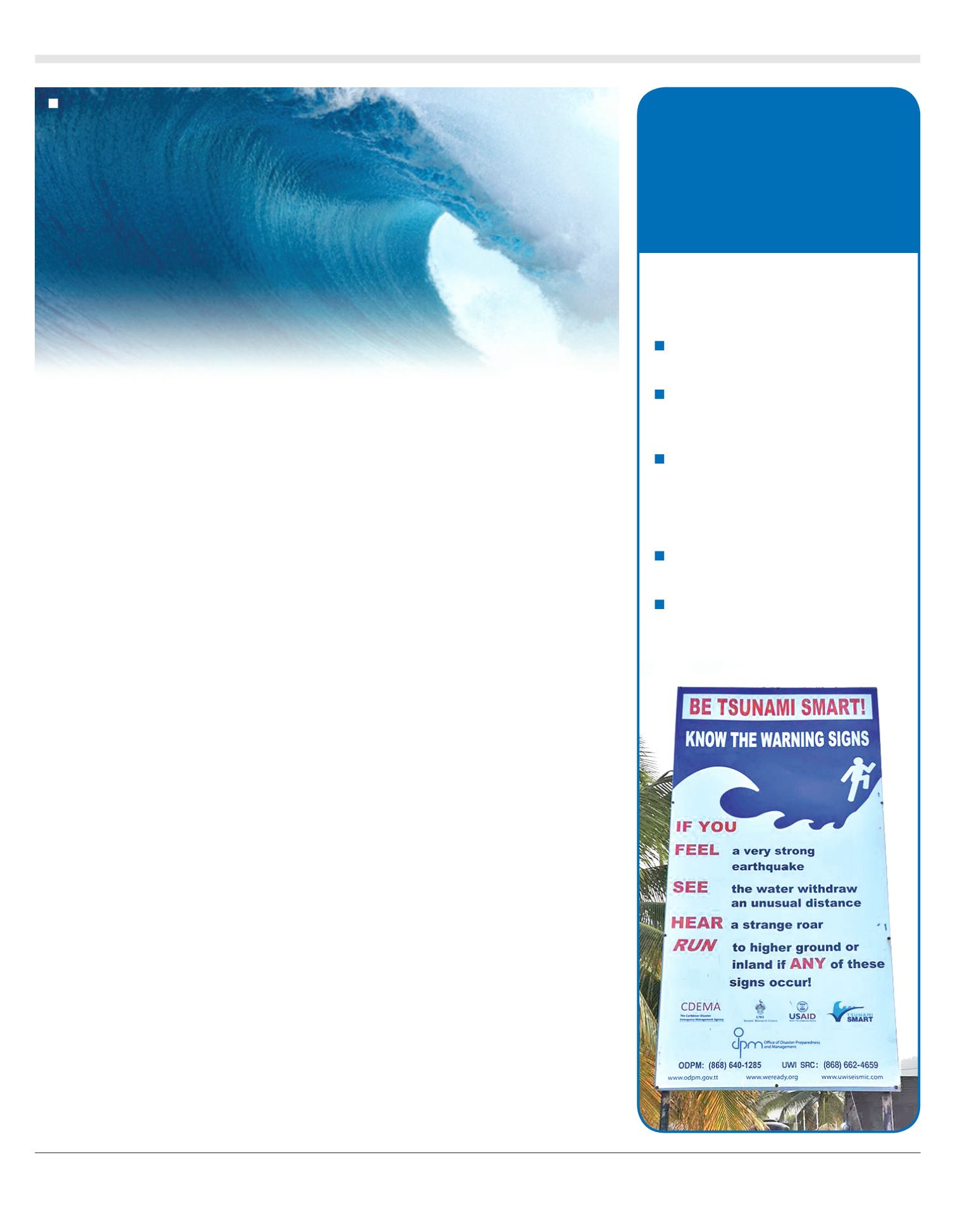
One of the ‘Be Tsunami Smart’ signs posted at
Maracas Bay, Trinidad.
PHOTO: DR. TRUDY KAWAL
For more information on the study that was conducted, interested persons may refer to: Kanhai, La Daana K., Delezia Singh, Bruce Lauckner, Kristie L. Ebi, and Dave D. Chadee. 2016.
“Knowledge, attitude and practices of coastal communities in Trinidad and Tobago about tsunamis.” Natural Hazards 81 (2):1349-1372. doi: 10.1007/s11069-015-2138-3.
B Y L A D A A N A K A D A K A N H A I A N D D A V E D . C H A D E E
Region at
RISK
Kick ’em Jenny can kick up a tsunami


