SUNDAY 13TH MARCH, 2016 – UWI TODAY
19
NATIONAL CONSULTATION ON EDUCATION
The UWI School of Education (SOE)
made a significant
contribution to the three-day National Consultation on
Education (NCE). Our experts’ advice ranged from best
assessment and health and family life practices to early
childhood interventions to curb school violence. SOE staff
also addressed meeting students’ special needs through a
comprehensive, national inclusive education programme. To
lend further support to this Ministry of Education initiative,
staff and graduate students also served as moderators and
rapporteurs for panels at the three venues.
At the first consultation, Dr. Jerome De Lisle shared his
expertise in public examinations and large scale assessments.
He cautioned Trinidad and Tobago against benchmarking
and borrowing assessment policy from countries, which are
high performing in international assessment. He advised
that the focus should be on formative assessment (to
monitor student learning and provide ongoing feedback
to improve teaching and student learning). This is done in
Hong Kong and Singapore. Finland also focuses on this type
of teacher-led assessment from the early grades. Reforms
in the US also include such a focus and consider the use
of challenging performance assessment for performance
understanding among students.
He lamented that this focus is missing in both teacher
preparation and system emphasis in Trinidad and Tobago.
High stakes summative assessments (like SEA and CSEC
which evaluate student learning at the end of an instructional
unit) continue to be important for benchmarking and
providing the full picture of learning nationally. Dr. De
Lisle warned that we must be cautious of trying to use one
assessment to (1) select and certify; (2) promote and support
learning; and (3) monitor student learning standards.
Implementing these kinds of assessments in the classroom
require significant improvements in teacher preparation
and professional learning. He also recommended a review
of policies which promote measurement-driven instruction
(as contained in current SEA/CAC practice).
At the Inclusive Education forum, Dr. Elna Carrington-
Blaides reported on a recent UWI study which indicated
SYSTEMMUST CATER FOR SPECIAL NEEDS
B Y S A B E E R A H A B D U L - M A J I E D
As an early childhood specialist, I noted that school
violence usually starts as challenging behaviours in pre-
schools and early primary classes. Some of our gifted
students may be among those displaying behavioural
problems because school is boring. Left unattended the
problems escalate. In the absence of interventions for
addressing challenging behaviours, young children can
become bullies or “troublemakers.” It is critical therefore to
make behavioural interventions before children reach age 6.
Thereafter interventions are still possible but more complex
and costly. While the home situation is often the root cause,
reasons for “acting out” behaviours are varied and can be
exacerbatedwhen schools are not equipped to assist students
with social and emotional problems.We therefore need
research to understand the scale of the problem. We also
need to introduce policy, teacher professional development
and developmentally appropriate intervention models to
assist young students with challenging behaviours.
All stakeholders, including families, should be included
to identify and solve problems.
In relation to health and family life issues Dr. Bernice
Dyer-Regis, Dr. Madgerie Jameson-Charles and MPhil
student Chinyere Onuoha, stated that 60% of all deaths in
Trinidad and Tobago are caused by health behaviour and
lifestyles established early in life. The Trinidad and Tobago
Global School Health Survey (2011), found that 26.2% of
students were overweight. Further, only 29.2% of students
were physically active for a total of at least 60 minutes
per day on five or more days over a seven-day period.
Statistics also revealed smoking, alcohol and drug abuse
problems among students. The good news is that schools
can promote good health among students through health
and family curriculumand everyday practices.TheMinistry
of Education has already produced policy and curricula
for Health and Family Life Education. They need to fully
implement curricula at the primary and secondary levels;
improve teacher training; and re-visit the School Health
Policy to facilitate the development of health promoting
schools.
“The output of our education system
should facilitate the building of a more
competitive, sustainable, caring and safer
society. From such a perspective, we can
then take some key issues like learning
outcomes, performance rates, behaviour
in our schools, access, quality and funding
of education and especially at the tertiary
level, the training of our teachers for all
sectors, relevant and efficient curricula, and
especially the role of science and technology,
engineering and mathematics as important
ingredients for supporting a technologically
driven society; the role of technical and
vocational education to meet the manpower
needs of business and industry, business
innovation and entrepreneurship and
infusing the humanities and education to
build more understanding, caring societies
are also important,”
Professor Clement Sankat
Sabeerah Abdul-Majied lectures in Early Childhood Education at the School of Education, UWI St. Augustine.
that approximately 37% of the students have some type
of emotional behavioural disorder; far greater than the
projected 15% to 25%. She also lamented the lack of
legislation and a framework to guide the delivery of
inclusive services for students with special needs. Her
recommendations included field research to accurately
identify the prevalence of various disabilities; teacher
training to focus on differentiated instruction to assist all
teachers to modify curriculum and instruction to meet the
needs of diverse students; and developing a framework for
identifying and matching students with special needs to
required services.
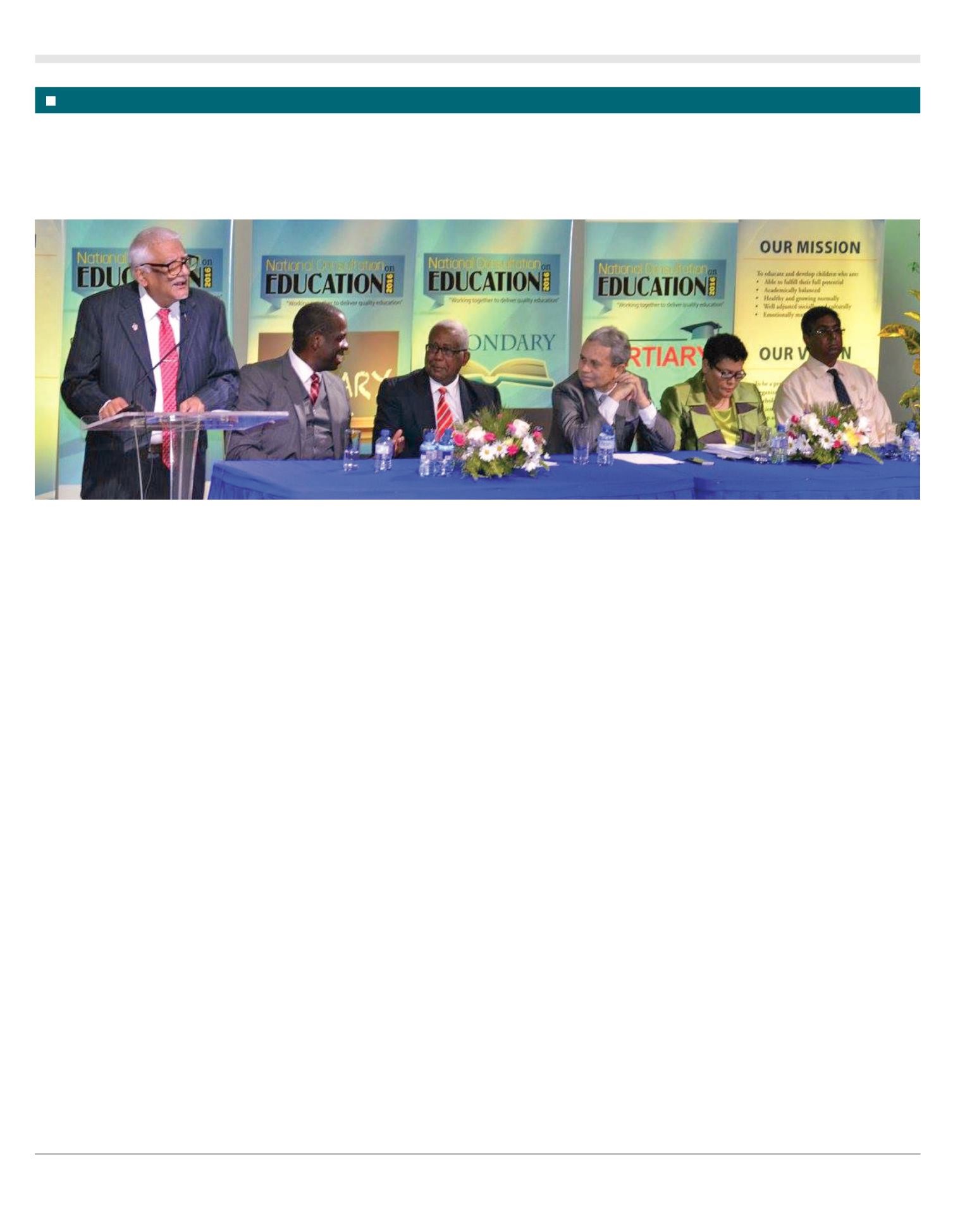
PVC and Campus Principal, Professor Clement Sankat at the opening of the National Consultation on Education on February 15, at the Teaching and Learning Complex at St. Augustine. At the head table from left are
Dr. Lovell Francis, Minister of State in the Ministry of Education, Anthony Garcia, Minister of Education, Colm Imbert, Minister of Finance, Zena Ramatali, President of the National Parent Teacher Association and
Devanand Sinanan, President of TTUTA.
PHOTO: ANEEL KARIM


