SUNDAY 13TH MARCH, 2016 – UWI TODAY
23
TheMasterclass,
WebOptimisation for International Trade,
was a learning opportunity like no other. Offered by the
Centre for Language Learning (CLL), the Masterclass was
part of Language and Competitiveness, an RDI-funded
project conceptualised and led by Dr Beverly-Anne Carter,
Director of the CLL at The UWI St. Augustine.
The Masterclass was practical and thought-provoking,
with a resource manual, exercises, and checklists. Led by
Sarah Carroll of Grow Global, the Masterclass covered
topics such as:
• The International Web Opportunity
• How the International Web Works
• Visibility on the International Web
• Options for an International Digital Strategy
• Building and Optimising an International Website
This is an era that affords businesses opportunities
aplenty. Information is accessible to potentially everyone,
regardless of the GDP of a country. The International
Web has become a virtual continent, the eighth continent,
inhabited by potentially every human being. Citizenship on
the eighth continent means crossing every tangible border,
especially physical and geo-political borders.
Yet there remains one unidirectional border still in
place for speakers of English – the language border. It is
time for speakers of English to cross that border.
Other world citizens have long dispensed with the
hurdles of language communication by investing in and
prioritising the teaching and learning of English. But it
has not usually been a two-way street. Speakers of English
often remain complacent and confident in the false idea that
English speakers have the edge, because everyone else seems
to speak English. This actually puts others at an advantage,
and puts English speakers at clear disadvantage.
One of the hallmarks of an international website is
basic and multilingual Search Engine Optimisation (SEO).
As it stands, 70% of online search enquiries are not in
English. International communication requires multilingual
and intercultural thinking. The benefits of being able to
communicate with overseas colleagues, students, clients,
suppliers and buyers are enormous, as are the reverse – the
costs of lacking that ability and facility. Sometimes, there
may be only one chance to impress.
Participants were told “Don’t just focus on one country
and one language. Adapt your website and optimise it for
international trade. Get it right in English first. Make it
good for home-based users first, but reach out – go beyond
English.”
Apart from multilingual content, optimisation also
includes structuring each website for mobile devices, home
page design, navigation, and creating calls to action.
Of the seven billion citizens of the planet, well over
three billion are internet users, close to half the world, and
the number is growing daily. Of these, one in four people
CAMPUS NEWS
(with statutory recognition), one of which is English. The
USA, in third position with 281 million users (87% of its
population), has 216 living languages, three of which are
institutional (English is only a de facto national language
in the USA, not a de jure one). Nigeria, in seventh position
with 93million users (51%of the population), has 520 living
languages, of which 20 are institutional, including English.
Given the status of English as an international lingua
franca, and its presence on every continent, it is not
surprising that English is still the top language of internet
users, with 852million users, but Chinese (Mandarin) is not
far behind, with 705 million internet users from China and
other countries. Although only 50% of China’s population
currently uses the internet, the number of Chinese users
is almost 2.5 times that of the USA. When the number of
Chinese users rises to almost 90% of their population, there
will be five times the number of Chinese users vs American.
This has huge international implications for language use,
and that includes us in the Caribbean and the rest of the
Americas.
The main UWI websites are considered to be in
relatively good shape, and there are many good websites
across the English-official Caribbean. (Interestingly, Bevil
Wooding, of T&T, is one of seven gatekeepers of the
internet.) However, what nearly all these websites are lacking
is the multilingual, international approach.
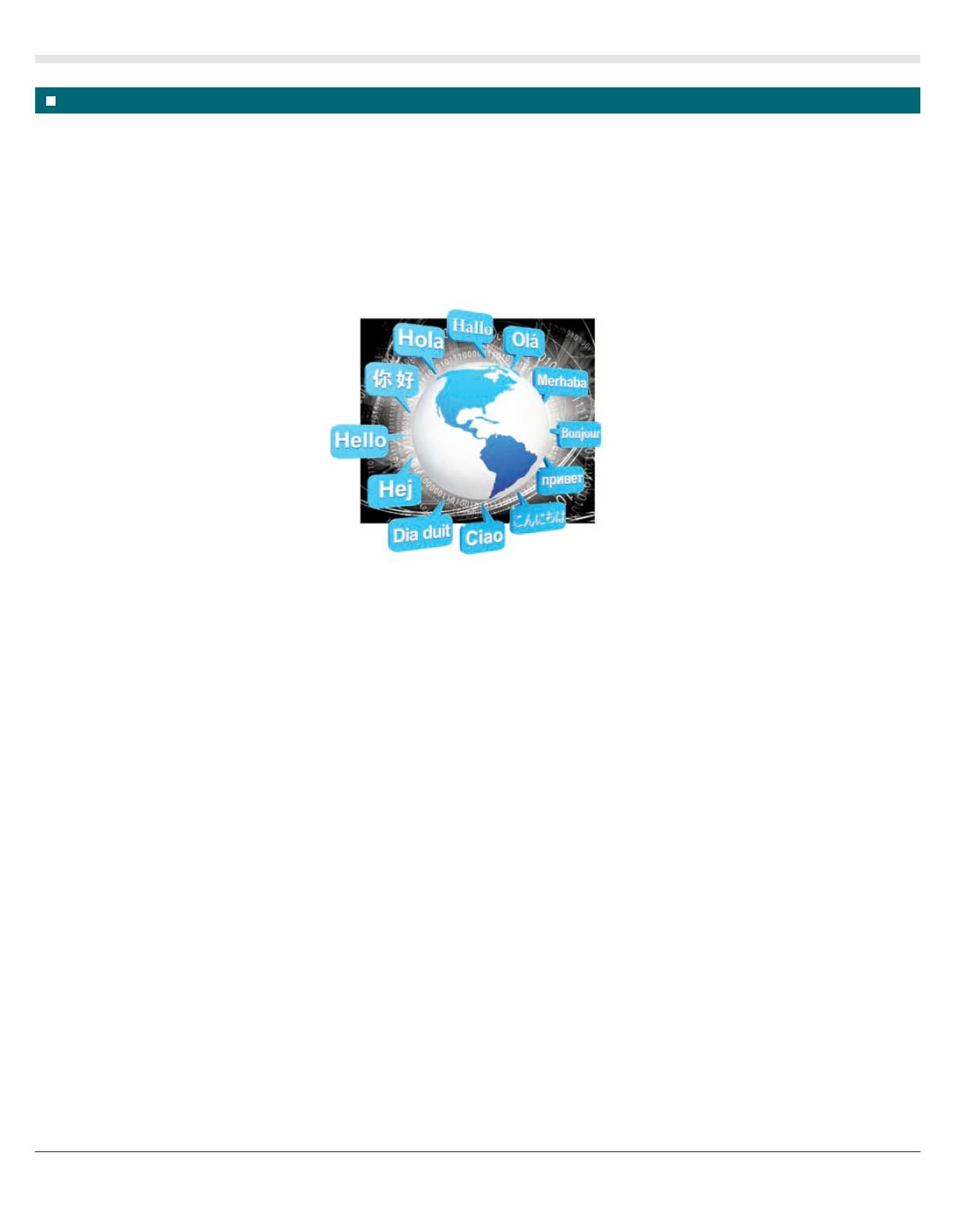
The Caribbean has at least 70 known languages, only
six of which have official status, namely, Dutch, English,
French, Haitian, Papiamentu and Spanish. Four of these are
international European languages used onmost continents.
These six official languages are a start, and Mandarin
Chinese is next. Searches in these languages (and possibly
related languages) can pick up sites with content in these
languages. As one concrete example, school-leavers from
Aruba, Bonaire and Curaçao (the ABC islands) speak four
languages a matter of course – Papiamentu, Dutch, English
and Spanish.They customarily chooseHolland (which offers
degrees in English) and the USA. Why not UWI?
Historically, Trinidad & Tobago has been the Babel of
the Caribbean, with a few heritage languages still surviving
(Spanish, Patois (French Creole), Hindustani (Bhojpuri),
Cantonese and Arabic among them), and a number of
immigrant languages on our shores, and right at The UWI,
St. Augustine campus. Interestingly, google.tt can be
searched in five languages. Everything is in place for not just
a bilingual, but a multilingual T&T. The choice of internet
language will depend on the choice of market.
In these days of STEAM, not STEM (Science,
Technology, Engineering, Arts and Mathematics), the
Language and Competitiveness project could not have
been more timely. Closing off the week was the launch of
the website of the project Language and Competitiveness.
Language competence offers the chance to grow in cultural
sensitivity and respect, shows interest, builds trust, and
provides the platform for effective communication.
Jo-Anne Ferreira is Senior Lecturer in Linguistics in the Department of Modern Languages & Linguistics, a sister department of the CLL, in the Faculty of Humanities and Education.
Life on the EighthContinent
English, the top language of internet users, is giving way to Mandarin Chinese
B Y J O - A N N E F E R R E I R A
“Of the seven billion citizens
of the planet, well over three
billion are internet users,
close to half the world, and
the number is growing daily.
Of these, one in four people
now use social networks.
Almost 50% of internet users
are in Asia, with China and
India sharing one billion
and 28 million users. From
China alone, come 674
million users (50% of China’s
population), and 354 million
come from India (28% of
India’s population).”
now use social networks. Almost 50% of internet users are
in Asia, with China and India sharing one billion and 28
million users. From China alone, come 674 million users
(50% of China’s population), and 354 million come from
India (28% of India’s population).
The top 10 countries by number of internet users
include only three countries that use English as an official
or main language, namely, India, the USA and Nigeria.
But all of these three countries are multilingual. India, in
second position with 354 million internet users, has 447
living languages (not dialects) of which 63 are institutional


